
Banaue Rice Terraces, a hand?carved mountain landscape
Published on 08/30/2026 at 10:52 | Editorial responsibility: Rafael Müller, Editor-in-Chief AD HOC NEWS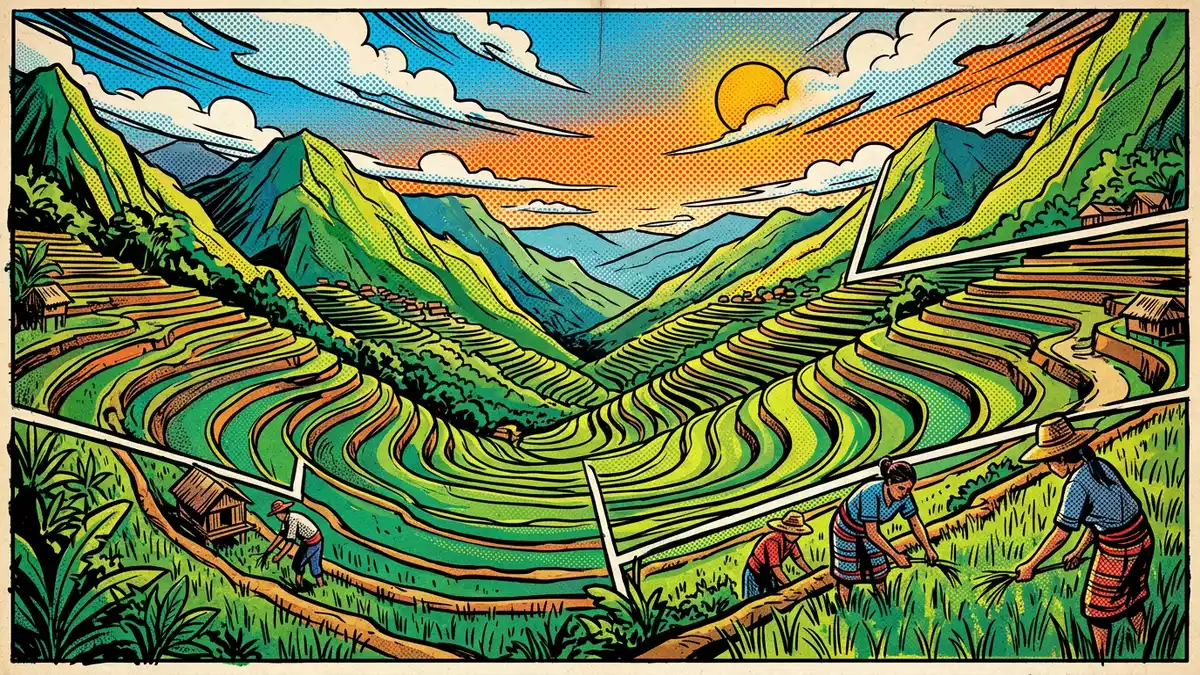
On the mountains above Banaue in the Philippines, the Banaue Rice Terraces form a steep, stepped landscape where human carving and dense green planting share the slopes. Rising across the Cordillera range in north?central Luzon, these terraces are a long?worked agricultural structure shaped by the Ifugao people over many centuries, and they now stand as part of a wider ensemble recognised on the World Heritage List as the Rice Terraces of the Philippine Cordilleras.
A living staircase of fields in the Cordilleras
The Banaue Rice Terraces occupy the mountainsides around Banaue, a municipality in Ifugao province on northern Luzon, where the Cordillera range runs inland from the Philippine coast.mountains of north-central Luzon From the lower valleys the terraces rise in successive bands, creating a stepped profile that traces the contours of the slopes for considerable distances. Each level holds a flooded field, bounded by earthen or stone walls, so that the overall effect from a viewpoint is of horizontal lines drawn across steep terrain.
The terraces around Banaue form part of a wider group of Ifugao rice terraces spread across several municipalities, including Batad, Bangaan, Mayoyao, Hungduan and Kiangan.Rice Terraces of the Philippine Cordilleras In this wider landscape, stone and mud walls define countless small fields that climb towards the ridgelines and connect to irrigation channels that lead in from forested slopes higher up.terraced fields that climb thousands of feet Within that network, the Banaue terraces close to the town centre are among the most accessible clusters, and viewpoints near the poblacion look across a dense pattern of paddies, walls and footpaths.
Ancient engineering in stone, mud and water
The core of the Banaue Rice Terraces is a long?developed system of agricultural engineering in which earth and stone are shaped to hold water on steep hillsides. Generations of Ifugao farmers have built and maintained walls that retain the soil of the paddies and tie them into a network of channels feeding water down from higher forested catchments.retaining walls with stones and mud The paddies themselves are levelled platforms set one above another, and narrow paths trace their edges, forming routes that link hamlets, field huts and resting places.
Various studies and heritage registers date the terraces to at least the first millennium BC, with some sources giving a completion date around 100 BC and others tracing the system back two millennia into pre?colonial history.dating from 100 BC In 1995 the Rice Terraces of the Philippine Cordilleras were inscribed on the UNESCO World Heritage List under identification number 722, recognising them as an evolved, living cultural landscape linked to the Ifugao ethnic group.Year of inscription on the World Heritage List 1995 The Banaue cluster is acknowledged within this framework as part of the national cultural treasure formed by the Ifugao Rice Terraces.
Ifugao culture and the rhythm of terrace farming
The terraces around Banaue are not only a set of fields, but also part of a broader cultural system in which agricultural work, seasonal cycles and ritual practices interlock. Over generations, communities of the Ifugao people have passed down knowledge on shaping walls, managing paddies and tending rice varieties adapted to upland conditions.Ifugao Rice Terraces registry Work on the terraces follows cyclical patterns of planting, weeding and harvest, and communal labour arrangements are tied to social structures in the villages.
The surrounding province of Ifugao centres its identity strongly on these terraced landscapes, which have become principal attractions for travellers as well as continuing fields for rice cultivation.main tourist attractions in the province Within Banaue itself, the terraces frame clusters of houses and local roads, and views from different angles reveal how homesteads, small shrines and footbridges sit amid the stairlike pattern of paddies. The terraces thus form a setting where agricultural work and daily village life share the same carved slopes.
Visiting Banaue Rice Terraces: what travellers from Western Europe should know
- Banaue lies in the interior of northern Luzon in the Philippines, reached overland from lowland towns towards the Cordillera Mountains, with viewpoints near the municipal centre.
- The Banaue Rice Terraces occupy steep hillsides, and many access paths follow narrow tracks along terrace walls with steps and uneven surfaces that demand steady footing.
- The mountains around Banaue rise to substantial elevations, so approaches to higher terrace clusters may involve noticeable altitude and cooler air than in the lowland plains.
- The official language is Filipino alongside other Philippine languages and the currency is the Philippine peso.
- Entry requirements depend on your nationality; UK travellers can check the FCDO travel advice at gov.uk/foreign-travel-advice, Irish travellers the Department of Foreign Affairs at ireland.ie.
Searching for Banaue Rice Terraces on social platforms
These links open searches for Banaue Rice Terraces on each platform.
Frequently asked questions about Banaue Rice Terraces
Where are the Banaue Rice Terraces located?
The Banaue Rice Terraces lie around the municipality of Banaue in Ifugao province on the island of Luzon in the northern Philippines, within the Cordillera mountain range.
What should travellers expect when visiting the terraces?
Travellers encounter steep terraced hillsides with flooded paddies, stone and earth walls and narrow paths, where agricultural work and village life share the carved slopes.
What makes Banaue Rice Terraces distinctive compared with other landscapes?
The Banaue Rice Terraces form part of a long?developed agricultural landscape in which hand?carved stone and mud walls support rice fields on mountainsides, recognised on the UNESCO World Heritage List.


