
Balboa Park turns exposition architecture into a cultural landscape
Published on 09/24/2026 at 12:26 | Editorial responsibility: Rafael Müller, Editor-in-Chief AD HOC NEWS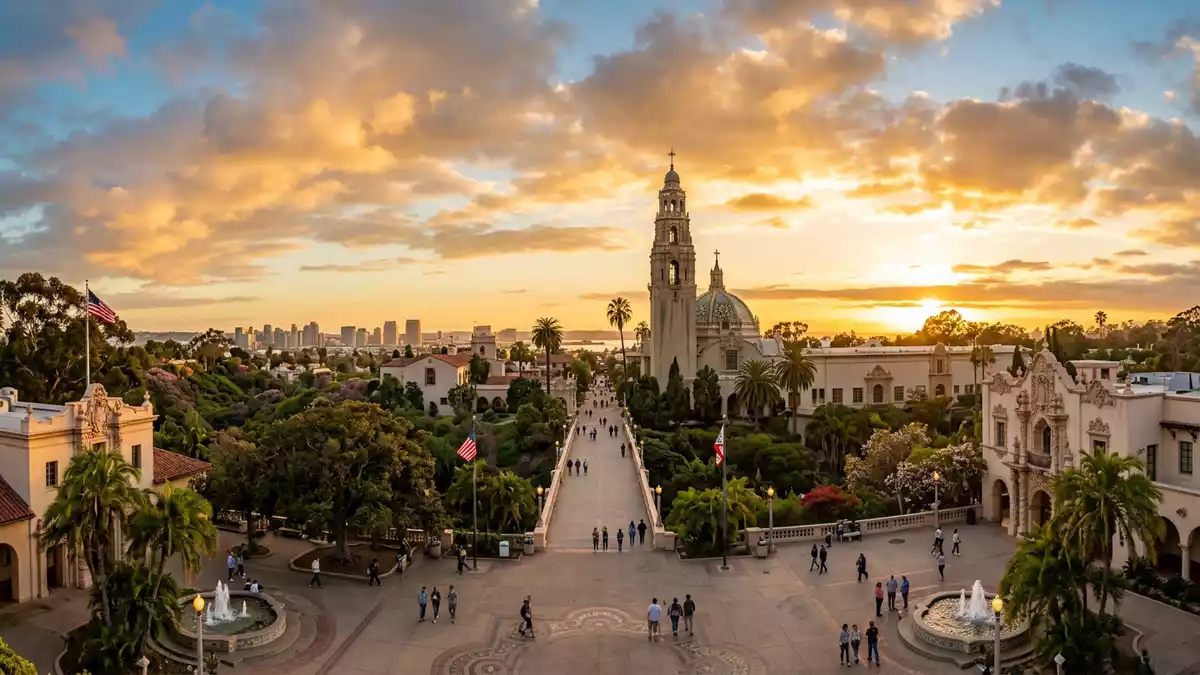
Balboa Park is a cultural landscape where Spanish Colonial Revival buildings, gardens, museums and natural canyons occupy the same San Diego park. El Prado forms its architectural centre, linking exhibition halls, arcades, courtyards and towers created around the Panama–California Exposition of 1915–1916.
El Prado and the architecture of the expositions
The park began as a public reserve in 1868, when San Diego civic leaders set aside 1,400 acres of mesa and arroyos. The land was then known as City Park. Its name became Balboa Park in 1910, honouring Vasco Núñez de Balboa, the Spanish explorer associated with the first recorded European sighting of the Pacific Ocean from the American mainland.
The central architectural ensemble took shape for the Panama–California Exposition. Bertram Goodhue served as exposition architect, with Carleton Winslow among the designers working on the buildings and landscape. Their work established a Spanish Colonial Revival character expressed through stucco walls, tiled roofs, arcades, ornamental façades and towered silhouettes. The House of Hospitality is a surviving landmark of this group, with a façade recalling late seventeenth-century Churrigueresque Spanish Colonial architecture.
El Prado crosses the Central Mesa between the Cabrillo Bridge and Park Boulevard. The promenade passes the California Tower, the House of Hospitality, Casa del Prado and other former exhibition buildings. Museums now occupy many of these structures, including the San Diego Museum of Art, the Museum of Us and the San Diego Natural History Museum.
Gardens, canyons and named spaces
Balboa Park is not confined to its formal architectural core. Palm Canyon, Florida Canyon and other planted or natural spaces interrupt the paved avenues and lawns. Their vegetation includes palms, cycads, ferns, orchids, desert plants and regional species, creating a varied landscape within the wider park.
The Botanical Building and its Lily Pond belong to the 1915 exposition landscape. The building uses a lattice-like structure and contains plant displays associated with tropical and subtropical collections. Nearby, the Alcazar Garden contains Moorish-inspired tiles, fountains and a pergola. Its name refers to the Alcázar gardens in Seville, while the Casa del Rey Moro Garden draws on garden traditions associated with Ronda in Andalusia.
Other named spaces include the Japanese Friendship Garden, the Inez Grant Parker Memorial Rose Garden, the Desert Garden, the Old Cactus Garden, Zoro Garden and the California Native Plant Garden. Each has a distinct planting theme or design language. Together they add horticultural detail to the long architectural axis of El Prado.
Kate Sessions also belongs to the park’s horticultural history. Her planting work in the 1890s introduced trees and shrubs that helped establish the park’s cultivated character. The result is a landscape containing formal gardens, shaded paths, open lawns, planted canyons and exhibition-era buildings.
From public park to National Historic Landmark
The second major exposition, the California Pacific International Exposition, took place in 1935–1936. Its buildings and gardens added another layer to the park, including work associated with San Diego architect Richard Requa. The architectural vocabulary expanded through Spanish, Moorish and regional references, while the earlier El Prado ensemble remained the principal visual focus.
Several institutions use buildings that began as exhibition halls. The park contains museums devoted to art, natural history, science, anthropology, photography, transport and regional history. The San Diego Zoo occupies part of the wider park, while cultural organisations and gardens extend across the Central Mesa and surrounding areas. The City of San Diego describes Balboa Park as covering more than 1,000 acres and containing museums, gardens and cultural associations.Balboa Park’s civic landscape
Balboa Park and its historic exposition buildings received National Historic Landmark and National Historic Landmark District designation in 1977. The park was also placed on the National Register of Historic Places. This status covers an urban cultural landscape whose significance rests on buildings, promenades, gardens and their relationship across the Central Mesa.
The park’s architectural identity is therefore read along a route rather than through a single monument. Cabrillo Bridge introduces the Central Mesa, El Prado gathers the principal façades, and the surrounding gardens and canyons widen the setting. The visible contrast between ornate exhibition architecture and planted or wooded spaces gives Balboa Park its defining form.
Visiting Balboa Park: what travellers from Western Europe should know
- Balboa Park lies north-east of central San Diego, with the Central Mesa reached through Cabrillo Bridge from Sixth Avenue. Metropolitan Transit System buses serve streets near the park, and the San Diego Trolley’s Fifth Avenue station lies near its south-west corner.
- El Prado is a long pedestrian promenade crossing the Central Mesa. The wider park includes canyons, lawns, gardens and paths, so visits between museums and named gardens involve changes in surface and terrain.
- The official language is English and the currency is the United States dollar.
Searching for Balboa Park on social platforms
These links open searches for Balboa Park on each platform.
Frequently asked questions about Balboa Park
Where is Balboa Park?
Balboa Park is in San Diego, California, north-east of the city centre. Its Central Mesa contains El Prado, the main exposition-era architectural ensemble.
What can visitors find there?
The park contains museums, gardens, cultural organisations, the San Diego Zoo, historic buildings, planted canyons and open lawns. El Prado connects many of the principal cultural buildings.
What makes Balboa Park distinctive?
Its Spanish Colonial Revival architecture shares the landscape with named gardens, natural canyons and museums. The ensemble grew from the 1915–1916 and 1935–1936 expositions and received National Historic Landmark recognition in 1977.


