
Balboa Park’s Spanish-inspired cultural landscape in San Diego
Published on 08/21/2026 at 09:15 | Editorial responsibility: Rafael Müller, Editor-in-Chief AD HOC NEWS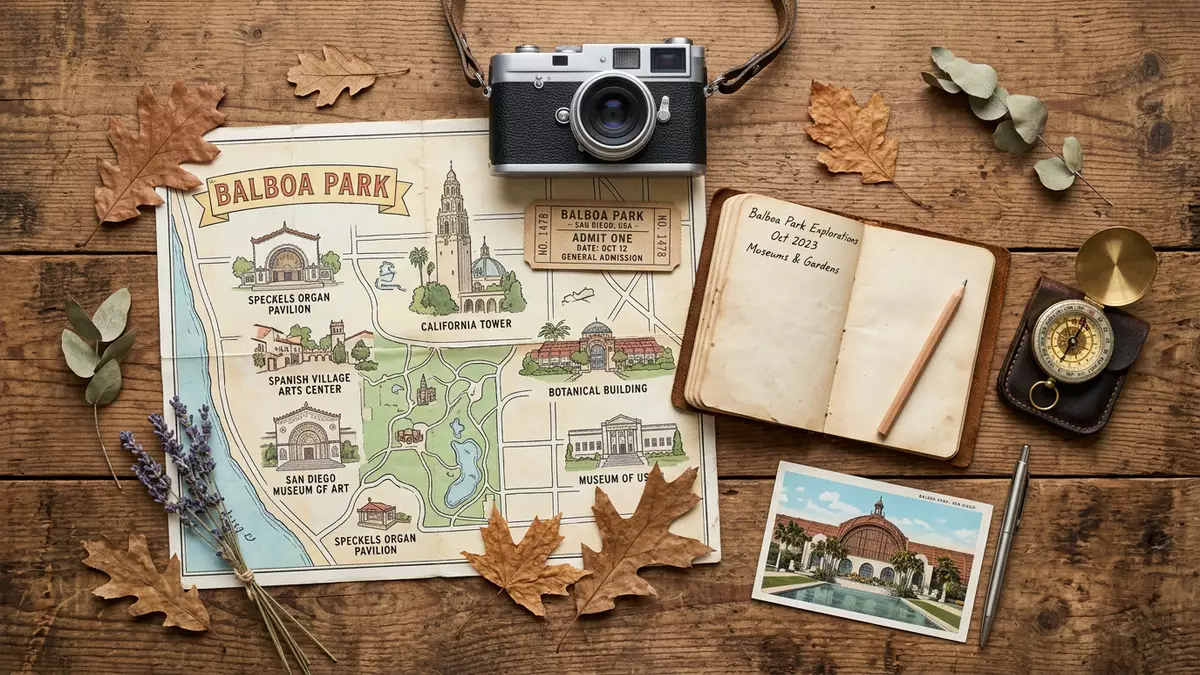
Balboa Park in San Diego is a vast urban cultural landscape where Spanish-inspired architecture, gardens and museums occupy a single, contiguous parkland above the city’s harbour. Set aside as public land in the nineteenth century and renamed for the explorer Vasco Núñez de Balboa in 1910, it now combines cultural institutions, landscaped grounds and the San Diego Zoo within one municipal park.
From nineteenth-century “City Park” to Balboa Park
The story of Balboa Park begins in 1868, when civic leaders in San Diego reserved a large tract of mesa top as public parkland under the name “City Park”. A tract of about 1,400 acres was drawn from pueblo lands, giving the growing city an extensive open space close to its centre.a 1,400-acre tract Over time the park’s exact acreage was reduced, but it still covers around 1,200 acres (roughly 490 ha) of varied terrain.around 1,200 acres
The change from “City Park” to Balboa Park came as San Diego prepared for the Panama–California Exposition. In 1910 the city renamed the park in honour of Vasco Núñez de Balboa, the Spanish-born explorer associated with the first European sighting of the Pacific Ocean from Panama.renamed in honour of Vasco Núñez de Balboa The exposition itself opened in 1915 and ran into 1917, turning parts of the mesa and canyon landscape into exhibition courts and boulevards lined with ornate pavilions.Panama–California Exposition from 1915 to 1917
Spanish Colonial Revival architecture along the Prado
Many of the most recognisable buildings in Balboa Park date from the Panama–California Exposition and reflect Spanish Colonial Revival, Mission Revival and Pueblo Revival styles.Spanish Colonial Revival, Mission Revival and Pueblo Revival styles Their façades use stucco surfaces, intricate ornament and towers to evoke historical architecture from Spain and Latin America, yet they stand as purpose-built exhibition halls from the early twentieth century.
Along the park’s central boulevard, often referred to as the Prado, these exposition-era buildings now house museums and cultural institutions. Structures on this axis include the Museum of Us, the San Diego Museum of Art, the Museum of Photographic Arts, the San Diego Natural History Museum and the San Diego History Center, among others.museums along Balboa Park's Prado Arcades frame views into courtyards and across lawns, and the ensemble of buildings gives the park a strong architectural character that visitors encounter even before entering individual galleries.
Gardens, museums and the San Diego Zoo
Balboa Park is known for combining cultural venues with landscaped grounds. Inside its boundaries lie gardens such as Palm Canyon, the Inez Grant Parker Memorial Rose Garden, the Desert Cactus Garden and the Japanese Friendship Garden, each occupying a different pocket of the park and introducing a distinct planting palette.gardens including Palm Canyon and the Japanese Friendship Garden The historic Botanical Building, set beside a lily pond, adds a further layer with its timber-and-glass structure and interior displays of tropical and subtropical plants.
The cultural institutions are equally substantial. Balboa Park contains around fifteen museums covering aviation, art, natural history, regional heritage and more.around fifteen museums The San Diego Air & Space Museum and the San Diego Automotive Museum occupy buildings near the main promenade, while the San Diego Museum of Art stands close to sculpture gardens that bridge indoors and outdoors. Within the park, a large parcel hosts the San Diego Zoo, established in the early twentieth century and now extending across canyon and hillside terrain inside the wider park boundary.a zoo built within the park
Visiting Balboa Park: what travellers from Western Europe should know
- Balboa Park lies just north-east of downtown San Diego, on a mesa above the harbour. It is reached by city streets and is served by local bus routes.
- The terrain combines level promenades with canyon edges and slopes. Moving between different areas can involve stairways, inclines and walks across open lawns.
- The park sits in southern California’s coastal zone, and outdoor areas such as gardens, plazas and canyons form a substantial part of any visit.
- The official language is English and the currency is the United States dollar.
- Entry requirements depend on your nationality; UK travellers can check the FCDO travel advice at gov.uk/foreign-travel-advice, Irish travellers the Department of Foreign Affairs at ireland.ie.
Searching for Balboa Park on social platforms
These links open searches for Balboa Park on each platform.
Frequently asked questions about Balboa Park
Where is Balboa Park and what kind of place is it?
Balboa Park is a large urban park in San Diego in southern California, set on a mesa just north-east of the city centre and containing cultural institutions and gardens.
What can visitors expect on a visit to Balboa Park?
Visitors encounter Spanish-influenced pavilions along a central promenade, multiple museums and galleries, formal and informal gardens, and extensive outdoor spaces including canyons and lawns.
What makes Balboa Park distinctive among city parks?
Balboa Park stands out for its combination of early twentieth-century Spanish Colonial Revival architecture, a concentration of museums and the presence of the San Diego Zoo within one continuous park landscape.


