
Bagh-e Fin, Kaschan’s classical Persian garden of water and geometry
Published on 08/31/2026 at 12:40 | Editorial responsibility: Rafael Müller, Editor-in-Chief AD HOC NEWS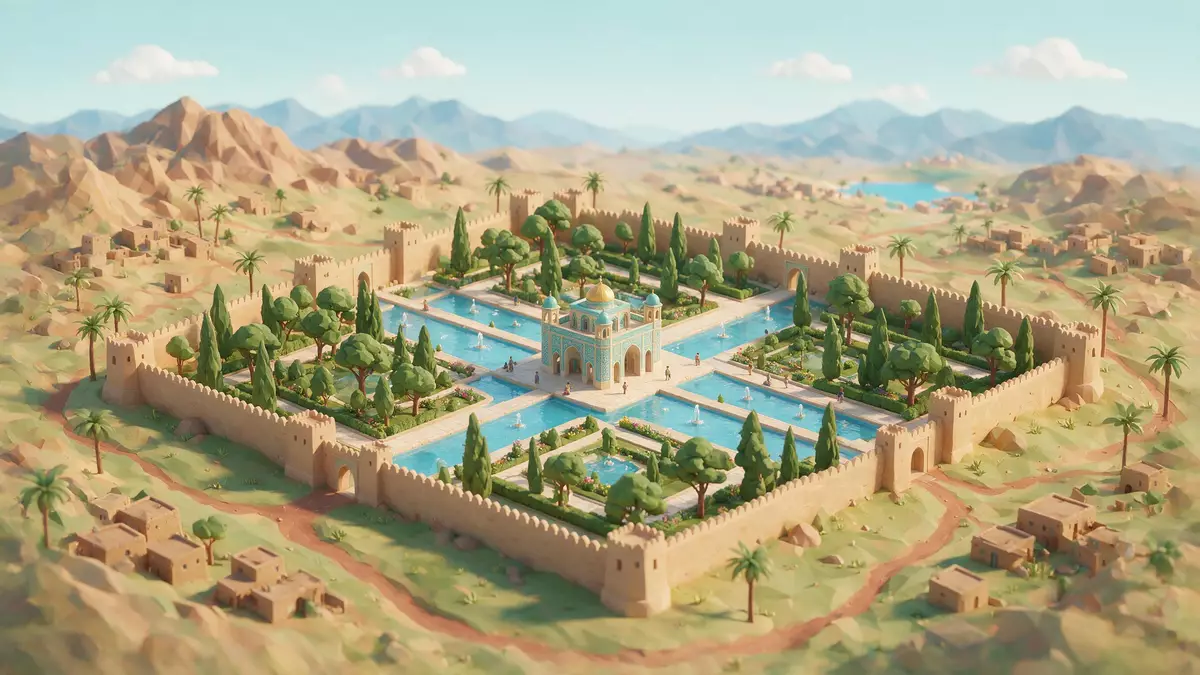
Bagh-e Fin, on the south-western edge of Kaschan in Iran, is a classical Persian garden where running water, brick pavilions and tall trees are held inside one walled rectangle. Laid out in its present form under Shah Abbas I in the late sixteenth century, it combines Safavid and Qajar structures around a geometric grid of channels and garden plots.
Water at the heart of a desert-edge garden
Bagh-e Fin sits near the Fin suburb outside Kaschan, close to the point where the Soleimaniyeh spring rises at the margin of the central Iranian desert. The garden captures that water and spreads it through straight channels and basins that divide the enclosure into ordered quadrants, following the chahar bagh tradition of Persian garden design.chahar bagh tradition Brick-lined watercourses run between plots planted with evergreen trees, and the sound of water accompanies the length of the main axes.
The enclosure covers several hectares and is aligned so that the main avenue leads from the monumental entrance towards central pavilions, intersected by transverse channels.Fin Garden Within this layout, the spring-fed pools feed smaller runnels that supply both ornamental basins and the historic bathhouses. The regular grid gives the garden a clear structure, yet the planting and the play of water turn each compartment into a distinct space.
Safavid foundations and Qajar additions
The core of Bagh-e Fin belongs to the Safavid period, when Shah Abbas I ordered the construction of the outer walls, entrance portal and central pavilion.Safavid constructions These elements give the garden its basic form as a fortified rectangle with towers at the corners and a ceremonial axis running inwards. Later Safavid rulers extended the garden during the seventeenth century, weaving more plots and subsidiary buildings into the same ordered frame.
Qajar rulers added further layers two centuries later, including a larger bathhouse and a library within the grounds.Qajar rulers added The Qajar era also left the garden with one of its most charged historical associations: in 1852 the reforming premier Amir Kabir was killed in Kashan’s Fin Bathhouse on the orders of Naser al-Din Shah Qajar, an event still tied closely to the site.Amir Kabir was murdered The combination of Safavid architecture and Qajar history makes Bagh-e Fin a compact record of several Iranian dynasties.
A World Heritage Persian garden
Bagh-e Fin is widely regarded as a classical example of the Persian garden type, with its interplay of water, shade, geometry and enclosure. The garden, completed around 1590, is described as the oldest surviving garden of its kind in Iran, and its layout influenced later gardens across the country.Completed in 1590 In 2012 it was inscribed on the UNESCO World Heritage List as part of the serial property “The Persian Garden”, underlining its role within a broader tradition of planned landscapes.UNESCO World Heritage
Within the enclosure, visitors encounter structures from several historical periods alongside archaeological displays. The Kashan National Museum stands on the western side of the garden and houses finds from sites such as Tepe Sialk and Chogha Zanbil, linking Bagh-e Fin to a deeper archaeological landscape.Kashan National Museum This combination of formal garden, royal pavilions, bathhouses and museum makes the site both a place of leisure and a compact introduction to central Iranian history.
Visiting Bagh-e Fin: what travellers from Western Europe should know
- Bagh-e Fin lies south-west of central Kaschan near the Fin suburb, reached by road along Amir Kabir Road from the city’s main squares and historic bazaars.
The garden stands at the edge of the desert hills beyond the built-up area. - The enclosure is largely level, but moving through it involves walking along stone paths and crossing low steps between different terrace levels.
Interiors such as the bathhouses and pavilions are accessed by doorways and short staircases. - Kaschan is in central Iran, where Persian is the official language and the currency is the Iranian rial.
Entry requirements depend on your nationality; UK travellers can check the FCDO travel advice at gov.uk/foreign-travel-advice, Irish travellers the Department of Foreign Affairs at ireland.ie.
Searching for Bagh-e Fin on social platforms
These links open searches for Bagh-e Fin on each platform.
Frequently asked questions about Bagh-e Fin
Where is Bagh-e Fin located?
Bagh-e Fin is a historic Persian garden near the Fin suburb south-west of Kaschan in central Iran, at the edge of the desert terrain.
What can visitors expect inside the garden?
Visitors encounter walled gardens with spring-fed channels, Safavid and Qajar pavilions, historic bathhouses and the Kashan National Museum within one ordered enclosure.
What makes Bagh-e Fin distinctive among Persian gardens?
Bagh-e Fin combines a late sixteenth-century Safavid layout, Qajar-era history centred on Amir Kabir and formal recognition as part of the UNESCO “Persian Garden” World Heritage property.


