
Bagan’s temple plain of brick, stucco and sky
Published on 09/05/2026 at 20:08 | Editorial responsibility: Rafael Müller, Editor-in-Chief AD HOC NEWS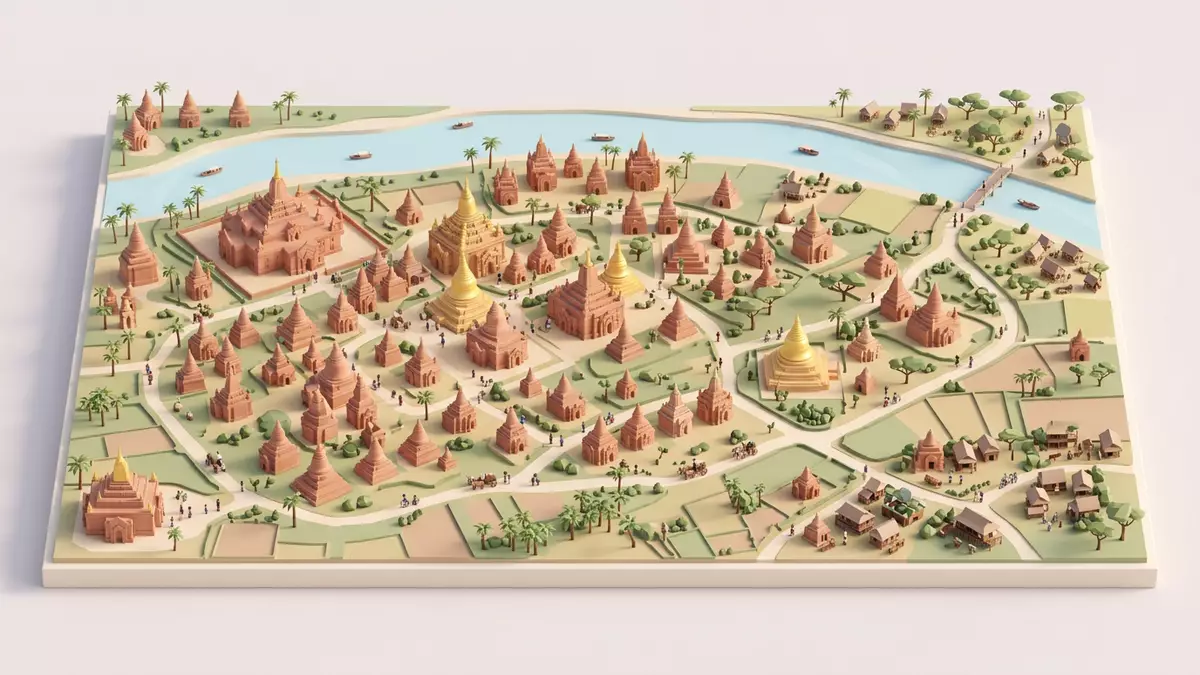
Bagan in central Myanmar is a temple plain on a bend of the Ayeyarwady River, where thousands of Buddhist structures rise from dry earth under a wide sky. Across this landscape, brick stupas and hollow temples from the Pagan dynasty form an open-air record of Theravada Buddhism between the eleventh and thirteenth centuries.
The Pagan kingdom and its temple landscape
Bagan began as the capital of the Kingdom of Pagan and grew into the centre of a Buddhist empire that dominated much of what is now Myanmar from the mid-eleventh century.Kingdom of Pagan During this period the court and religious communities presided over a surge of construction that covered the plain with stupas, monasteries and temples. At the height of this building phase between the eleventh and thirteenth centuries, more than 10,000 religious structures were raised on the Bagan plain, creating one of the densest concentrations of Buddhist architecture in Asia.more than 10,000 religious structures Today only a fraction of those buildings survive, but the remaining pagodas, shrines and monasteries still mark the former city’s outline.
The surviving ensemble has been recognised as a World Heritage Site for its testimony to the Bagan period and Theravada Buddhist culture.World Heritage Site The protected area covers a broad zone of scrub and cultivation in the Mandalay Region, bordered by the river and low hills.protected area of roughly 104 square kilometres Scattered across this landscape, religious structures range from compact brick stupas on small mounds to large walled temples with processional paths and interior image halls.
Brick stupas and hollow temples
The built form of Bagan divides broadly into solid stupas and hollow temples, each type serving different aspects of Buddhist devotion.solid stupas and hollow temples Stupas are massive brick structures, often carrying relics and crowned by tapering spires. Their surfaces are layered with mouldings and terraces, with niches for small images and bands of decorative stucco. Hollow temples, by contrast, combine exterior massing with interior passageways and Buddha images, allowing worshippers to move through a series of halls.
Across the plain these forms appear in regional variations that draw on Sri Lankan, Indian and Mon influences.regional variations Brick is the primary material, sometimes left exposed, sometimes covered with stucco and once gilded or painted. Many structures stand on square or multi-level platforms, with stairways and terraces that articulate the transition from ground to upper zones. The skyline is shaped by the repetition of spires, finials and terraces, creating a layered horizon when seen from higher ground.
Ananda Temple: a masterpiece of Bagan
Among the surviving temples of Bagan, Ananda Temple is a landmark of the middle Bagan period and a key example of the hollow temple type. It stands in Old Bagan southeast of Tharabar Gate and is associated with King Kyansittha of the Pagan dynasty.Ananda Temple in Old Bagan Construction dates place it in the early twelfth century, with completion recorded around 1105 during Kyansittha’s reign.built in 1105 AD
Ananda Temple’s plan forms a cross, with large gabled vestibules projecting from a central square core, and its outer walls carry arcades and niches with image panels.plan a square with gabled vestibules Inside, corridors encircle a central block, and tall Buddha statues face along the axes, framed by decorative arches. The building rises in tiers of terraces and mouldings to a crowning spire, its height and mass marking it out even among the surrounding temples.
Bagan in its central Myanmar setting
Bagan lies on the eastern bank of the Ayeyarwady River in the dry central plain of Myanmar, within the Mandalay Region.eastern bank of the Ayeyarwady River The river’s curve defines one edge of the archaeological zone, while tracks and minor roads link Old Bagan, Nyaung-U and other clusters of temples. Low vegetation and patches of cultivation separate groups of monuments, and many stupas stand close to the river’s floodplain.
The wider setting includes Mandalay to the north, a regional centre connected by road and river routes, and the Ayeyarwady itself is a major transport corridor through Myanmar.dry zone of central Myanmar Within the plain, the distribution of temples reflects historical axes of movement and patronage, with clusters around former city walls, river ghats and ancient processional ways.
Visiting Bagan: what travellers from Western Europe should know
- Bagan lies in the Mandalay Region of central Myanmar on the eastern bank of the Ayeyarwady River, reached overland and by domestic flights via nearby towns.
- The temple plain is largely flat and open, with sandy tracks and brick platforms; approaches to taller temples include stairways and interior passages.
- English is not an official language in Myanmar; the official language is Burmese and the currency is the kyat.
- Entry requirements depend on your nationality; UK travellers can check the FCDO travel advice at gov.uk/foreign-travel-advice, Irish travellers the Department of Foreign Affairs at ireland.ie.
Searching for Bagan on social platforms
These links open searches for Bagan on each platform.
Frequently asked questions about Bagan
Where is Bagan?
Bagan is in the Mandalay Region of central Myanmar on the eastern bank of the Ayeyarwady River, within a broad archaeological zone.
What can visitors expect on a visit to Bagan?
Visitors encounter a wide plain dotted with brick stupas and temples from the Pagan dynasty, linked by tracks and minor roads between Old Bagan and surrounding settlements.
What makes Bagan distinctive among temple sites?
Bagan is distinctive for its concentration of thousands of religious structures from the eleventh to thirteenth centuries, combining solid stupas and hollow temples in a single riverine landscape.


