
Bagan’s temple plain and the legacy of the Pagan kings
Published on 09/10/2026 at 11:32 | Editorial responsibility: Rafael Müller, Editor-in-Chief AD HOC NEWS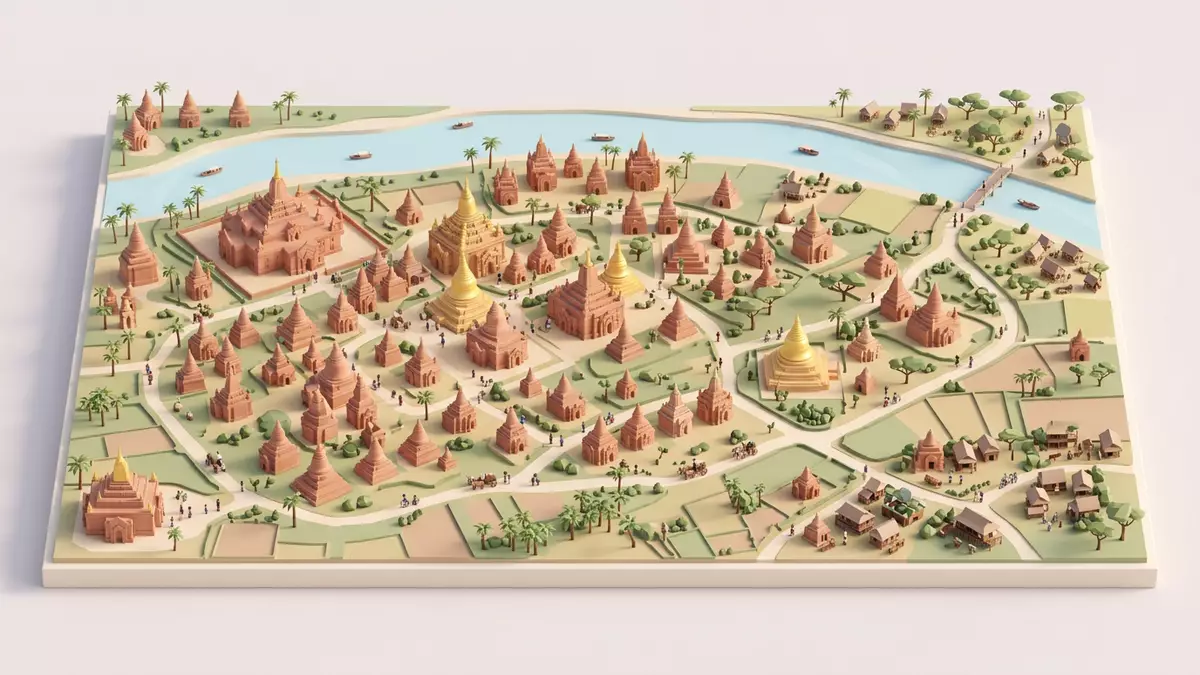
Bagan in Myanmar is an immense temple plain, where thousands of brick Buddhist monuments rise from the dry Irrawaddy river landscape and trace the power of the Pagan kings between the eleventh and thirteenth centuries.
A brick landscape of stupas and temples
Bagan lies on the Ayeyarwady (Irrawaddy) River in central Myanmar, in a broad plain dotted with stupas, hollow temples and monastery complexes in brick.Bagan lies on the Ayeyarwady River The monuments stand across an area of around 104 km² (40 sq mi), where religious structures occupy fields, low rises and river terraces in varying densities.an area of around 104 km²
Between the mid-eleventh and late thirteenth centuries, the Pagan Kingdom raised an estimated 10,000 religious monuments on this plain, including stupas, temples and monasteries, of which over 2,000 survive in different states of preservation.over 2,000 surviving monuments The result is a continuous historic landscape where clusters of large temples such as Ananda, Dhammayangyi and Shwezigon punctuate a background of smaller pagodas and ruins.Ananda, Dhammayangyi and Shwezigon
Capital of the Pagan Kingdom and Theravada centre
From the 9th to 13th centuries, Bagan served as the capital of the Pagan Kingdom, the first kingdom to unify many of the regions that later formed Myanmar.capital of the Pagan Kingdom The reign of King Anawrahta, beginning in 1044, marked the consolidation of this power and the close association of the court with Theravada Buddhism.reign of King Anawrahta from 1044
Between about 1044 and 1287, the rulers of Bagan and their elites invested heavily in religious construction, creating thousands of monuments as acts of merit-making and royal patronage.between about 1044 and 1287 The surviving temples display forms and decorative programmes that reflect Buddhist doctrinal themes, local craftsmanship and the evolution of brick architecture over the Bagan Period of the 11th to 13th centuries.evidence of the Bagan Period
Bagan as a UNESCO World Heritage sacred landscape
Bagan is inscribed as a UNESCO World Heritage Site as a sacred landscape with a dense array of Buddhist art and architecture that records centuries of Theravada Buddhist practice.inscribed as a UNESCO World Heritage Site The Archaeological Zone includes areas with the greatest concentration of monuments, buffer zones and surrounding protected land with fewer structures that preserve the wider setting of the plain.zones within the Archaeological Zone
The temples range from large multi-storey brick structures with interior image halls to solid stupas, with building dates that span the 11th to early 14th centuries and later periods of restoration. Notable examples include the Ananda Temple dated to 1105, Htilominlo Temple from the early 13th century and Shwezigon Pagoda associated with the 11th century.Ananda, Htilominlo and Shwezigon Together they form a landscape where religious structures, agricultural land and village areas coexist within a continuous historic environment.
Visiting Bagan: what travellers from Western Europe should know
- Bagan lies in central Myanmar on the Ayeyarwady River plain, reached overland from Mandalay and Nyaung-U, with local roads crossing the Bagan Archaeological Zone.
- The temple plain is largely flat with sandy and dusty paths, and visiting major temples often involves staircases inside towers and terraces.
- Village areas and cultivated fields sit among the monuments, so many routes cross mixed terrain rather than formal paved streets.
- The official language is Burmese and the currency is the Myanmar kyat.
- Entry requirements depend on your nationality; UK travellers can check the FCDO travel advice at gov.uk/foreign-travel-advice, Irish travellers the Department of Foreign Affairs at ireland.ie.
Searching for Bagan on social platforms
These links open searches for Bagan on each platform.
Frequently asked questions about Bagan
Where is Bagan and what kind of place is it?
Bagan is an archaeological zone on the Ayeyarwady River in central Myanmar, with a broad plain covered in Buddhist temples, stupas and related monuments.
What should visitors expect when exploring the temple plain?
Visitors encounter brick temples and stupas set among fields and villages, with sandy tracks, staircases within certain structures and views across a wide monument-dotted landscape.
What makes Bagan distinctive among historic sites in Southeast Asia?
Bagan is distinctive for the sheer number of surviving brick Buddhist monuments built between the 11th and 13th centuries and for its role as capital of the Pagan Kingdom.


