

Bagan’s temple plain and the legacy of the Pagan Kingdom
Published on 08/16/2026 at 13:02 | Editorial responsibility: Rafael Müller, Editor-in-Chief AD HOC NEWS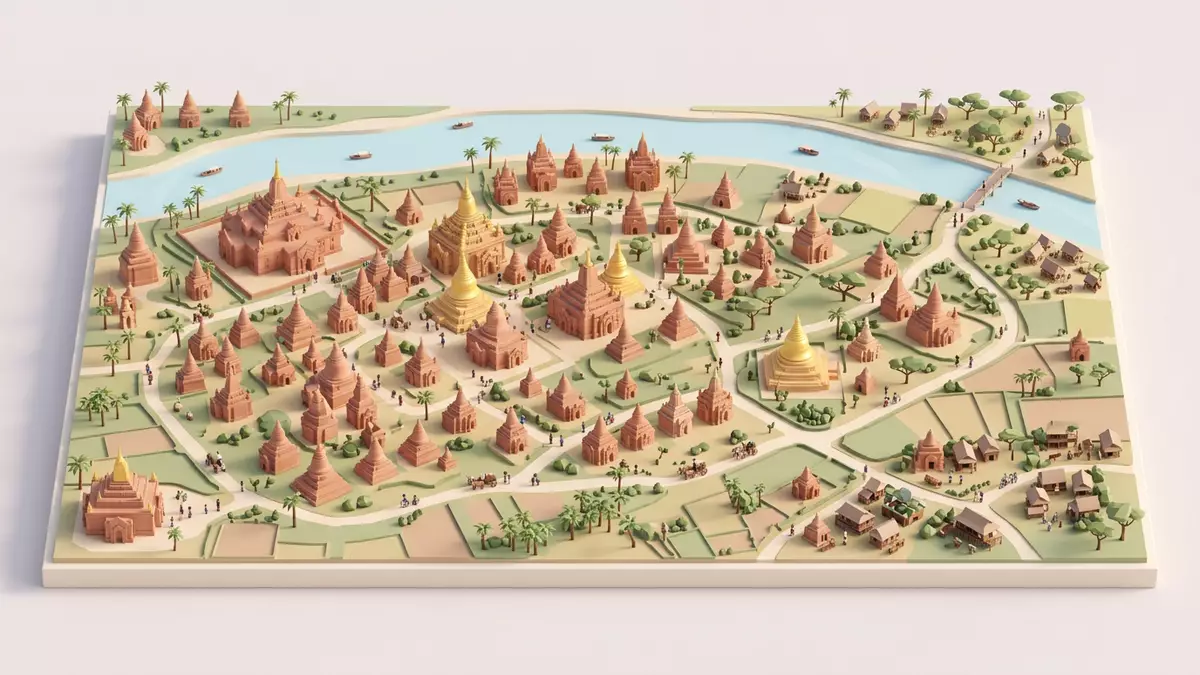
On the dry central plain of Myanmar, Bagan spreads along a bend in the Irrawaddy River as a vast archaeological landscape of Buddhist temples, stupas and monasteries dating largely from the 11th to 13th centuries. The city was the capital of the Pagan Kingdom during this period, when rulers and donors sponsored an extraordinary surge of religious construction that left thousands of brick structures scattered across the plain.
The Pagan Kingdom and the making of Bagan’s temple plain
Bagan developed into the capital of the Pagan Kingdom, an early Burmese state whose height between the 11th and 13th centuries saw the creation of a dense religious cityscape across the surrounding plain.capital of the Pagan Kingdom The archaeological zone today preserves the remains of over 2,000 temples and stupas, a fraction of the more than 10,000 religious structures believed to have been built during the kingdom’s golden age.more than 10,000 religious structures This concentration of monuments forms a continuous field of religious architecture rather than a single centrally planned complex.
Royal chronicles and later historical studies place the foundation of Bagan in the mid?to?late 9th century, with the city gaining prominence as the Burman people expanded into the central plains and established their seat of power there.founded in the mid?to?late 9th century From about 1044, under King Anawrahta, the Pagan Kingdom consolidated territory and authority, and over the following two and a half centuries the plain around Bagan was transformed by religious buildings erected by kings, courtiers, monastic communities and lay donors.over roughly two and a half centuries of building
Brick temples, stupas and the architecture of Theravada Buddhism
The temples and stupas of Bagan are predominantly constructed from baked brick, with many monuments originally finished with stucco and, in some cases, gilded surfaces, creating a striking contrast with the low scrub of the surrounding plain.extraordinary set of ancient Buddhist sanctuaries Among the best known is Ananda Temple, a large cruciform structure whose construction is dated to 1105 and which preserves extensive interior frescoes and stone carvings.Ananda Temple dated to 1105 Nearby stand grand multi?storey temples such as Thatbyinnyu and Dhammayangyi, which rise above the surrounding monuments and mark the scale achieved by Pagan?period builders.Thatbyinnyu and Dhammayangyi
In addition to large temple complexes with internal corridors and shrine rooms, Bagan’s archaeological zone contains smaller stupas and shrines that line tracks and field edges, forming continuous alignments of religious markers across the landscape.numerous temples, stupas and monasteries Many structures house seated or standing Buddha images, while upper terraces of certain temples provide elevated views over the plain and the line of the Irrawaddy River. Interior mural cycles in some monuments depict Jataka stories and episodes from Buddhist history, adding a painted layer to the brick and stucco architecture.
UNESCO World Heritage status and the Bagan landscape
Bagan is inscribed on the UNESCO World Heritage List under the simple name “Bagan”, recognising the ensemble of religious monuments and associated archaeological remains as a sacred landscape of Theravada Buddhist practice.inscribed on the UNESCO World Heritage List The serial property covers several components within the wider archaeological zone, including major temple groups, monasteries, pilgrimage sites and mural?rich interiors, as well as sculptural fragments that testify to the artistic production of the Bagan Period.components of the serial property
The city lies in central Myanmar on the eastern bank of the Irrawaddy River, in a relatively dry region where low vegetation and open fields leave the silhouettes of hundreds of temples clearly visible.on the eastern bank of the Ayeyarwady River Within the archaeological zone, old villages, tracks and modern settlements coexist with monuments from the Pagan Kingdom’s height, while nearby towns act as gateways for travellers approaching the site by road or river. Earthquakes and weathering have affected many structures over the centuries, and the landscape now includes both unrestored ruins and conserved monuments.
Visiting Bagan: what travellers from Western Europe should know
- Bagan lies in central Myanmar on the eastern bank of the Irrawaddy River, reached overland from nearby towns and by river transport along the Irrawaddy.
- Within the archaeological zone, approaches to many temples follow sandy tracks or uneven paths, and internal stairways in taller monuments can be steep and narrow.
- The wider landscape consists of low scrub and fields with limited shade, so movement between clusters of temples involves walking across exposed terrain.
- The official language is Burmese and the currency is the kyat.
- Entry requirements depend on your nationality; UK travellers can check the FCDO travel advice at gov.uk/foreign-travel-advice, Irish travellers the Department of Foreign Affairs at ireland.ie.
Searching for Bagan on social platforms
These links open searches for Bagan on each platform.Frequently asked questions about Bagan
Where is Bagan?
Bagan is in central Myanmar on the eastern bank of the Irrawaddy River, occupying a broad plain with temples spread between the river and inland settlements.
What should visitors expect when exploring the temples?
Visitors encounter a wide landscape of brick temples and stupas, with approaches along tracks and fields and interiors that can include mural painting and Buddha images.
What makes Bagan distinctive among Buddhist sites?
Bagan is distinctive for its dense concentration of Pagan?period temples and stupas, its role as the 11th–13th century capital of the Pagan Kingdom and its recognised World Heritage status.


