

Bagan’s temple plain along the Ayeyarwady River
Published on 08/14/2026 at 14:40 | Editorial responsibility: Rafael Müller, Editor-in-Chief AD HOC NEWS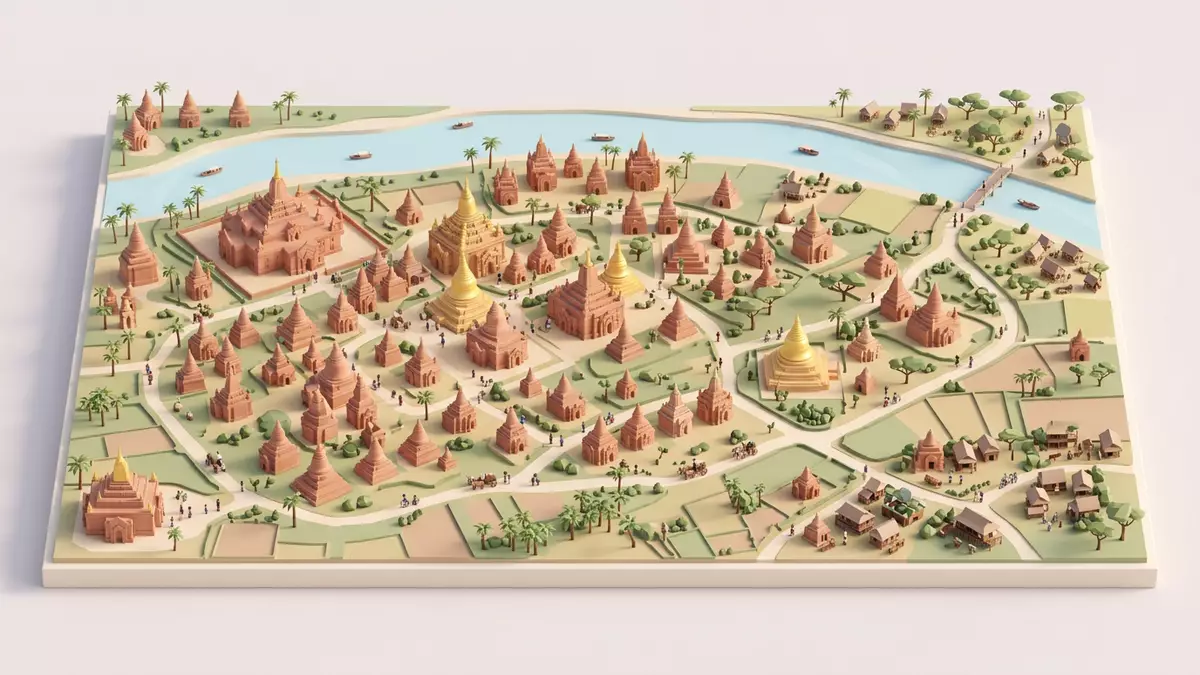
Bagan in central Myanmar stretches across a broad bend of the Ayeyarwady River, its dry plain studded with thousands of Buddhist temples and pagodas built during the height of the Pagan Kingdom between the 11th and 13th centuries. The landscape today preserves the core of that early Burmese empire, with surviving monuments that still mark the era when Bagan served as the capital of a kingdom unifying much of what is now Myanmar.
A sacred temple landscape of the Pagan Kingdom
The historical city of Bagan, also known in older sources as Pagan, lies in the central dry zone of Myanmar on the eastern bank of the Ayeyarwady River, where the flat plain leaves space for religious structures to spread toward the horizon.Located on a bend in the Ayeyarwady River the archaeological area forms a dense concentration of temples, stupas and monasteries that reflects centuries of Theravada Buddhist practice and merit-making in the region.a sacred landscape featuring Buddhist art and architecture
Bagan rose to prominence as the capital of the Pagan Kingdom from the 9th to the 13th centuries, becoming the centre of a regional empire that controlled river transport and trade along the Ayeyarwady.capital of the Pagan Kingdom from the 9th to 13th centuries Under rulers such as King Anawrahta in the 11th century, Theravada Buddhism gained firm ground at Bagan, and the construction of religious monuments accelerated across the plain for roughly 250 years.the golden age beginning under King Anawrahta in 1057
Thousands of temples across the Bagan plain
The scale of construction at Bagan between the 11th and 13th centuries remains one of its defining features, with estimates indicating that more than 10,000 Buddhist temples, pagodas and monasteries once stood on the plain surrounding the capital.over 10,000 temples were built on the plains Royal patrons and wealthy donors commissioned structures ranging from large brick temples with interior walkways and Buddha images to smaller stupas rising above the scrub and cultivated fields.
Although many buildings have been lost to time and earthquakes, thousands of monuments remain recorded within the Bagan archaeological zone, forming a serial property of multiple components that extends across the river plain.3,595 recorded monuments in the serial property Among the best known are large temples such as the Ananda Temple, dated to 1105, and Dhammayangyi Temple, built in the late 12th century, which display elaborate brickwork and internal corridors lined with murals and sculpture.Ananda Temple dated to 1105
Bagan’s inscription as a World Heritage Site
Bagan’s extraordinary concentration of religious architecture led to its inscription as a UNESCO World Heritage Site, recognising the temple plain as a record of Buddhist devotion and imperial history from the 11th to 13th centuries.Bagan on the World Heritage List The property covers several distinct zones within the plain, including major clusters of monuments and associated archaeological remains, frescoes and inscriptions that document the Bagan Period.
The World Heritage inscription highlights both the architectural range of Bagan’s monuments and their role in illustrating how redistributional Buddhism shaped political authority in the Pagan Kingdom.evidence of the Bagan civilisation and its Buddhist tradition Massive brick temples stand beside slender stupas and monastery compounds, with surviving murals and carved stone illustrating stories from Buddhist texts, images of donors and traces of court life during the period when Bagan was a major religious centre in Southeast Asia.testimony to the peak of Bagan civilisation
Visiting Bagan: what travellers from Western Europe should know
- Bagan lies in central Myanmar on the eastern bank of the Ayeyarwady River, south-west of Mandalay, and is reached by domestic flights and intercity buses serving the local airport and town.
- The archaeological zone spreads across a flat river plain with dusty tracks and minor roads between the temples, so visiting the major monuments involves walking on uneven ground and climbing internal stairways in some structures.
- The official language is Burmese and the currency is the Myanmar kyat; entry requirements depend on your nationality, UK travellers can check the FCDO travel advice at gov.uk/foreign-travel-advice, Irish travellers the Department of Foreign Affairs at ireland.ie.
Searching for Bagan on social platforms
These links open searches for Bagan on each platform.
Frequently asked questions about Bagan
Where is Bagan?
Bagan is in central Myanmar on the eastern bank of the Ayeyarwady River, within the country’s dry zone and south-west of Mandalay.
What should visitors expect in the Bagan archaeological zone?
Visitors encounter a wide plain containing thousands of Buddhist temples and stupas in varying states of preservation, connected by minor roads and tracks across a dry landscape.
What makes Bagan distinctive among temple sites?
The plain at Bagan combines an unusually dense concentration of Buddhist monuments from the 11th to 13th centuries with surviving murals, inscriptions and architecture that reflect the height of the Pagan Kingdom.


