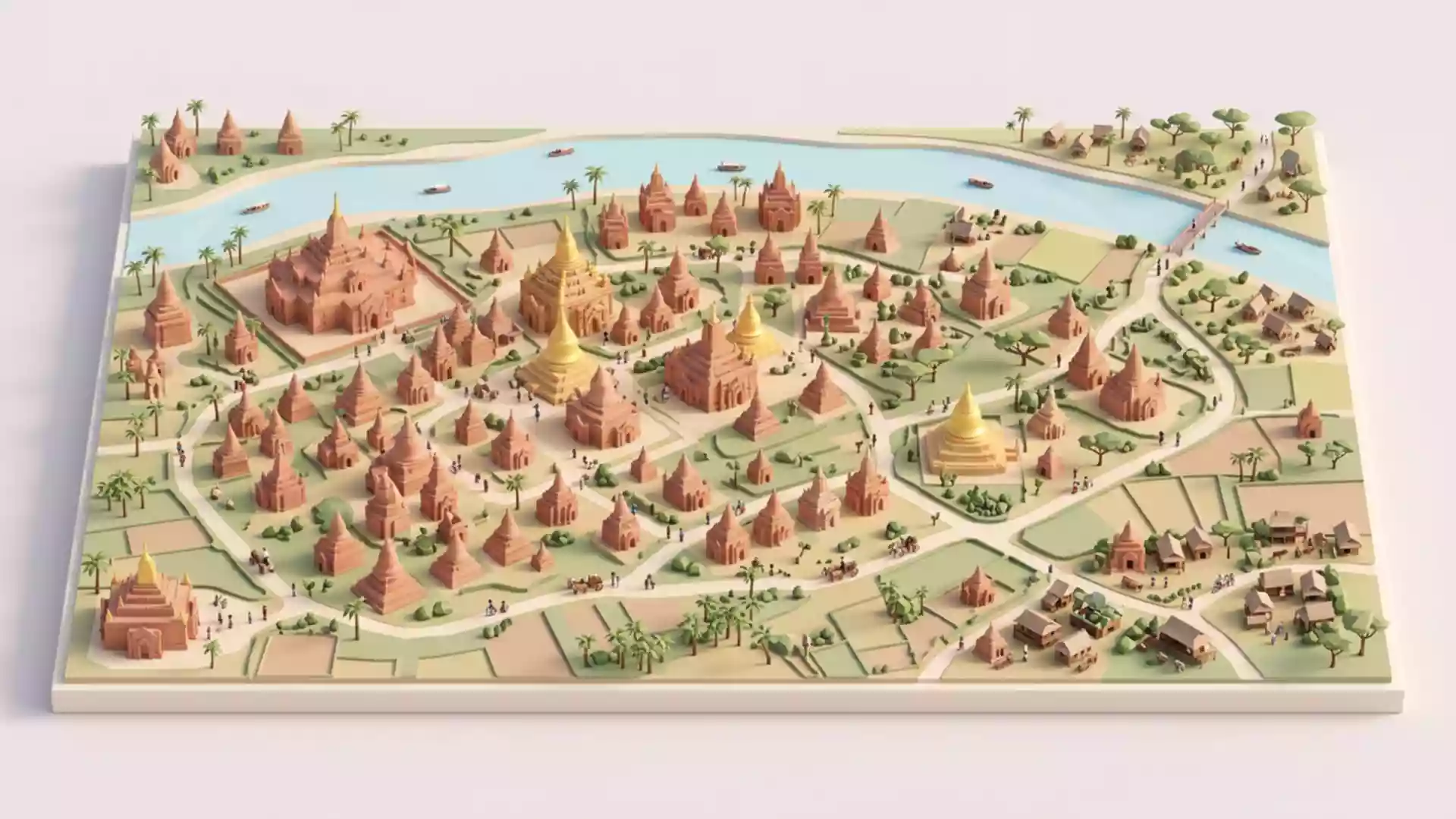
Bagan’s brick temples on the Ayeyarwady plain
Published on 09/11/2026 at 15:14 | Editorial responsibility: Rafael Müller, Editor-in-Chief AD HOC NEWS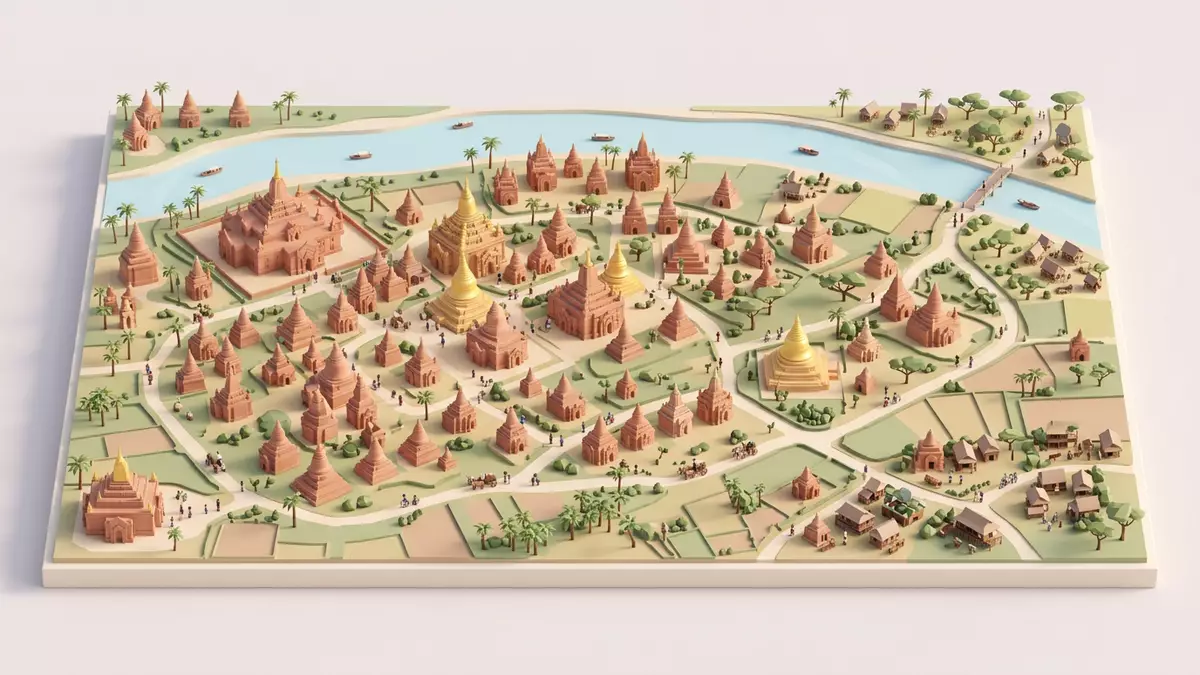
Bagan in Myanmar is a vast archaeological landscape where brick Buddhist temples and stupas rise from a dry plain beside the Ayeyarwady River. Across this expanse, religious buildings from the Bagan period create a continuous built horizon, turning the river bend into a terrain of towers and terraces. The site bears structures dating from the eleventh to the thirteenth century, when the Bagan kingdom centred its religious and political life on this plain.
A sacred city of brick and stone
Bagan lies on a bend in the Ayeyarwady River in central Myanmar, in a dry zone where scrub and fields run down towards the water. Over this ground, Buddhist builders of the Bagan kingdom raised temples, stupas and monasteries in dense clusters, so closely spaced that religious structures dominate most lines of sight.Bagan is described as a sacred landscape on the Ayeyarwady The core building period runs from the eleventh to the thirteenth century, a span in which Theravada Buddhist practice became intertwined with royal power.
Surveys of the area record thousands of religious monuments spread across the plain. A statement adopted for the site notes 3,595 recorded monuments, including temples, stupas and other structures built for Buddhist spiritual practice.The serial property for Bagan lists 3,595 monuments from the Bagan period Many are constructed in brick, with stone used for particular details, stairways and sculptural elements, so that the area reads as a field of masonry architecture between the earth and the river.
UNESCO World Heritage status and the Bagan period
Bagan is recognised on the World Heritage List as a cultural site under criteria (iii), (iv) and (vi, reflecting its testimony to Buddhist traditions, its range of architecture and its association with religious practice over centuries.Bagan appears on the UNESCO World Heritage List as a cultural property The inscription covers multiple components of the plain, including concentrations of monuments as well as associated archaeological remains such as murals, inscriptions and sculptures.
The Bagan kingdom’s height, between the eleventh and thirteenth centuries, saw the construction of more than 10,000 temples, pagodas and monasteries on the plain. Structures from that era survive in their thousands, and the period is treated as a distinct civilisation, marked by redistributional Buddhism tied to royal patronage.The Bagan kingdom flourished between the eleventh and thirteenth centuries This concentration gives Bagan one of Asia’s richest archaeological landscapes for Buddhist art and architecture.
Key temples on the Bagan plain
Among the many structures at Bagan, several temples and pagodas form clear reference points on the plain. Ananda Temple, built in the early twelfth century, stands near the Tharabar Gate of Old Bagan and is noted in lists of Bagan monuments for a completed date of 1105.Ananda Temple is recorded with a built year of 1105 The building carries interiors and external terraces that represent mature Bagan brick architecture.
Shwezigon Pagoda, dating from the eleventh and twelfth centuries, stands at Nyaung-U and appears in catalogues of Bagan monuments with a built date in the eleventh century.Shwezigon Pagoda is listed among Bagan’s pagodas with an eleventh-century origin Dhammayangyi Temple, built in the twelfth century, is described as the most massive brick structure on the plain, its bulk visible across wide stretches of the landscape.Dhammayangyi Temple is identified as the most massive structure in Bagan Together, these named monuments provide fixed points in a landscape where religious buildings form the dominant built fabric.
Visiting Bagan: what travellers from Western Europe should know
- Bagan lies in central Myanmar on the eastern bank of the Ayeyarwady River, reached via Nyaung-U, which has road and air connections from other parts of the country.
- The archaeological zone stretches across a largely flat plain, but many temples have stairways and elevated terraces, so visiting often involves climbing brick and stone steps.
- The official language is Burmese and the currency is the Myanmar kyat.
- Entry requirements depend on your nationality; UK travellers can check the FCDO travel advice at gov.uk/foreign-travel-advice, Irish travellers the Department of Foreign Affairs at ireland.ie.
Searching for Bagan on social platforms
These links open searches for Bagan on each platform.
Frequently asked questions about Bagan
Where is Bagan?
Bagan is in central Myanmar on the Ayeyarwady River, near the town of Nyaung-U, in a dry zone where the river bends around the archaeological plain.
What can visitors expect when exploring Bagan?
Visitors encounter a wide plain scattered with brick temples, stupas and monasteries from the Bagan period, with paths, tracks and roads linking clusters of monuments.
What makes Bagan distinctive among Buddhist sites?
Bagan’s distinction lies in the density and number of its surviving religious structures from the eleventh to thirteenth centuries, forming a continuous sacred landscape rather than isolated temples.