
Bagan’s brick temples across an ancient plain
Published on 09/22/2026 at 06:50 | Editorial responsibility: Rafael Müller, Editor-in-Chief AD HOC NEWS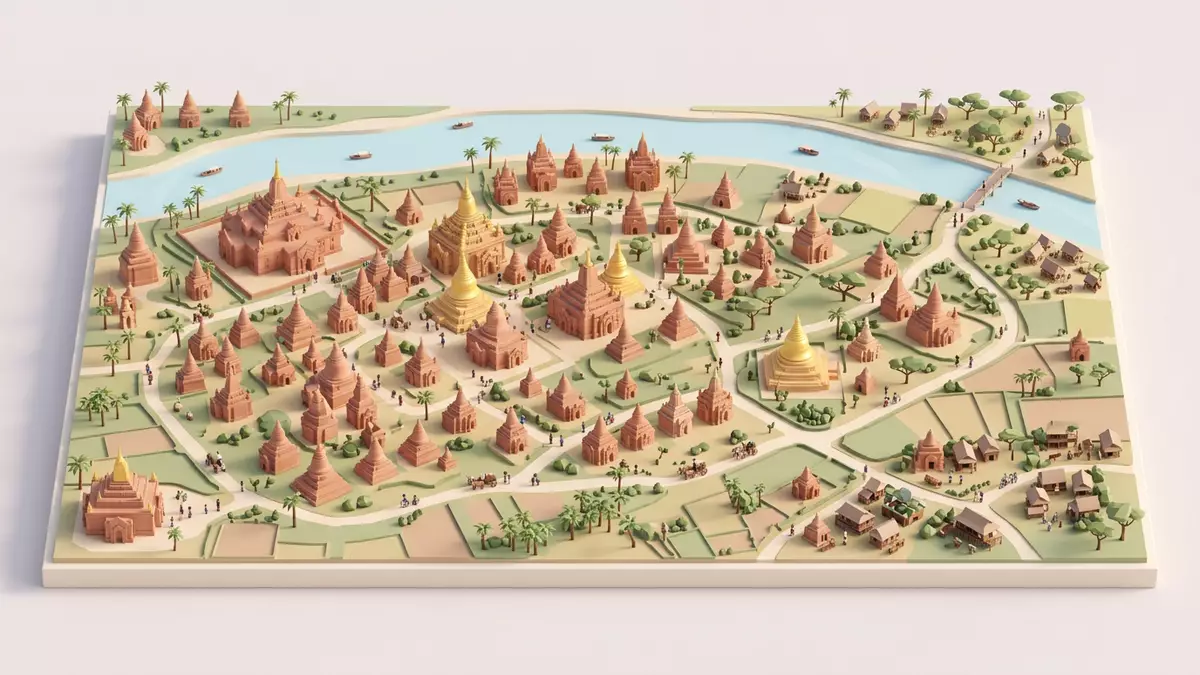
Bagan is a vast archaeological landscape in central Myanmar, where brick temples and stupas rise across a bend of the Ayeyarwady River. The surviving monuments belong chiefly to the Bagan Period, from the eleventh to the thirteenth century, when the city served as the centre of the Bagan Kingdom.
Bagan’s brick skyline on the Ayeyarwady plain
Bagan is not a single monument but a cultural landscape spread across dry ground beside the Ayeyarwady. Its buildings include temples, stupas, monasteries and other places connected with Buddhist religious practice. Brick dominates the landscape, from compact shrine walls to tall, tapering stupas.
The scale is visible in the relationship between the monuments and the open plain. Individual structures stand apart from one another, while groups of buildings extend towards the river and the surrounding settlements. The result is an archaeological setting in which architecture and landscape remain closely connected.
The Bagan Kingdom and the Buddhist building tradition
Bagan became the capital of the Pagan Kingdom between the ninth and thirteenth centuries. Its central historical period belongs to the eleventh, twelfth and thirteenth centuries, when Buddhist religious construction shaped the city and its surrounding plain.
King Anawrahta is closely associated with the formation of the Bagan Kingdom in the eleventh century. His reign is connected with the expansion of Theravada Buddhist practice, while later rulers and donors added temples, monasteries and stupas across the royal landscape.
Buildings at Bagan preserve several forms of Buddhist architecture. Stupas present solid masses and rising profiles, while temples contain enclosed spaces, corridors, images and wall paintings. Interiors may include carved details, sculptures and murals linked to Buddhist stories and devotional practice.
Temples, stupas and a World Heritage landscape
Bagan became a UNESCO World Heritage Site in 2019. The listed property recognises the archaeological remains, religious buildings, murals, sculptures and inscriptions as parts of a connected sacred landscape. Bagan’s World Heritage listing identifies the site with Buddhist art, architecture and Theravada traditions.
The landscape records the Bagan Period from the eleventh to the thirteenth centuries. The Bagan Period is represented through monuments that combine religious use, royal patronage and artistic production.
Architectural details vary from one building to another. Some temples have broad halls and passageways, while others present compact plans with a central image chamber. Stupas provide a different visual language, with solid brick forms and smooth or ornamented surfaces.
Murals add another layer to the site. Painted interiors preserve scenes, figures and decorative patterns associated with Buddhist teaching and the cultural life of medieval Myanmar. Sculptures and inscriptions extend that record beyond the buildings themselves.
Visiting Bagan: what travellers from Western Europe should know
- Bagan lies in central Myanmar beside the Ayeyarwady River, in the Mandalay Region. It is reached through Nyaung-U, which has Bagan’s airport and road connections.
- The archaeological landscape includes brick temples, stupas, monasteries and open ground. Visits involve movement between separate monuments rather than one continuous museum building.
- Many temples contain steps, uneven masonry and enclosed corridors. Some interiors include wall paintings, sculptures and devotional images.
- The official language is Burmese and the currency is the Myanmar kyat.
- Entry requirements depend on your nationality; UK travellers can check the FCDO travel advice at gov.uk/foreign-travel-advice, Irish travellers the Department of Foreign Affairs at ireland.ie.
Searching for Bagan on social platforms
These links open searches for Bagan on each platform.
Frequently asked questions about Bagan
Where is Bagan?
Bagan is in central Myanmar, beside a bend of the Ayeyarwady River. The archaeological landscape lies in the Mandalay Region.
What can visitors see in Bagan?
Visitors encounter brick temples, stupas, monasteries, sculptures, inscriptions and painted interiors. The monuments are distributed across an open archaeological landscape.
What makes Bagan distinctive?
Bagan combines a large Buddhist architectural landscape with the history of the Bagan Kingdom. Its monuments belong chiefly to the eleventh, twelfth and thirteenth centuries.


