
Bagan and the plains of thousands of temples
Published on 08/31/2026 at 15:37 | Editorial responsibility: Rafael Müller, Editor-in-Chief AD HOC NEWS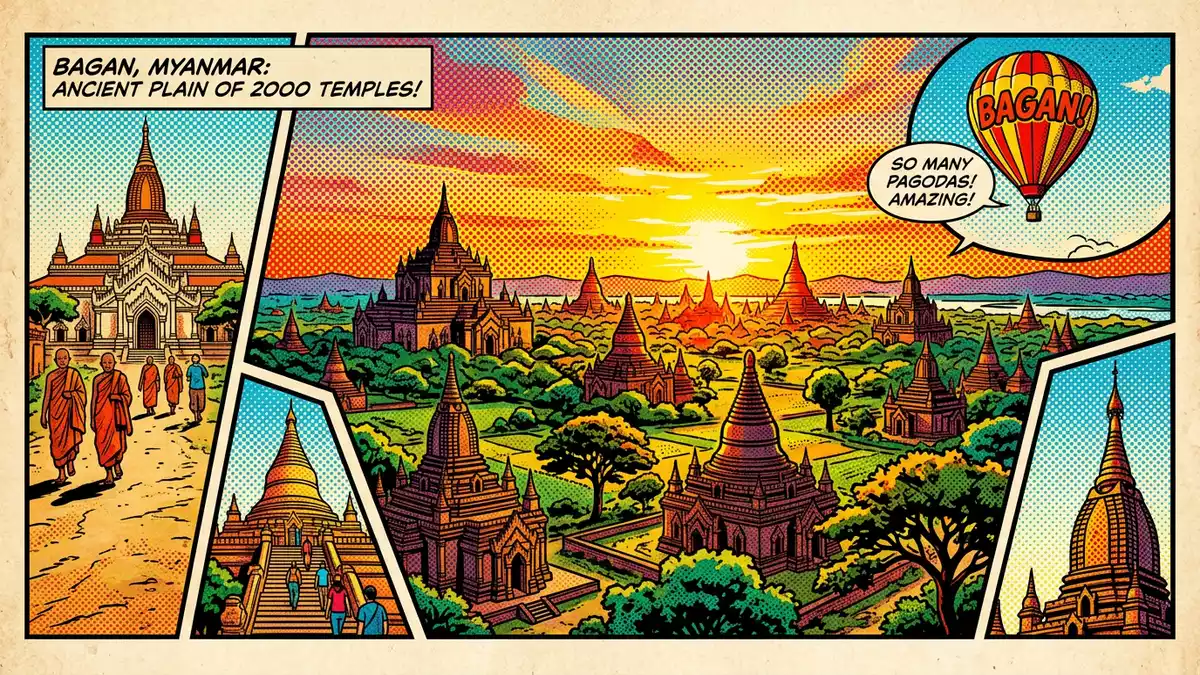
Bagan is an ancient city in central Myanmar where thousands of brick temples rise from the flat plains beside the Irrawaddy River, forming one of Asia’s densest sacred landscapes of the medieval period. From the 11th to the 13th centuries, Bagan served as the capital of the Pagan Kingdom, and its surviving temples preserve the brick architecture and Buddhist art of that era with unusual clarity.
Bagan as the capital of the Pagan Kingdom
Bagan lies in the Mandalay Region of Myanmar, on the eastern bank of the Irrawaddy River, where a fortified settlement rose to prominence under early Burmese rulers such as King Pyinbya in the ninth century AD.Bagan rulers and locals Between the 11th and 13th centuries, the city became the political, economic and cultural centre of the Pagan Kingdom, the first Burmese kingdom to unify many of the regions that later formed Myanmar.capital of the Pagan Kingdom
During roughly 250 years of royal patronage, Bagan’s kings and wealthy subjects commissioned an extraordinary concentration of religious buildings on the surrounding plain. Over 10,000 Buddhist temples, pagodas and monasteries were constructed within an area of about 104 km² (40 sq mi), with the remains of more than 2,200 temples and pagodas still standing.over 10,000 religious monuments This density of brick religious architecture makes Bagan one of the most extensive archaeological zones of the Buddhist world.
Brick temples on the Irrawaddy plain
The Bagan Archaeological Zone stretches across dry plains beside the Irrawaddy, where temples and stupas rise above low scrub and farmland, their massed outlines creating a layered skyline of towers and terraces. Most structures are built in fired brick, often coated with stucco and once painted or gilded, a construction tradition that has helped many survive centuries of weathering in the semi-arid climate.ancient Buddhist sanctuaries Inside, mural paintings, seated Buddha images and carved stone details reflect the Theravada Buddhist practice that shaped the city’s religious life.Theravada Buddhist tradition of merit making
Among the many temples, certain monuments stand out for their scale or refinement. Ananda Temple is dated to the early 12th century and is known for its symmetrical plan and tall central tower, while Dhammayangyi Temple from the later 12th century is noted for its massive volume and fine brickwork.Ananda and Dhammayangyi temples Together with numerous medium-sized shrines and small stupas, these large temples form clusters across the plain, each with its own layout of courtyards, terraces and interior corridors.
World Heritage landscape of merit and decline
Bagan is recognised as a UNESCO World Heritage Site, inscribed for the way its temples and stupas document the peak of Bagan civilisation between the 11th and 13th centuries and its status as a regional empire centred on Theravada Buddhist practice.UNESCO World Heritage Site in the Mandalay Region Temple building was closely linked to merit making, with kings and lay donors funding religious monuments as acts of devotion that also reinforced political authority.Bagan Period merit-making landscape
The city’s golden age waned in the late 13th century, when Mongol invasions and internal strains contributed to the decline of the Pagan Kingdom.Mongol invasion in 1287 Many temples were gradually abandoned, and the population shifted, leaving the religious buildings as dominant features of the landscape. Despite periods of damage from earthquakes, a large number of structures remain standing, and careful conservation work has helped retain original brickwork, stucco surfaces and murals where possible.ancient city of 2,000 temples
Visiting Bagan: what travellers from Western Europe should know
- Bagan sits in central Myanmar’s Mandalay Region on the eastern bank of the Irrawaddy River, reached from the regional centres by road, river travel or domestic flights.
- The archaeological zone covers a broad, open plain, and exploring the temples involves walking on uneven ground, climbing interior stairways and moving between sites dispersed across the landscape.
- The official language is Burmese and the currency is the kyat.
- Entry requirements depend on your nationality; UK travellers can check the FCDO travel advice at gov.uk/foreign-travel-advice, Irish travellers the Department of Foreign Affairs at ireland.ie.
Searching for Bagan on social platforms
These links open searches for Bagan on each platform.
Frequently asked questions about Bagan
Where is Bagan and what kind of place is it?
Bagan is an ancient city and archaeological zone in Myanmar’s Mandalay Region, set on the eastern bank of the Irrawaddy River and covered with brick Buddhist temples.
What can a visitor expect when exploring Bagan?
Visitors encounter a wide, open plain dotted with thousands of temples, pagodas and stupas, with individual monuments offering interior spaces of murals, Buddha images and brick corridors.
What makes Bagan distinctive among historical sites?
Bagan is distinctive for its role as capital of the Pagan Kingdom and for the extraordinary number of surviving brick temples, which together form a continuous sacred landscape from the 11th to 13th centuries.


