
Bagan and the Buddhist plain of Myanmar
Published on 08/29/2026 at 06:38 | Editorial responsibility: Rafael Müller, Editor-in-Chief AD HOC NEWS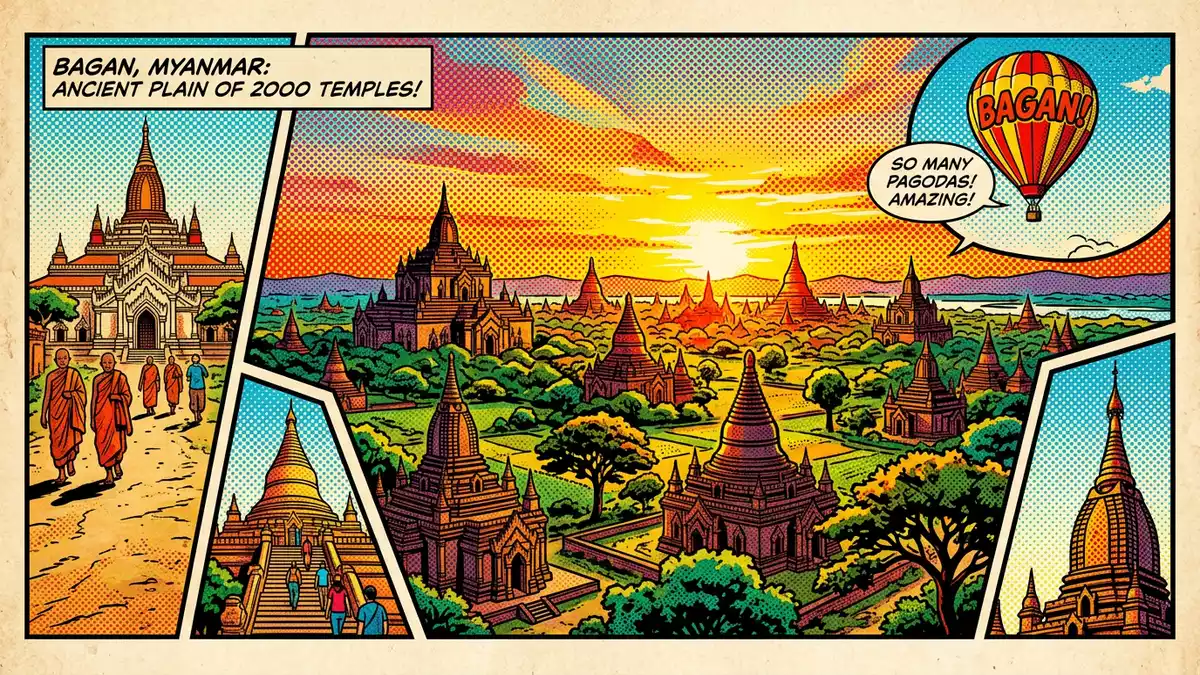
Bagan spreads across Myanmar’s dry zone as a landscape of temples, stupas and monasteries rather than a single monument. Its layers of brick, inscription and sculpture make the whole plain the subject, not just one building.World Heritage landscape
Bagan’s brick horizon
The first impression is scale. Brick towers rise from flat ground in dense clusters, and the overall effect comes from quantity, variation and age rather than from one dominant silhouette.3,595 recorded monuments
Bagan is linked to the Bagan Period, the eleventh to thirteenth centuries, when the old city served as the capital of a regional empire. That period left an immense concentration of Buddhist architecture, much of it still standing in the central plain of Myanmar.eleventh to thirteenth centuries
Temples, stupas and living practice
The site combines monumental forms with devotional use. Temples, monasteries and places of pilgrimage stand alongside archaeological remains, murals and sculptures, so the place reads as both sacred ground and historic record.temples, stupas and monasteries
The cultural setting matters as much as the masonry. Bagan is tied to Theravada Buddhist practice and to the tradition of merit making, which remains part of the landscape’s identity and helps explain why worship and ruins sit side by side.Theravada Buddhist practice
UNESCO status and the Bagan period
UNESCO inscribed Bagan, Myanmar, on the World Heritage List in 2019 under criteria iii, iv and vi. The listing recognises the ensemble as a cultural landscape of Buddhist art, architecture and continuing religious tradition.World Heritage List
The formal designation also underlines the site’s historical depth. Bagan is presented as evidence of the Bagan civilisation, and the monuments survive as part of a wider river plain on the Ayeyarwady.Ayeyarwady River
Visiting Bagan: what travellers from Western Europe should know
- Bagan lies in central Myanmar, on a bend of the Ayeyarwady River in the dry zone. The site is reached through the wider Bagan area, including its archaeological and urban components.
- The terrain is flat, open and extensive, with monuments spread across a large plain. Brickwork, plaster and surviving decoration appear in many forms across the site.
- The landscape includes stupas, temples, monasteries, inscriptions, murals and sculptures. It is as much an archaeological zone as a religious one.
- The official language is Burmese and the currency is the kyat.
Searching for Bagan on social platforms
These links open searches for Bagan on each platform.
Frequently asked questions about Bagan
Where is Bagan?
Bagan is in central Myanmar, on the Ayeyarwady River in the country’s dry zone. It forms a broad historic landscape rather than a compact city centre.
What does a visit involve?
The site consists of spread-out monuments, open ground and archaeological remains. The experience centres on moving through brick towers, temples and monasteries across the plain.
What makes Bagan distinctive?
Its strength lies in the combination of scale, age and religious continuity. A UNESCO-listed Buddhist landscape stretches across the plain, with monuments from the Bagan period still shaping it.


