
Badshahi Masjid and the red sandstone heart of Mughal Lahore
Published on 09/21/2026 at 09:59 | Editorial responsibility: Rafael Müller, Editor-in-Chief AD HOC NEWS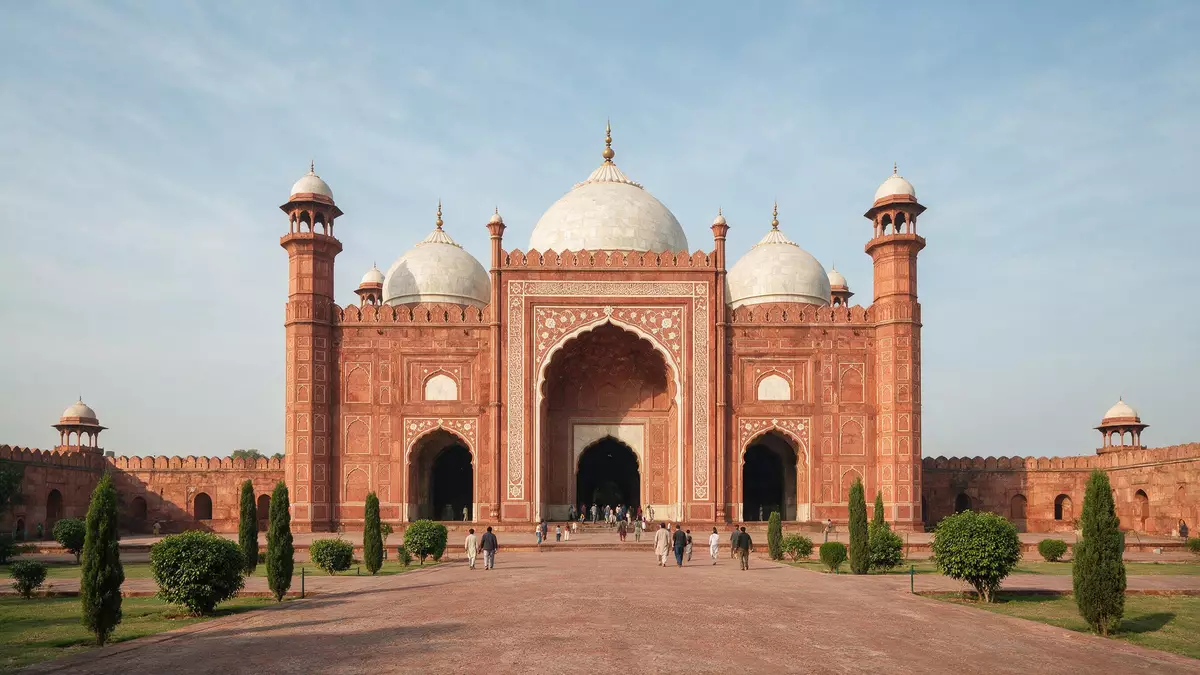
Badshahi Masjid in Lahore is one of the grandest surviving mosques of the Mughal era, laid out as a vast courtyard complex in red sandstone and white marble. Commissioned by the Mughal emperor Aurangzeb Alamgir and completed in 1673, it stands on the western edge of the old city facing Lahore Fort across the formal garden of Hazuri Bagh.
A Mughal imperial mosque on the Ravi
Badshahi Masjid belongs to the high point of Mughal imperial building in the Indian subcontinent, a period when Lahore served as one of the key cities of the empire.The mosque was commissioned by Aurangzeb in 1671 and brought to completion in 1673 as a congregational mosque on the west bank of the Ravi River.Its site faces Lahore Fort across Hazuri Bagh
The mosque is closely tied to the names of Aurangzeb and his foster brother Muzaffar Hussain, better known as Fidai Khan Koka, who oversaw construction in the early 1670s.Inscriptions record the work of Aurangzeb and Fidai Khan Koka between 1671 and 1673 The building is recognised as one of the last major Mughal imperial mosques and appears on Pakistan’s tentative list for UNESCO World Heritage status, underscoring its importance as both a working place of worship and a historic monument.Badshahi Mosque has been on the UNESCO tentative list since 1993
Red sandstone, marble and a sea of paving
The first impression of Badshahi Masjid is defined by material and scale: carved red sandstone walls and gateways frame an expansive courtyard, while white marble highlights articulate the main prayer hall. The mosque’s external surfaces are lined with panels of red stone picked out with marble inlay and decorative calligraphy that echoes other imperial Mughal projects of the seventeenth century.The exterior combines red sandstone with marble inlay and carved detail
The courtyard is laid in stone and bounded by arcaded galleries, creating a large open rectangle that can accommodate congregational prayer on an impressive scale.Architectural surveys describe Badshahi Masjid as the largest mosque courtyard on the Indian subcontinent At the western edge stands the multi-domed prayer hall, its central dome flanked by slightly smaller companions and framed by a high central iwan. At the corners of the main platform rise tall minarets, which mark the mosque on Lahore’s skyline and underline the geometric order of the complex without needing any modern tower or spire.
Courtyards, gateways and the setting in Lahore
Badshahi Masjid is carefully aligned within the civic and ceremonial landscape of Lahore’s historic core. The mosque’s main gateway, approached from Hazuri Bagh, leads visitors through a sequence of thresholds before they step out into the open courtyard with the prayer hall beyond.Descriptions of the site emphasise the axial relationship with Lahore Fort and the garden between them Standing in the courtyard, the visual axis back towards the fort and garden makes clear how closely mosque, fort and open space were composed.
Within the prayer hall, the interior articulation follows the rhythms of arches, recessed niches and marble detailing typical of Mughal mosque architecture of the later seventeenth century.Architectural commentary compares the plan and detailing with Delhi’s Jama Masjid while noting the larger scale of Badshahi Masjid The building has accommodated changes in Lahore’s political history, including periods when its courtyard and chambers were used for military purposes under Sikh rule, yet it remains an active congregational mosque where daily prayer and major religious gatherings take place alongside heritage tourism.
Visiting Badshahi Masjid: what travellers from Western Europe should know
- Badshahi Masjid stands in Lahore’s historic walled city, directly opposite Lahore Fort and Hazuri Bagh on the western side of the old core. It is a short walk between fort, garden and mosque platforms.
- The complex is arranged around a large stone-paved courtyard, with steps leading up to the main platform and additional stairways into the arcaded galleries and prayer hall.
- The mosque lies in Pakistan, where the official language is Urdu and the currency is the Pakistani rupee.
- Entry requirements depend on your nationality; UK travellers can check the FCDO travel advice at gov.uk/foreign-travel-advice, Irish travellers the Department of Foreign Affairs at ireland.ie.
Searching for Badshahi Masjid on social platforms
These links open searches for Badshahi Masjid on each platform.
Frequently asked questions about Badshahi Masjid
Where is Badshahi Masjid located?
Badshahi Masjid stands in Lahore, in the Punjab region of Pakistan, on the western side of the old city opposite Lahore Fort and Hazuri Bagh.
What should a visitor expect during a visit?
A visit centres on a large open courtyard in red sandstone, framed by arcaded galleries and leading to a marble-accented prayer hall with multiple domes and tall minarets.
What makes Badshahi Masjid distinctive among Mughal mosques?
Badshahi Masjid combines imperial Mughal patronage under Aurangzeb, a completion date in 1673 and a vast paved courtyard, making it one of the most expansive red sandstone mosque complexes of its period.


