
Badshahi Masjid and the red sandstone heart of Mughal Lahore
Published on 08/27/2026 at 10:21 | Editorial responsibility: Rafael Müller, Editor-in-Chief AD HOC NEWS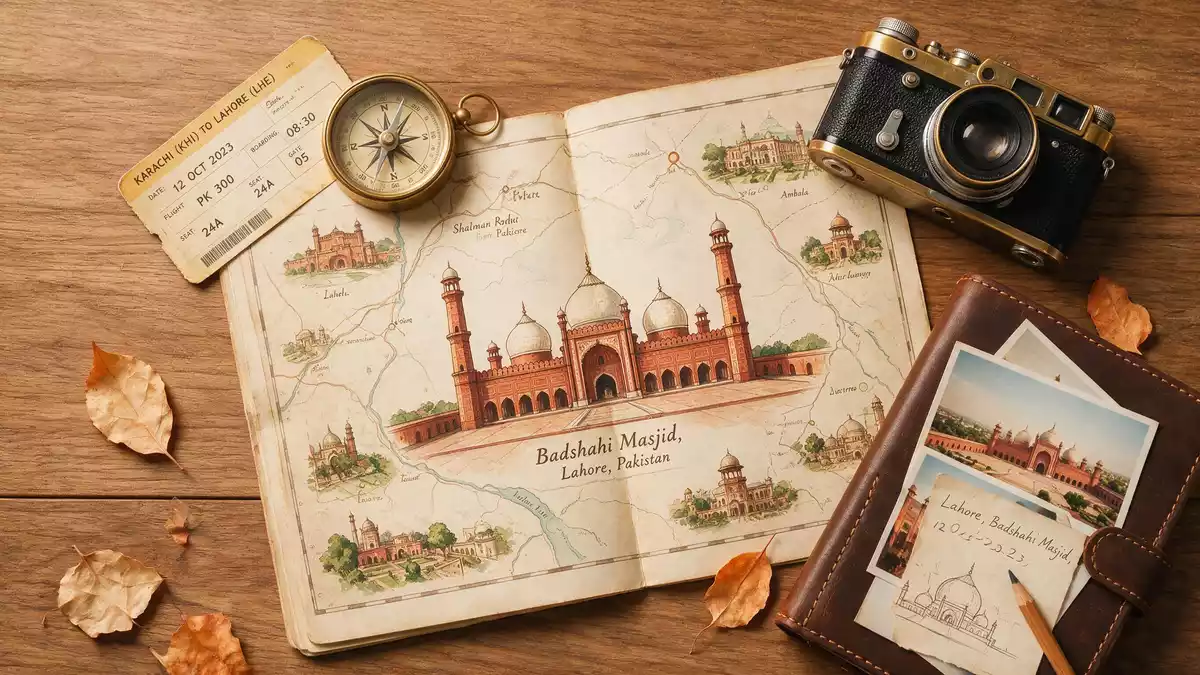
Badshahi Masjid in Lahore is a Mughal-era congregational mosque of red sandstone and white marble completed in the early 1670s under Emperor Aurangzeb, facing the citadel of Lahore Fort across Hazuri Bagh. Its vast courtyard, flanked by tall minarets and crowned by three white domes, turns imperial-scale architecture into an open-air stone landscape that visitors step into rather than merely look at.
Aurangzeb’s imperial mosque on the edge of the old city
Badshahi Masjid stands on the north-western side of Lahore’s historic core, beside the Lahore Fort and above the bank of the Ravi River, in what had been the Mughal imperial seat in Punjab.In the north-west corner of Lahore the mosque and fort share the same high platform, separated by the formal garden of Hazuri Bagh, so that their red walls and corner towers answer one another across the square.Facing the Lahore Fort across the Hazuri Bagh
The mosque belongs to the late Mughal period and was commissioned by the sixth Mughal emperor, Aurangzeb Alamgir, whose reign stretched from 1658 to 1707.Aurangzeb ordered the mosque in the early 1670s Construction began in 1671 and was completed within a few years, with Aurangzeb’s foster-brother Muzaffar Hussein, known as Fidai Khan Koka, supervising the work in his role as governor of Lahore.Construction between 1671 and 1673 under Fidai Khan Koka
Red sandstone, white marble and a courtyard like a plaza
The material palette of Badshahi Masjid follows other grand Mughal projects but scales them up: carved red sandstone is used for the walls and minarets, with panels of white marble inlaid in geometric and floral patterns.Red sandstone and white marble define the structure The main prayer hall is crowned by three white marble domes, while the surrounding structures carry smaller domes and parapets, creating a layered skyline when viewed from Hazuri Bagh or the ramparts of the fort.
Stepping through the main entrance brings visitors into an immense courtyard paved in stone, large enough to register as a public square in its own right.The courtyard accommodates vast congregations At its edges stand tall minarets at each corner, with further minarets set against the facade of the prayer hall, reinforcing the sense of a carefully framed open space. The alignment of the courtyard, gates and hall creates long, uninterrupted axes, which bring the eye from gate to mihrab and from the mosque across Hazuri Bagh to the fort beyond.
A working mosque and a heritage landmark
Badshahi Masjid remains a functioning congregational mosque while also standing as a major historic monument recognised at national level. The mosque’s period of construction in the early 1670s places it among the last great Mughal imperial mosques,a culmination of a century of Mughal mosque design and its scale allowed it to hold the record as the largest mosque built under the Mughals for generations.
The site is included on Pakistan’s Tentative List for UNESCO World Heritage inscription as part of the wider ensemble of Lahore’s monumental core.Badshahi Mosque on Pakistan’s UNESCO Tentative List Visitors see not only the mosque itself but also its setting among other Mughal and later-period structures, with the mosque’s red and white profile forming one of the defining silhouettes of the old city.
Visiting Badshahi Masjid: what travellers from Western Europe should know
- Badshahi Masjid stands next to Lahore Fort in the north-western quarter of Lahore’s old city, with Hazuri Bagh lying between the mosque and the fort.
- The approach to the mosque involves broad stone platforms and flights of steps, and the courtyard and outer terraces are paved in stone.
- The official language is Urdu and the currency is the Pakistani rupee.
- Entry requirements depend on your nationality; UK travellers can check the FCDO travel advice at gov.uk/foreign-travel-advice, Irish travellers the Department of Foreign Affairs at ireland.ie.
Searching for Badshahi Masjid on social platforms
These links open searches for Badshahi Masjid on each platform.
Frequently asked questions about Badshahi Masjid
Where is Badshahi Masjid located within Lahore?
Badshahi Masjid stands beside Lahore Fort in the north-western corner of Lahore’s old city, with Hazuri Bagh forming a formal square between mosque and fort.
What should visitors expect when entering Badshahi Masjid?
Visitors pass through monumental gates into a large stone-paved courtyard framed by red sandstone walls, minarets and a white-domed prayer hall that dominates the far side.
What makes Badshahi Masjid distinctive among Mughal mosques?
Its combination of a vast courtyard, extensive red sandstone surfaces, three white marble domes and a setting directly facing Lahore Fort marks it as a climax of late Mughal mosque design.


