Badshahi Masjid and Lahore Fort: Mughal grandeur in red sandstone
Published on 09/15/2026 at 06:51 | Editorial responsibility: Rafael Müller, Editor-in-Chief AD HOC NEWS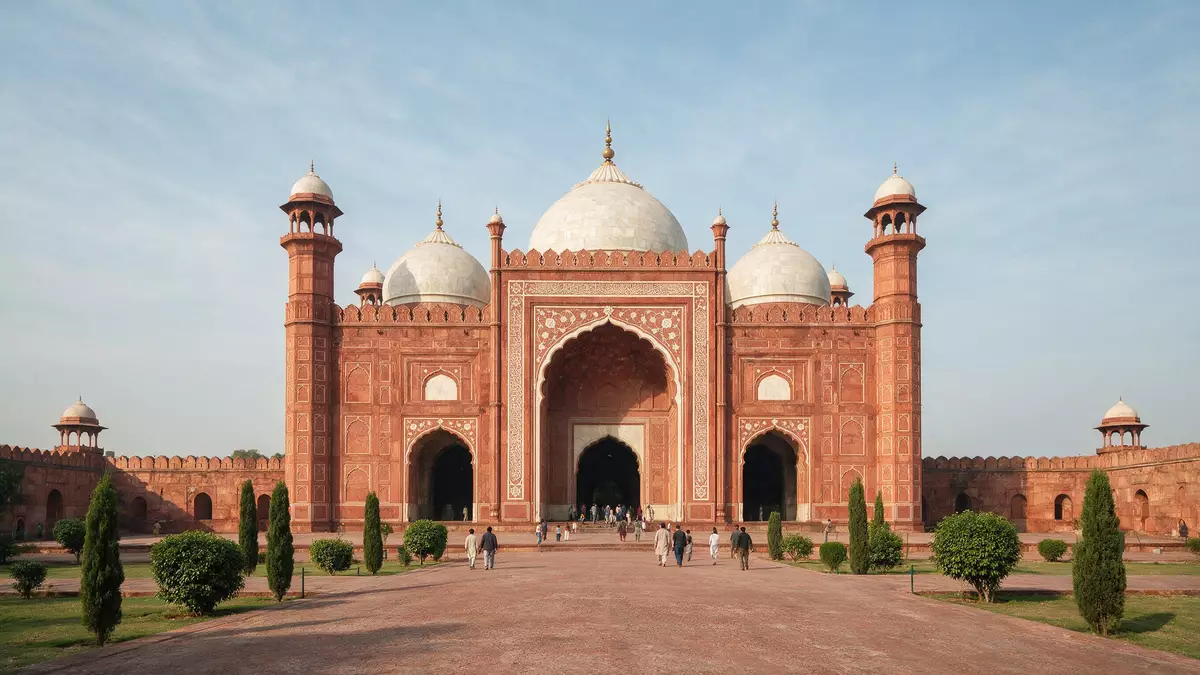
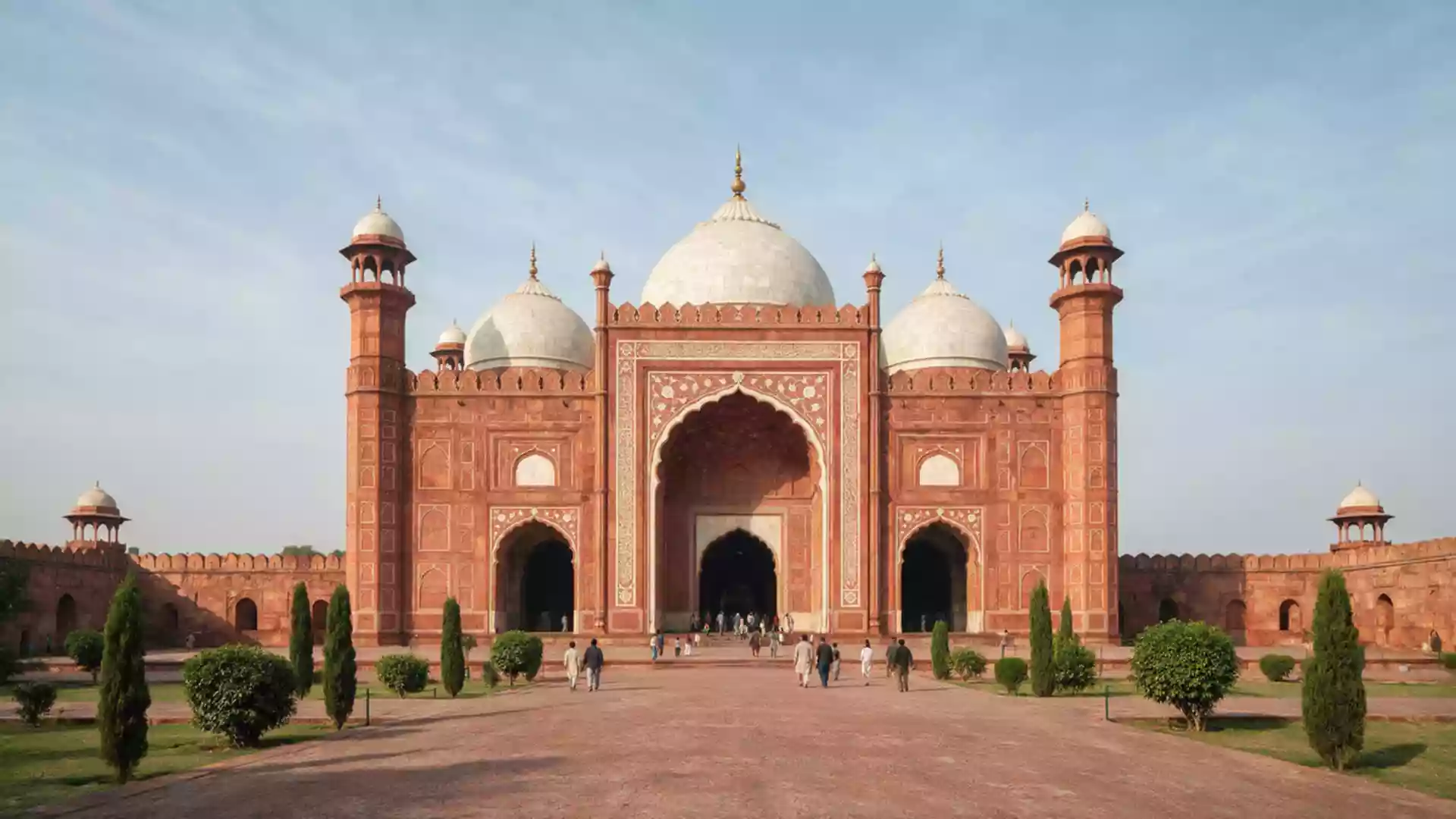
Badshahi Masjid in Lahore is a Mughal-era imperial mosque commissioned by Emperor Aurangzeb Alamgir in the early 1670s, facing the great Lahore Fort across Hazuri Bagh. Its immense red sandstone enclosure and white marble domes turn the north-west corner of Lahore into a single monumental ensemble, with mosque and fort sharing a raised terrace above the old city.
A seventeenth-century Mughal imperial mosque
Badshahi Masjid was commissioned by the sixth Mughal emperor Aurangzeb in 1671 and completed in 1673, during the high period of Mughal rule in South Asia.commissioned in 1671 and completed in 1673 It stands in Lahore, then a major Mughal capital, adjacent to the western wall of Lahore Fort with the open Hazuri Bagh garden between the two.adjacent to Lahore Fort across Hazuri Bagh The mosque is a congregational place of worship, laid out on an axis aligned towards Mecca, with its main prayer hall on the western side of a huge walled courtyard.
The building belongs to the Indo-Islamic Mughal architectural tradition, whose courtly style developed from the early sixteenth century onwards under emperors such as Akbar, Jahangir and Shah Jahan.Mughal architecture as a distinctive Indo-Islamic style Badshahi Masjid is often described as the last of the great Mughal imperial mosques, marking a culmination of this formal language in the later seventeenth century.the last great Mughal masjid Its scale reflects that status: the courtyard spreads across a vast platform, framed by arcades and punctuated by tall minarets at the corners.
Red sandstone, white marble and a vast courtyard
The character of Badshahi Masjid comes above all from its materials and layout. The exterior is built largely of carved red sandstone, with white marble used for inlay, mouldings and the three dominant domes of the prayer hall.cut and carved red sandstone with white-marble domes and inlay The combination creates a strong contrast between the warm tone of the walls and the pale stone crowning them, a palette echoed in detailing on arches and balustrades. Within the mosque, fresco work and stucco tracery add further layers of ornament to the structural brick and stone.
Plan and section are arranged around a single large courtyard, which functions as both circulation space and open-air place of prayer. High gateways lead into this enclosure; the principal entrance stands on the eastern side, opening from the garden square in front.white marble inscription over the main entrance On the west, the prayer hall rises on a base, its elevation articulated by tall recessed arches and capped by the three marble domes. At each corner of the courtyard, a slender, multi-storey minaret climbs above the parapets, their vertical emphasis balancing the broad horizontal sweep of the enclosing walls.
Badshahi Masjid in Lahore’s historic landscape
Badshahi Masjid occupies the north-western corner of Lahore, close to the old walled city and on the west bank of the River Ravi.on the west bank of the Ravi The mosque terrace and fort together form a single elevated complex, with views across the roofs of the historic neighbourhoods and towards the plains beyond. Between them lies Hazuri Bagh, a formal garden laid out as a parade ground and gathering place, which today reads as an open forecourt shared by palace and mosque.
The importance of Badshahi Masjid in this setting is recognised in heritage terms. The site is listed on Pakistan’s tentative roster for inscription on the UNESCO World Heritage List, underscoring both its architectural value and its role in the urban fabric of Lahore.tentative World Heritage list entry It remains a working place of worship and a major focus of civic life, while also serving as a landmark in views of the city from surrounding bridges and roads.
Visiting Badshahi Masjid: what travellers from Western Europe should know
- Badshahi Masjid stands beside Lahore Fort in the north-western part of Lahore, with the Hazuri Bagh square between the two and city streets leading up from the old town.
- The mosque complex is arranged on a raised stone platform with broad flights of steps at its main approach, and the courtyard itself covers a large paved area that involves substantial walking on hard surfaces.
- Lahore is in Pakistan, where the official language is Urdu and the currency is the Pakistani rupee.
- Entry requirements depend on your nationality; UK travellers can check the FCDO travel advice at gov.uk/foreign-travel-advice, Irish travellers the Department of Foreign Affairs at ireland.ie.
Searching for Badshahi Masjid on social platforms
These links open searches for Badshahi Masjid on each platform.
Frequently asked questions about Badshahi Masjid
Where is Badshahi Masjid located?
Badshahi Masjid is in the north-western part of Lahore in Pakistan, beside Lahore Fort and near the historic walled city.
What should visitors expect at Badshahi Masjid?
Visitors encounter a vast Mughal mosque complex with a large paved courtyard, red sandstone arcades, tall corner minarets and a richly decorated prayer hall.
What makes Badshahi Masjid distinctive among Mughal mosques?
Badshahi Masjid is distinguished by its enormous scale, its combination of carved red sandstone with white marble domes, and its close relationship with Lahore Fort across Hazuri Bagh.