

Babylon’s ruined walls on the Euphrates at Hillah
Published on 08/31/2026 at 11:13 | Editorial responsibility: Rafael Müller, Editor-in-Chief AD HOC NEWS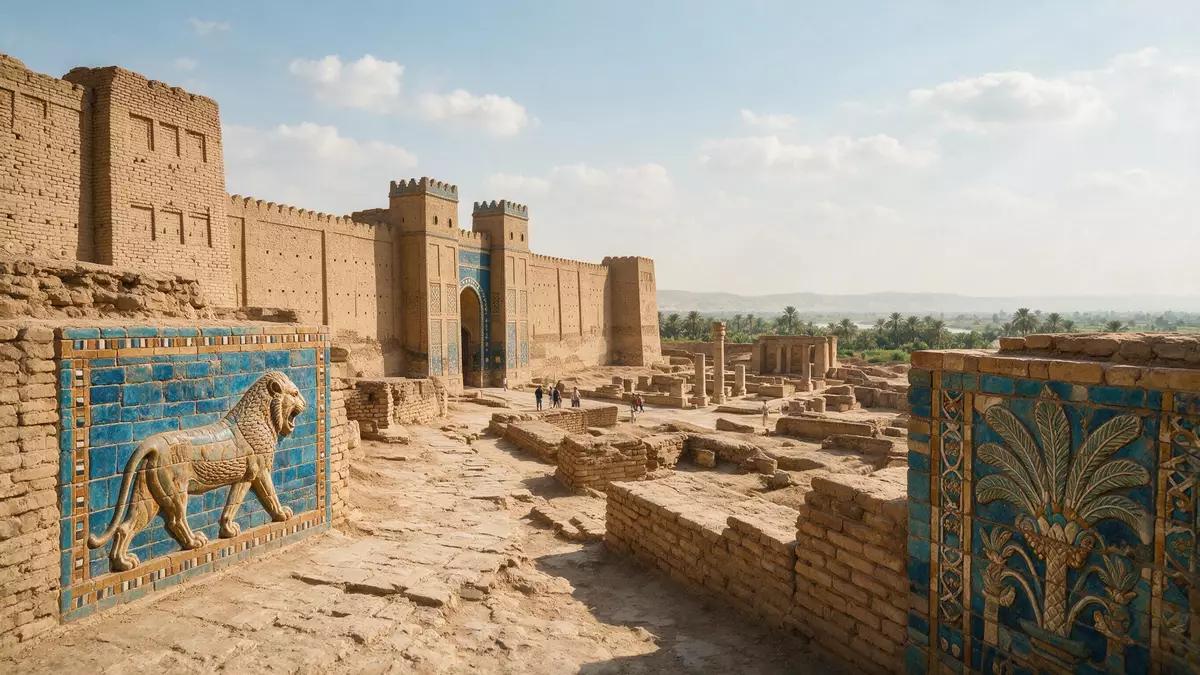
Babylon near Hillah in Iraq is an ancient city on the lower Euphrates where ruined walls, gates and temples still mark the outline of a former imperial capital. Its location in southern Mesopotamia and the surviving architecture reflect the city’s central role in the Neo-Babylonian Empire between 626 and 539 BCE, a period associated with rulers such as Hammurabi and Nebuchadnezzar II.
The imperial city in southern Mesopotamia
Babylon lies about 85 km south of Baghdad, within the Babil Governorate, on a flat plain beside a branch of the Euphrates River that once fed its canals and palace precincts.modern-day Hillah, Iraq The archaeological site covers well over 1,000 hectares, encompassing the core of the ancient city and adjoining agricultural land that framed its approach across the Mesopotamian landscape.the property includes the ruins From the main entrance area, visitors move through mudbrick walls and gateways aligned with the former processional routes that once led towards palace complexes and temple courtyards.
The city’s origins reach back into the late third millennium BCE, when an Akkadian settlement grew on this river bend, but its monumental scale dates from the Neo-Babylonian period in the seventh and sixth centuries BCE.first settled in the late third millennium BCE Under Nebuchadnezzar II, Babylon became the capital of a powerful empire whose territory stretched across much of the Near East, and the remains of outer and inner city walls, gates, palaces and temples on the site today reflect that role as a seat of royal power.seat of successive powerful empires
Walls, gates and the Ishtar processional way
Walking through Babylon, the most striking structures are the lines of fortification and ceremonial architecture that still define routes across the ruins. Sections of the inner city wall stand in long stretches of mudbrick, with towers and gateways marking former entrances to the royal and sacred precincts.outer and inner city walls, gates, palaces and temples Within this framework, the foundations of palaces and temples form rectangular blocks and platforms that suggest the dense urban fabric once enclosed behind the defensive ring.
One of the most evocative alignments is the route of the Processional Way associated with the Ishtar Gate, a grand thoroughfare paved in stone and brick and traced over more than half a mile.stone- and brick-paved avenue In antiquity, the eighth gate in the inner city wall, the Ishtar Gate, rose over this route as an enormous burnt-brick entryway, more than 12 m (39 ft) high, decorated in tiers with glazed reliefs of dragons and bulls.burnt-brick Ishtar Gate The original gate, excavated by Robert Koldewey between 1899 and 1917, now survives as reconstructed fragments in Berlin, while on site at Babylon a modern replica and foundations mark its former position along the northern approach.eighth gate to the inner city wall
Temples, palaces and World Heritage recognition
Beyond the defensive and ceremonial architecture, Babylon preserves the ground plans of major temples and palaces that illustrate the city’s religious and political functions. Named structures such as the Ninmakh Temple, Esagila Temple and the remains of a Greek theatre appear in the core area, with brick platforms, column bases and wall fragments indicating the layout of sanctuaries and public buildings.Ninmakh Temple and Esagila Temple The famous Lion of Babylon sculpture stands on a stone base within the site, representing a monumental piece of basalt carving that has become a symbol of Iraqi heritage.Lion of Babylon
In 2019, Babylon was inscribed as a UNESCO World Heritage Site under cultural criteria recognising its outstanding testimony to one of the ancient world’s most influential empires.inscribed on the World Heritage List The inscription highlights the city’s role as capital of the Neo-Babylonian Empire and emphasises how its unusual urbanism, monumental architecture and decorative programmes express royal authority on an urban scale.statement of outstanding universal value Although only a fraction of the site has been excavated, the exposed remains, combined with unexcavated mounds and surrounding villages, give a sense of the scale at which the ancient city once operated.
Visiting Babylon: what travellers from Western Europe should know
- Babylon lies south of Baghdad near Hillah in central Iraq, reached overland from the capital along the highway towards Babil Governorate and the Euphrates plain.
- The archaeological area is extensive and largely level, with long walks between ruined walls, gateways and temple platforms across open ground.
- The site stands in a semi-arid river landscape, so exposure to sun and dust is a permanent feature of any walk through the ruins.
- Arabic is the official language and the currency is the Iraqi dinar.
- Entry requirements depend on your nationality; UK travellers can check the FCDO travel advice at gov.uk/foreign-travel-advice, Irish travellers the Department of Foreign Affairs at ireland.ie.
Searching for Babylon on social platforms
These links open searches for Babylon on each platform.Frequently asked questions about Babylon
Where is Babylon in relation to Hillah and Baghdad?
Babylon stands near the modern city of Hillah in the Babil Governorate of Iraq, about 85 km south of Baghdad on the Euphrates plain.
What can visitors expect to see on a visit to Babylon?
Visitors encounter extensive mudbrick ruins of city walls, gateways, temple platforms, palace foundations and the route of the Processional Way linked to the Ishtar Gate.
What makes Babylon distinctive among ancient cities?
Babylon is distinctive for its role as capital of the Neo-Babylonian Empire and for the scale of its fortifications, ceremonial routes and monumental architecture preserved in the archaeological site.


