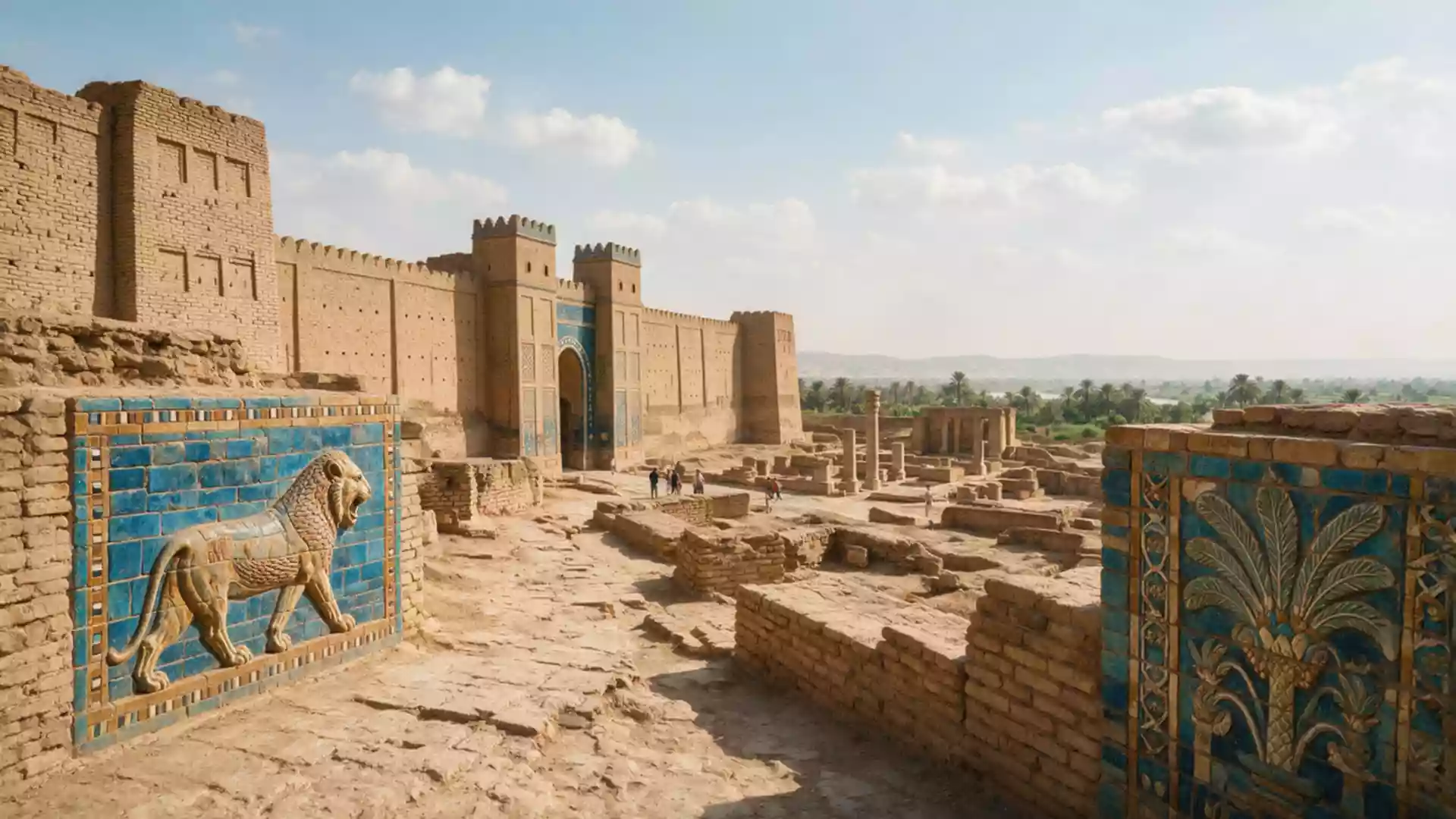
Babylon’s brick horizons above the Euphrates
Published on 09/03/2026 at 19:40 | Editorial responsibility: Rafael Müller, Editor-in-Chief AD HOC NEWS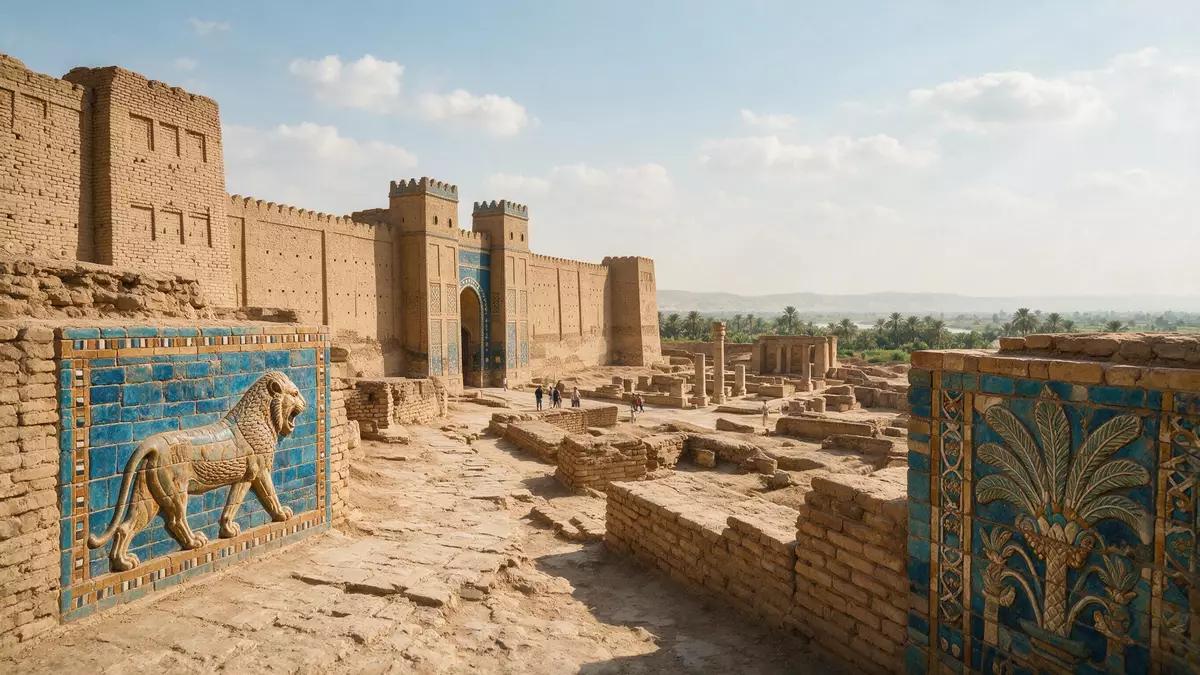
South of Hillah in Iraq, Babylon stretches across the plain as an immense field of ancient mudbrick and fired brick ruins along the Euphrates. Once the capital of the Babylonian Empire under Nebuchadnezzar II in the sixth century BC, the archaeological site now reveals layers of city walls, palaces and ceremonial avenues set within farmland and low modern villages.
An imperial city on the Euphrates
Babylon occupies a wide area on the lower Euphrates in southern Mesopotamia, within the modern Babil Governorate and the municipality of Shatt al-Hillah. The nominated World Heritage property includes both the inner and outer city walls together with selected agricultural land around the ancient core, so the ruins sit amid date groves, fields and small settlements rather than in isolation.Babylon is located 85 km south of Baghdad and is closely linked to the regional centre of Hillah.
The city flourished in Mesopotamia as a major centre of power, law and literature and became the heart of the Neo-Babylonian Empire under Nebuchadnezzar II in the sixth century BC.The site covers about 9 km², making it one of the largest preserved urban footprints from the ancient Near East, with defensive walls, monumental gateways and palace platforms still traceable in the ground plan.
Walls, palaces and the Processional Way
Within the core of Babylon, the ruins of the inner city wall define a dense zone of former streets, courtyards and towers that framed the royal and religious quarter. The remains of the South Palace, attributed to Nebuchadnezzar II, rise on a broad elevated platform of brickwork and rooms that once hosted the royal court and ceremonial receptions. Nearby stand museum buildings and twentieth-century additions, constructed in brick and concrete, which house finds and interpretive displays amid the older fabric.Villages such as Annanah and Sinjar lie within the property, so palace walls and domestic houses share the same horizon.
Running north from the main ceremonial quarter is the Processional Way, a paved avenue that once linked the city’s religious centre with an outer temple complex. This thoroughfare was built in stone and brick, laid in bitumen, and flanked by high walls decorated with rows of brick relief lions symbolising the goddess Ishtar.The Processional Way has been traced over more than half a mile, giving visitors a sense of the scale of Babylon’s ceremonial architecture even where the decoration survives only in fragments.
The Ishtar Gate and global echoes of Babylon
At the northern end of the inner city wall stood the Ishtar Gate, constructed around 575 BC under Nebuchadnezzar II. In its original form it was a double gate, with an outer and inner section, rising high above the Processional Way and faced with deep blue glazed bricks. Rows of moulded reliefs of bulls and dragons, arranged in tiers, gave the gate a striking appearance that is closely associated with Babylonian art.The Ishtar Gate was the eighth gate of the inner city wall and formed the ceremonial northern approach into Babylon.
In the early twentieth century, German archaeologist Robert Koldewey led excavations at Babylon, recovering large sections of the Ishtar Gate and the paving of the Processional Way.Fragments of the gate and avenue were reassembled in Berlin’s Pergamon Museum, where a reconstruction using original materials stands as one of the most recognisable images of Babylon. On site near Hillah, later brick reconstructions and modern replicas mark the position of the gate and its adjoining walls, so visitors encounter both ancient foundations and twentieth-century interpretations of the city’s appearance.
Visiting Babylon: what travellers from Western Europe should know
- Babylon lies south of Hillah in the Babil Governorate, close to the Euphrates; travellers generally reach it by road from Baghdad or other Iraqi cities.
- The archaeological zone covers a broad area, with long, exposed walks over uneven ground and extended stretches of brick and earth platforms.
- Summer temperatures in central Iraq can be very high, and the ruins provide limited shade, so visits involve significant time in direct sun.
- The official language is Arabic and the currency is the Iraqi dinar.
- Entry requirements depend on your nationality; UK travellers can check the FCDO travel advice at gov.uk/foreign-travel-advice, Irish travellers the Department of Foreign Affairs at ireland.ie.
Searching for Babylon on social platforms
These links open searches for Babylon on each platform.
Frequently asked questions about Babylon
Where is Babylon in relation to Hillah and Baghdad?
Babylon stands near Hillah in the Babil Governorate of Iraq, about 85 km south of Baghdad along the Euphrates River.
What can visitors expect to see at the Babylon site?
Visitors encounter extensive city walls, palace platforms, the line of the Processional Way, later reconstructions of the Ishtar Gate and museum buildings among surrounding villages.
What makes Babylon distinctive among ancient cities?
Babylon’s scale, brick architecture and surviving layout of walls, gates and ceremonial avenues mark it as a major imperial capital of the sixth century BC.