
Babylon’s brick-built horizons on the Euphrates
Published on 09/22/2026 at 02:25 | Editorial responsibility: Rafael Müller, Editor-in-Chief AD HOC NEWS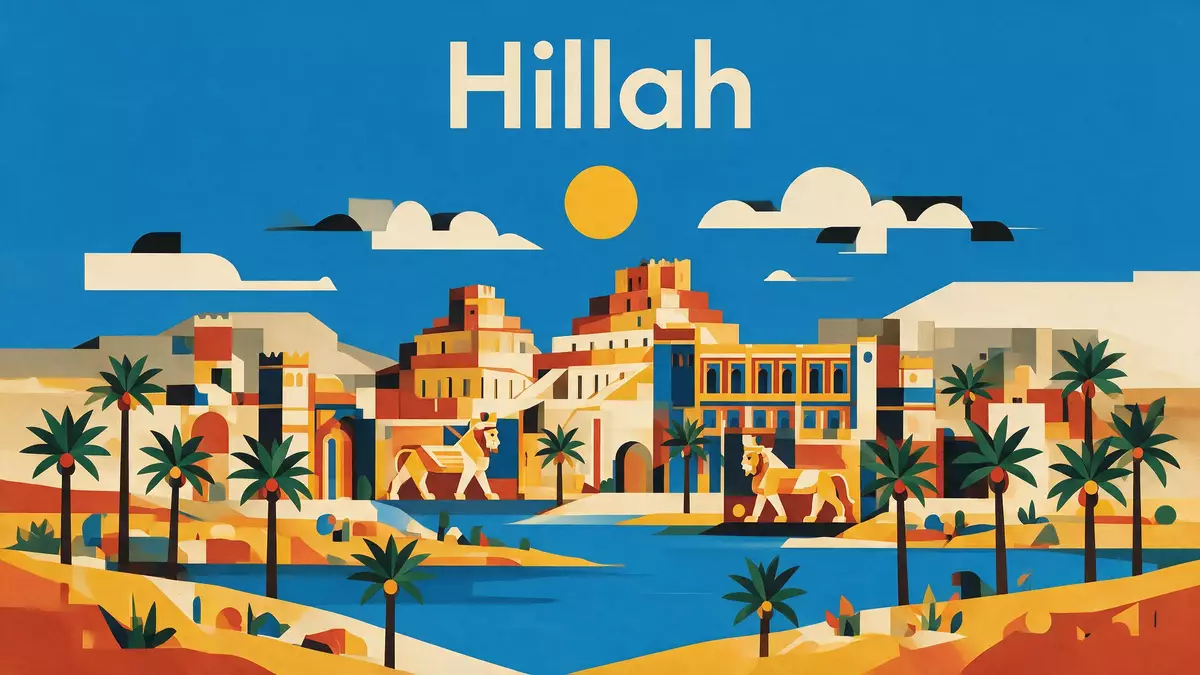
Babylon near Hillah in Iraq spreads across low mounds and reconstructed walls beside a bend in the Euphrates, a vast archaeological city shaped largely in fired mudbrick. Founded as a settlement in ancient Mesopotamia and later capital of the Neo-Babylonian Empire under Nebuchadnezzar II, it is one of the most recognisable names in world history and a World Heritage Site on Iraq’s central plain, where traces of palaces, processional streets and fortifications still define the terrain.ancient city in southern Mesopotamia
Brick, river and royal scale
The Babylon site lies within Babil Governorate, south of Baghdad and close to Hillah, where the Euphrates river threads past long platforms of ancient construction and eroded ramparts.location within the Shatt Al-Hillah municipality The historic core occupies a wide area of low rises and depressions, much of it formed from mudbrick structures that have flattened and weathered. Paths lead across level ground and shallow slopes between ruin fields, reconstructed sections and more modern interventions that mark the outlines of palace complexes and defensive works.
The material character of Babylon is inseparable from brick. Ancient builders in the region used sun-dried and kiln-fired bricks in immense quantities, creating city walls, platforms and gateways that once towered over the river plain.remains of outer and inner-city walls, gates, palaces and temples Even in ruin, visitors encounter long stretches of brick facing, stepped bases of former structures and paved ceremonial routes whose surfaces blend baked brick with stone. The river lies nearby, beyond vegetation and modern embankments, hinting at the way water, transport and fortified urban form once interacted here without requiring any reconstruction of motives.
The Ishtar Gate and the Processional Way
Among Babylon’s most studied elements is the Ishtar Gate, which historically formed one of the main entrances to the inner city and stood on the north side of the urban core.eighth gate to the inner city wall of Babylon In antiquity this double gateway rose above the route used for state and religious ceremonies, its brick surfaces carrying glazed reliefs of animals associated with the city’s deities. On site, a modern reconstruction of the gateway’s form stands near the line of the ancient street, giving a sense of the scale and colour that once faced travellers approaching from the north.
The Processional Way itself remains one of the most tangible linear features at Babylon. Archaeology has traced this stone- and brick-paved avenue over a considerable distance, linking the northern approach with central cult and palace areas.paved avenue called the Processional Way Walking its course today means moving between flanking walls and foundations, some restored, others eroded into low banks. Sections of pavement, kerbs and alignments still express the straight rhythm of the ancient route through the city, even where only a fraction of the original structure survives above ground.
Lion, palaces and UNESCO recognition
Scattered across the Babylon site are individual monuments that give shape to the story of imperial power. One of the best known is the Lion of Babylon, a carved stone figure set on a base that rises from surrounding ground formed primarily of brick ruins.Lion of Babylon Nearby, the outlines of the South Palace and other complexes attributed to Nebuchadnezzar II present courts and halls defined by reconstructed walls, entrances and open spaces, indicating the arrangement of royal architecture within the city.
Babylon’s significance has been recognised formally through its inscription on the World Heritage List, where it appears under Iraq’s entries as an archaeological city characterised by extensive surviving remains of walls, gates, palaces and temples.Babylon, Iraq, inscribed on the World Heritage List The property covers a broad area that includes parts of the ancient urban fabric and surrounding landscape, and documentation emphasises its role as capital of the Babylonian Empire and as a key centre in Mesopotamian civilisation. Visitors exploring the terrain encounter mounds, partial reconstructions and conservation works that reflect the ongoing effort to stabilise this fragile fabric of mudbrick and plaster.
Visiting Babylon: what travellers from Western Europe should know
- Babylon lies in Babil Governorate south of Baghdad, near the city of Hillah on the Euphrates; it is reached overland on roads that connect the capital with Hillah and the archaeological zone.
- Inside the archaeological area, movement is largely on foot over packed earth, brick surfaces and modest gradients, with some sections involving stairways and uneven ground among ruins and reconstructed walls.
- The wider setting is a river plain with hot summers and milder winters; seasonal temperatures in central Iraq influence how exposed the site feels on open terraces and streets.
- The official language is Arabic and the currency is the Iraqi dinar. Entry requirements depend on your nationality; UK travellers can check the FCDO travel advice at gov.uk/foreign-travel-advice, Irish travellers the Department of Foreign Affairs at ireland.ie.
Searching for Babylon on social platforms
These links open searches for Babylon on each platform.
Frequently asked questions about Babylon
Where is Babylon in relation to Hillah?
Babylon lies within Babil Governorate close to Hillah, on the Euphrates river south of Baghdad, forming an archaeological zone reached from the city by local roads.Babylon located 85 km south of Baghdad within Shatt Al-Hillah municipality
What can visitors expect to see at the Babylon site?
Visitors encounter extensive mudbrick ruins, reconstructed palace and wall sections, the line of the Processional Way, the Lion of Babylon and a modern reconstruction of the Ishtar Gate near the ancient route.highlights including Lion of Babylon, Processional Way and replica Ishtar Gate
What makes Babylon distinctive among ancient sites?
Babylon stands out for its scale as a former imperial capital, its mudbrick urban fabric, monumental gates like the Ishtar Gate, and its recognition as a World Heritage Site representing a major Mesopotamian empire.Babylon inscribed for criteria (iii) and (vi)


