
Babylon in Hillah, Iraq as a city of brick and empire
Published on 09/16/2026 at 14:12 | Editorial responsibility: Rafael Müller, Editor-in-Chief AD HOC NEWS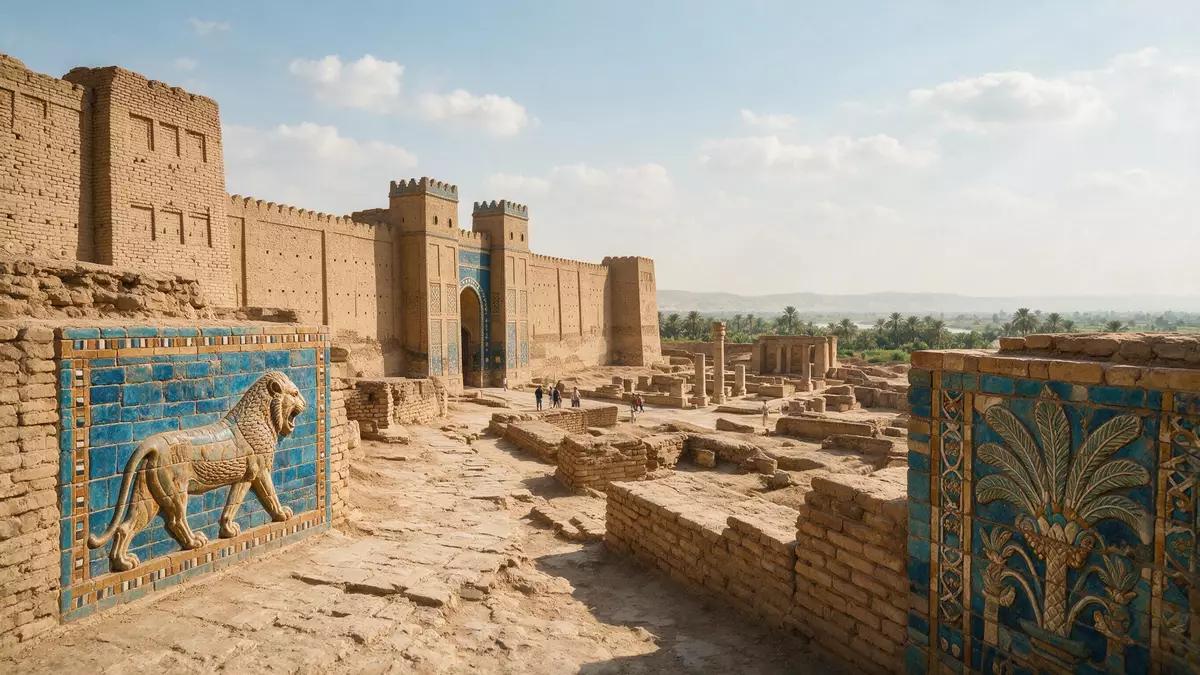
Babylon near Hillah in Iraq stretches across the flat Mesopotamian plain as an archaeological city of baked brick, earth mounds and surviving walls that still outline an ancient imperial plan. Set on the lower Euphrates in southern Mesopotamia and recognised as a UNESCO World Heritage Site, it preserves the core of the Neo-Babylonian capital that reached its height under King Nebuchadnezzar II in the sixth century BC.
Babylon on the lower Euphrates
Babylon occupies ground on the lower course of the Euphrates River in southern Mesopotamia, south of Baghdad and within the orbit of modern Hillah in Iraq. Archaeological and historical descriptions place the ruins around 85 km (about 53 mi) south of the Iraqi capital, close to the town that has grown up as Hillah.about 55 miles south of Baghdad Within this landscape the ancient city extended across a broad tract of land, with fortification lines enclosing a large area beside the river.
The archaeological property recognised on the World Heritage List brings together the ruins of the city that served as the centre of the Neo-Babylonian Empire between 626 and 539 BC, along with surrounding villages and agricultural land.centre of the Neo-Babylonian Empire between 626 and 539 BC Official documentation locates Babylon within Babil Governorate and places it inside the Shatt Al-Hillah Municipality area, underlining how the ancient remains sit within a living rural landscape as much as within an excavated city.within the territory of the Shatt Al-Hillah Municipality
City of Nebuchadnezzar II and the Neo-Babylonian Empire
The name Babylon refers above all to the capital of the Neo-Babylonian Empire, a power that operated across Mesopotamia between 626 and 539 BC and ended with the conquest of the city by Cyrus II of Persia. In this period the urban fabric was reshaped on a grand scale, with walls, gates, palaces and temples built or rebuilt under the rule of King Nebuchadnezzar II, who reigned from 605 to 562 BC.Nebuchadnezzar II, ruling from 605 BC to 562 BC Later historical periods, including the Achaemenid Persian Empire, continued to use Babylon, but the sixth-century city defines the plan that visitors trace in the ruins.
Descriptions of the Neo-Babylonian city underline its scale. Under Nebuchadnezzar II the built-up area covered hundreds of hectares, with an outer and inner wall system and multiple monumental sectors.renovated the city so that it covered 900 hectares World Heritage documentation records an inscribed area of about 1,054 hectares for the archaeological property, which maps the surviving traces of these sectors and their relation to the river.area of 1,054.3 hectares Within this expanse the remains of fortification lines, palace platforms and temple precincts stand as alignments of baked mud-brick and stone amid earth embankments.
Brick architecture and named features in the ruins
Babylon’s surviving structures are above all built of baked mud-brick, a material characteristic of Mesopotamian architecture in the late third and early first millennium BC.an ancient city located on the lower Euphrates Walls, platforms and foundations rise in stepped courses, with some sectors showing patterned brickwork that once carried decorative reliefs or inscriptions. Excavated and reconstructed stretches allow visitors to walk along the line of the Processional Way, a major route that passed through the ceremonial quarter and led towards monumental gates.
Several named elements help orient a visit. The Lion of Babylon is a carved stone figure set on a plinth, standing as one of the most recognisable single pieces of sculpture on the site.the Lion of Babylon, Processional Way, and replica Ishtar Gate Nearby, remains of Nebuchadnezzar’s city walls form high linear masses of brick that mark former boundaries between districts. A reconstruction of the Ishtar Gate, raised in the twentieth century using modern materials on ancient foundations, gives a sense of the scale and colour of the glazed-brick architecture associated with the Neo-Babylonian period, even though original glazed elements are preserved elsewhere. Together, these points make the site legible as a structured city rather than a formless field of ruins.
Visiting Babylon: what travellers from Western Europe should know
- Babylon lies near Hillah in central Iraq, south of Baghdad along the Euphrates River, and is reached by road connections that link the archaeological site with Hillah and the wider region.
- The archaeological area extends over a broad, mostly level plain, but within it visitors encounter uneven ground, earth mounds and brick platforms that require walking on packed soil and climbing steps between levels.
- The site stands in Iraq, where the official language is Arabic and the currency is the Iraqi dinar.
- Entry requirements depend on your nationality; UK travellers can check the FCDO travel advice at gov.uk/foreign-travel-advice, Irish travellers the Department of Foreign Affairs at ireland.ie.
Searching for Babylon on social platforms
These links open searches for Babylon on each platform.
Frequently asked questions about Babylon
Where is Babylon in relation to Hillah and Baghdad?
Babylon stands near the modern town of Hillah in Babil Governorate in Iraq, on the lower Euphrates River roughly 85 km south of Baghdad.
What can visitors expect to see at the Babylon archaeological site?
Visitors find extensive mud-brick walls, earth mounds and platforms, along with named features such as the Lion of Babylon, the Processional Way and a reconstructed Ishtar Gate.
What makes Babylon distinctive among ancient Mesopotamian cities?
Babylon’s distinctiveness lies in its role as the Neo-Babylonian imperial capital under Nebuchadnezzar II and in the scale of its brick-built fortifications, gates and palace platforms still traceable in the ruins.


