
Babylon in Hillah, Iraq: an ancient city of brick and myth
Published on 09/05/2026 at 10:41 | Editorial responsibility: Rafael Müller, Editor-in-Chief AD HOC NEWS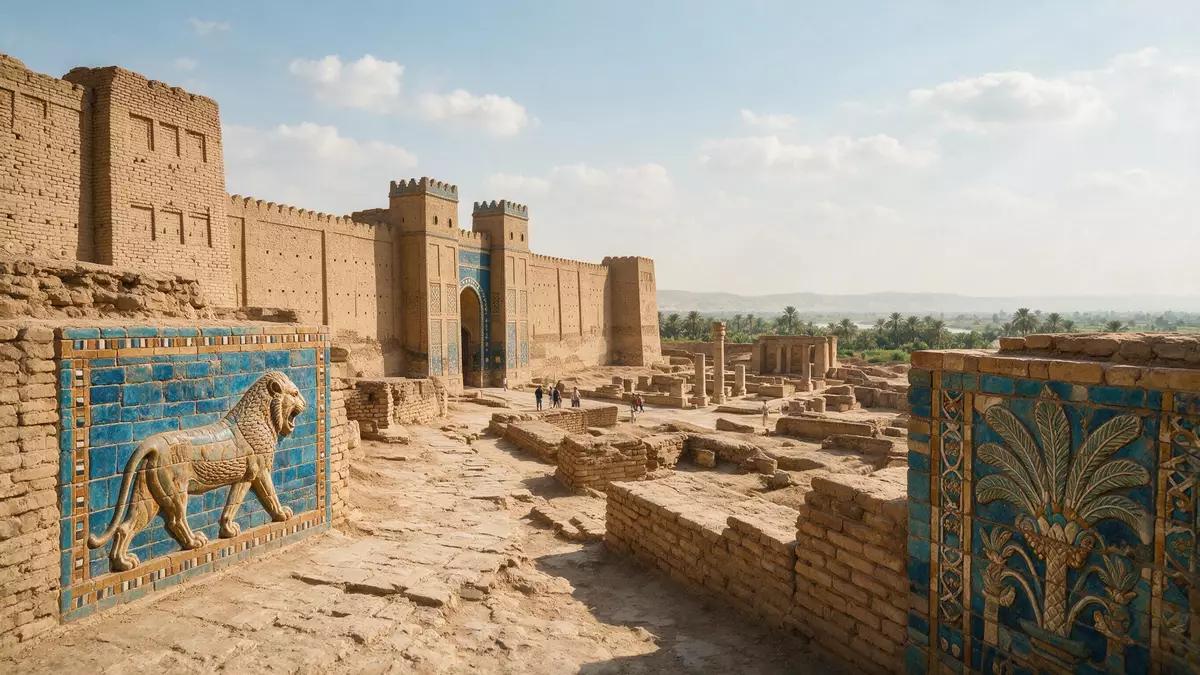
South of Baghdad near Hillah, Babylon stretches across the flat Mesopotamian plain as an archaeological city of baked brick, myth and measured geometry. Here the ruins of the Neo-Babylonian capital, centred on the reign of Nebuchadnezzar II in the sixth century BC, lie within a vast walled area that became a UNESCO World Heritage Site in 2019.
Brick, water and the plan of an imperial capital
Babylon occupies a broad tract of land on the lower Euphrates in southern Mesopotamia, within the orbit of modern Hillah in Iraq. Archaeological surveys and historical texts place the city around 85 km (about 53 mi) south of Baghdad, forming a rectangle of fortifications and inner districts that once enclosed palaces, temples and markets.Babylon on the lower Euphrates Within this space, the main constructions rise on platforms or mounds of compacted earth, with baked mud-brick walls marking former streets and courtyards.
The city plan combined massive outer ramparts with inner walls that separated royal and religious complexes from more ordinary quarters. Excavated stretches of fortification show bricks laid in regular courses, forming broad curtains punctuated by projecting defensive elements. Open areas within the walls include the palace district attributed to Nebuchadnezzar II, whose reign from 605 to 562 BC anchors much of the visible architecture, and temple precincts tied to the cult of Marduk, the chief god of Babylon.capital of the Neo-Babylonian Empire The scale of these complexes, read through foundations and wall lines, conveys the organisational power of a city that dominated Mesopotamia.
The Ishtar Gate and the Processional Way
Among the most striking remains at Babylon is the zone once occupied by the Ishtar Gate and its Processional Way, the ceremonial entrance to the inner city. The original gate, constructed under Nebuchadnezzar II in the later sixth century BC, stood as the eighth gate in the inner wall system and faced north towards the outer approaches.Ishtar Gate on the inner city wall Its structure used glazed bricks coloured in deep blue and other tones, arranged in panels of bulls, dragons and lions that represented deities such as Marduk, Adad and Ishtar.
From the gate a paved ceremonial street, the Processional Way, ran out across the city. Excavation has traced this route for hundreds of metres, with tall walls on either side carrying reliefs of lions in repeating sequence.lions along the Processional Way The paving incorporated red and yellow stones, some inscribed on their undersides with prayers from Nebuchadnezzar II to Marduk. The remains at Hillah show foundations, wall bases and sections of decorated brick that define the alignment of this route, while a modern reconstruction elsewhere, using bricks excavated from Babylon, gives a sense of the volume and colour the original once displayed.
Palaces, symbols and the Lion of Babylon
Beyond the gate complex, Babylon’s surviving structures include palace walls, temple outlines and freestanding monuments that have become visual symbols of the site. The principal palace associated with Nebuchadnezzar II occupies a substantial area of the inner city, with ranges of rooms and courtyards laid out in a sequence around larger halls. Excavated plans reveal a dense arrangement of right-angled spaces, service passages and open courts, all built in brick and resting on platforms of compacted soil.palace complex of Nebuchadnezzar II The thickness of the surviving walls suggests upper storeys or monumental interiors that once rose above the present ground level.
On a low rise near the principal ruins stands the Lion of Babylon, a sculpted stone figure of a lion set upon a block, long associated with the Neo-Babylonian period. Though weathered, the statue’s form remains recognisable and has become one of the most reproduced images of the site. Around it, other features such as the outlines of theatres and smaller temples appear in the archaeological record, indicating continued use and adaptation of Babylon into the Hellenistic era and beyond.structures including a Greek theatre Taken together, these elements show how Babylon functioned not only as a royal capital but also as a city with performance spaces and varied religious architecture.
Visiting Babylon: what travellers from Western Europe should know
- Babylon lies a short distance north of Hillah in central Iraq, south of Baghdad along the Euphrates; road links connect the archaeological site with Hillah and the wider region.
- The ruins extend across open, largely level terrain with long walks between palace mounds, gate remains and freestanding monuments, so firm footwear and protection from sun exposure are important.
- The official language is Arabic and the currency is the Iraqi dinar.
- Entry requirements depend on your nationality; UK travellers can check the FCDO travel advice at gov.uk/foreign-travel-advice, Irish travellers the Department of Foreign Affairs at ireland.ie.
Searching for Babylon on social platforms
These links open searches for Babylon on each platform.
Frequently asked questions about Babylon
Where is Babylon in relation to Hillah and Baghdad?
Babylon stands near Hillah in central Iraq, on the lower Euphrates, about 85 km south of Baghdad along the main route into the Babil Governorate.
What can visitors expect to see at Babylon?
Visitors encounter extensive brick ruins, including palace foundations, sections of city walls, the area of the Ishtar Gate and Processional Way, and monuments such as the Lion of Babylon.
What makes Babylon distinctive among ancient cities?
Babylon is distinctive for its role as the Neo-Babylonian imperial capital under Nebuchadnezzar II, its monumental gate and ceremonial street, and its inscription as a UNESCO World Heritage Site in 2019.


