
Ayutthaya Historical Park and the ruins of Siam
Published on 08/20/2026 at 06:34 | Editorial responsibility: Rafael Müller, Editor-in-Chief AD HOC NEWS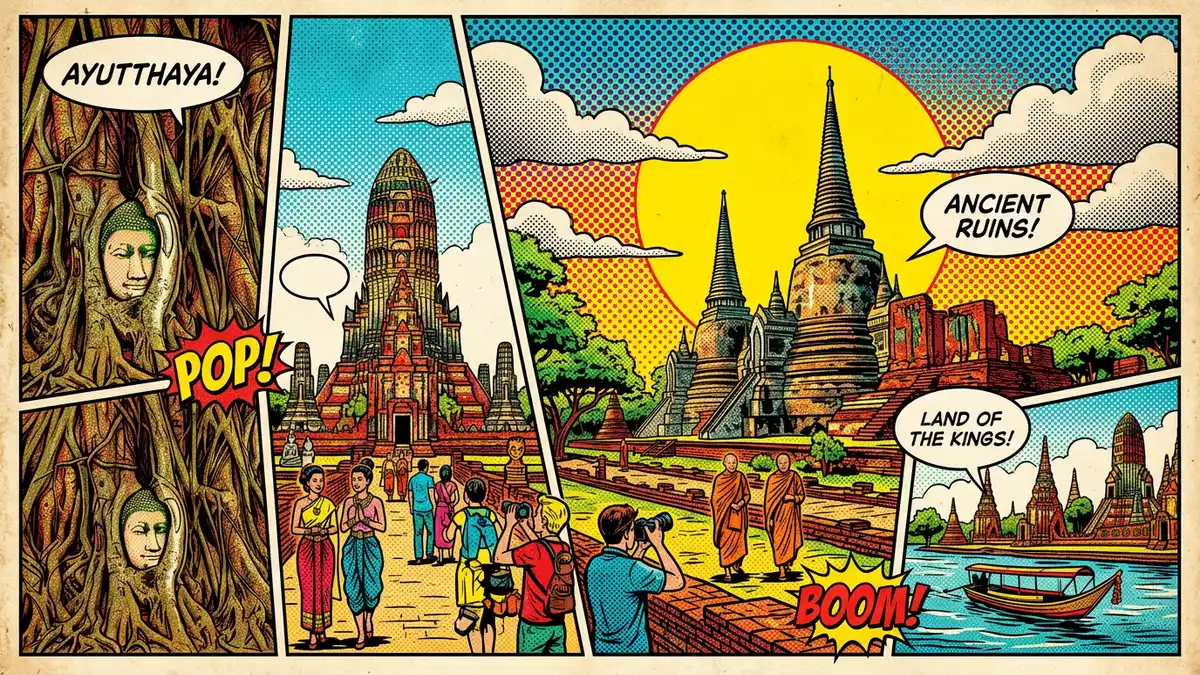
Ayutthaya Historical Park in Ayutthaya holds the remains of a former Siamese capital spread across temple ruins, brick foundations and tall prangs. It is part of the Historic City of Ayutthaya, inscribed in 1991, and its historic landscape remains legible as a ruined city.
Prangs, monasteries and ruined city blocks
The park’s most recognisable forms are the reliquary towers known as prangs and the large Buddhist monasteries that surround them. Their brick and stucco remains give the place a vertical accent, while the low walls and terraces mark out older temple grounds.
Wat Mahathat and Wat Phra Si Sanphet are among the names most closely associated with the park. Both belong to the wider fabric of the old capital, where ceremonial, religious and royal spaces once stood in close relation.
The capital of Ramathibodi I
Ayutthaya was founded around 1350 and became the second Siamese capital after Sukhothai. The site is linked with Ramathibodi I, whose name anchors the city’s early history, and with the long development of the Ayutthaya Kingdom.
Its ruins are tied to the city’s destruction in the eighteenth century, after which the remains were left as an archaeological landscape rather than a rebuilt capital. The park preserves that layered setting, where later repair sits beside collapsed masonry and empty sanctuaries.
A total area of 289 ha is recorded for the World Heritage property, and the protected core sits within the old urban area. The result is a broad field of monuments rather than a single enclosed monument.
Urban form and temple landscape
The old city was laid out with roads, canals and moats around principal structures, and that pattern still shapes how the ruins are read on the ground. Three rivers framed the island city, and the surviving ruins continue to sit within that water-bound setting.
Ayutthaya Historical Park is not a single temple complex but a historic cityscape in fragments. That makes its long lines of brick, broken towers and monastery platforms as important as any one building.
Visiting Ayutthaya Historical Park: what travellers from Western Europe should know
- The park lies in Ayutthaya, north of Bangkok, within Phra Nakhon Si Ayutthaya Province. Rail connections run to Ayutthaya station, and road access follows the main routes through the town.
- The ruins are spread across an extensive historic area, so movement between monuments involves open streets, temple grounds and paths around masonry remains.
- The site combines Buddhist sanctuaries, royal remains and archaeological fragments. Wat Mahathat, Wat Phra Si Sanphet and other temple sites form the main cluster.
- The official language is Thai and the currency is the Thai baht.
- Entry requirements depend on your nationality; UK travellers can check the FCDO travel advice at gov.uk/foreign-travel-advice, Irish travellers the Department of Foreign Affairs at ireland.ie.
Searching for Ayutthaya Historical Park on social platforms
These links open searches for Ayutthaya Historical Park on each platform.
Frequently asked questions about Ayutthaya Historical Park
Where is Ayutthaya Historical Park?
It is in Ayutthaya, in Phra Nakhon Si Ayutthaya Province, north of Bangkok. The park covers the ruins of the old capital within the historic city area.
What does a visit involve?
It involves moving among temple remains, brick platforms and ruined towers spread across a large archaeological landscape. The main monuments sit in the same broad urban setting rather than in a single compact compound.
What makes Ayutthaya Historical Park distinctive?
Its distinctive character lies in the scale of the ruined city and the survival of prangs, monasteries and water-linked urban traces. The place reads as a capital reduced to fragments, yet still coherent in outline.


