
Ayutthaya Historical Park and the brick skeleton of a lost Siamese capital
Published on 09/19/2026 at 18:10 | Editorial responsibility: Rafael Müller, Editor-in-Chief AD HOC NEWS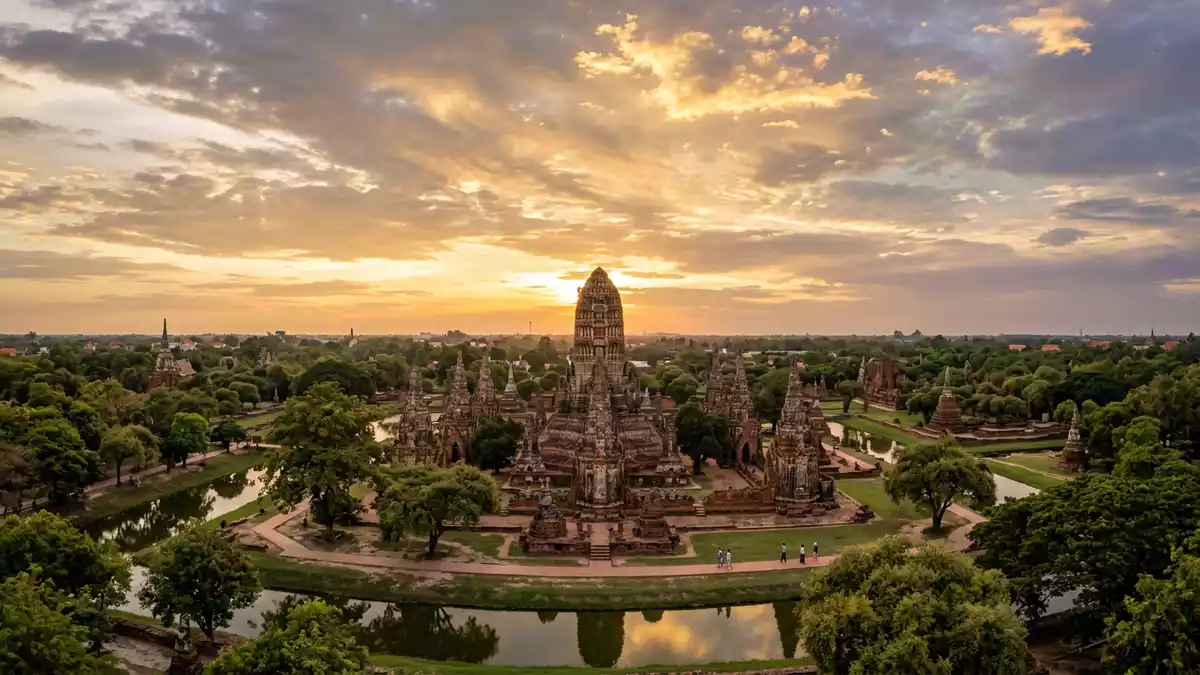
Ayutthaya Historical Park in Ayutthaya, Thailand preserves the brick and stucco skeleton of the former Siamese capital destroyed in the eighteenth century, turning a once?royal city into an open?air archaeological landscape. Within the park, temple platforms, prang towers and palace foundations trace the outline of a kingdom that rose in the mid?fourteenth century and fell in 1767, a history recognised in 1991 when the “Historic City of Ayutthaya” was inscribed as a UNESCO World Heritage Site.
A kingdom written in brick and stucco
The story carried by Ayutthaya Historical Park begins with King Ramathibodi I, also known as King U?Thong, who founded Ayutthaya as the capital of the Ayutthaya Kingdom in 1351. His decision established a city that would dominate large parts of mainland Southeast Asia for more than four centuries, leaving dense layers of religious and royal construction whose remains now form the park’s core.King Ramathibodi I founded Ayutthaya in 1351 Over time, successive rulers extended the city’s ceremonial and administrative heart, building monasteries around palace compounds and lining canals and processional routes with religious structures.
The destruction of Ayutthaya by Burmese forces in 1767 reduced much of this brick city to ruins, leaving collapsed chedi bases, shattered boundary walls and rows of decapitated Buddha images that still stand within the park. The remains show how religious and political power were physically intertwined: temple complexes sit next to palace platforms, and prang towers rise over former urban quarters in a pattern that can be read along the park’s main axes.The eighteenth?century destruction left temple ruins and broken Buddhas
Wat Mahathat, Wat Ratchaburana and the ceremonial core
Among the most studied monuments in Ayutthaya Historical Park are Wat Mahathat and Wat Ratchaburana, two major temple complexes that face one another near the city’s former centre. Wat Mahathat traces its origins to the fourteenth century and is associated with the role of the Supreme Patriarch of Thai Buddhist monks, a position that underlines the temple’s national religious importance.Wat Mahathat dates from the fourteenth century Its brick terraces and central prang survive in partly collapsed form, framed by rows of seated Buddha figures whose missing heads mark the violence of the city’s fall.
Directly across the street, Wat Ratchaburana preserves one of Ayutthaya’s most intact central prang towers, built in the fifteenth century and still rising above surrounding subsidiary structures.Wat Ratchaburana was built in the fifteenth century Together, Wat Mahathat and Wat Ratchaburana form a compact area in which travellers can compare different phases of Ayutthaya’s architectural language, from early Khmer?influenced tower forms to later expansions in brick and stucco. Their proximity also illustrates how major monasteries clustered around the political centre, with palace traces and other official buildings nearby.
The UNESCO?listed historic city and its wider landscape
Ayutthaya Historical Park is larger than the UNESCO?listed core, extending across the island bounded by rivers that define the old city’s outline. The World Heritage property known as the “Historic City of Ayutthaya” covers 289 hectares on this island and includes key temple and palace ruins such as Wat Phra Si Sanphet, Wat Phra Ram and the foundations of the main royal residences.The Historic City of Ayutthaya covers 289 hectares on the island Within this area, the grid of former streets and canals is still legible in the spacing between monuments and the alignment of walls.
Beyond the inscribed zone, but still within Ayutthaya Historical Park, stand additional sites such as Wat Chaiwatthanaram on the opposite riverbank and Baan Hollanda, the restored remains of a Dutch trading enclave, which underline Ayutthaya’s role as an international port city.Wat Chaiwatthanaram and Baan Hollanda lie within the wider park Together, these inner and outer zones show how the city combined royal, religious and mercantile functions, with brick monasteries, wooden waterfront quarters and foreign trading communities all woven into a single urban fabric.
Visiting Ayutthaya Historical Park: what travellers from Western Europe should know
- Ayutthaya Historical Park lies within the island?like old city of Ayutthaya, north of Bangkok, reached overland by road and rail links to Ayutthaya railway station.
- Many of the principal ruins stand on open, level ground, but several temple complexes include stairways climbing prang towers or chedi bases, as well as uneven brick surfaces that call for steady footing.
- The Chao Phraya and Pa Sak rivers run along the edges of the historic island, so some monuments such as Wat Chaiwatthanaram stand beside wide stretches of water with views back towards the main cluster of ruins.
- The official language is Thai and the currency is the baht.
- Entry requirements depend on your nationality; UK travellers can check the FCDO travel advice at gov.uk/foreign-travel-advice, Irish travellers the Department of Foreign Affairs at ireland.ie.
Searching for Ayutthaya Historical Park on social platforms
These links open searches for Ayutthaya Historical Park on each platform.Frequently asked questions about Ayutthaya Historical Park
Where is Ayutthaya Historical Park located?
Ayutthaya Historical Park occupies the island?based old city of Ayutthaya in central Thailand, with the core UNESCO?listed area covering 289 hectares within this urban island.
What can visitors expect when walking through the park?
Travellers move among temple platforms, prang towers, palace foundations and broken Buddha images, reading the outline of the former Ayutthaya Kingdom capital in brick, stucco and open grassy spaces.
What makes Ayutthaya Historical Park distinctive among historic sites in Thailand?
The park combines the ruins of royal palaces, major monasteries such as Wat Mahathat and Wat Ratchaburana, and foreign trading quarters within a single cityscape recognised as the Historic City of Ayutthaya on the UNESCO World Heritage List.


