
Axum Stelae and the stone towers of the Aksumite kingdom
Published on 09/14/2026 at 18:27 | Editorial responsibility: Rafael Müller, Editor-in-Chief AD HOC NEWS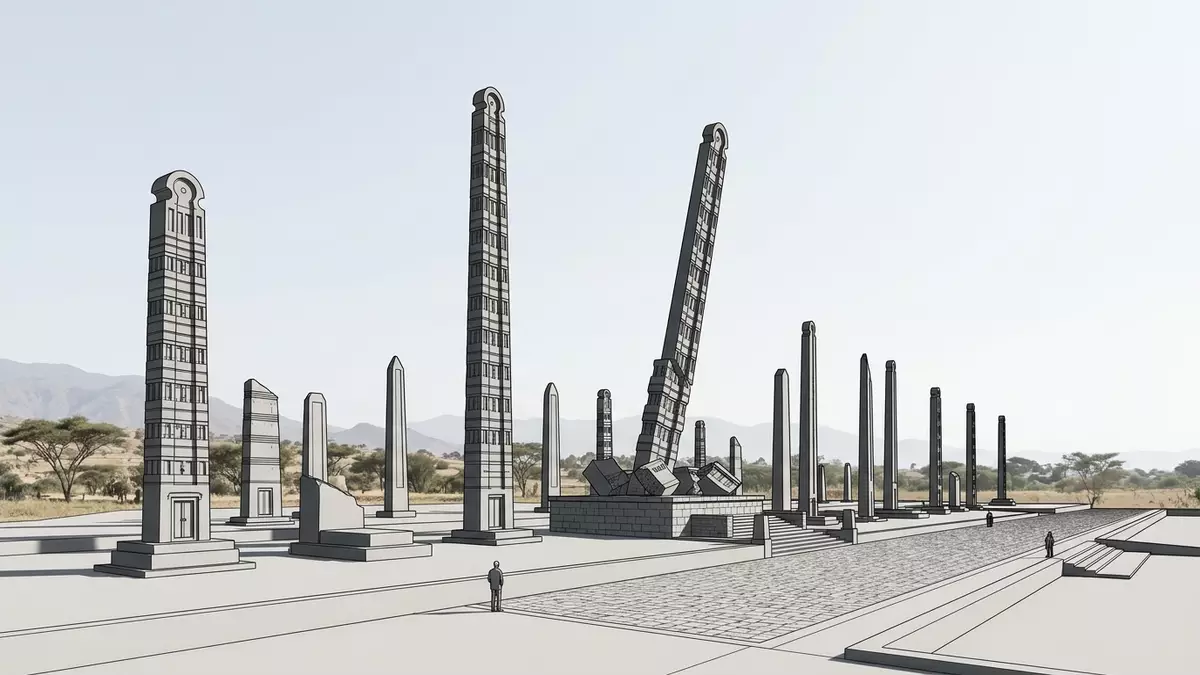
Axum Stelae are monumental stone towers standing over an ancient burial landscape on the northern edge of Aksum in northern Ethiopia. Carved from single blocks of local rock and aligned in rows, they form one of the most striking surviving ensembles of the Aksumite kingdom, with several major monuments dating to the third and fourth centuries AD.
Granite towers over an ancient necropolis
The main concentration of Axum Stelae lies in what is known as the Northern Stelae Park, an archaeological field close to the centre of Aksum where memorial towers and tombs share the same ground. In this park, dozens of monoliths stand or lie in ordered rows, marking burial structures beneath the surface and forming a dense forest of vertical stone in front of the town’s low buildings.Northern Stelae Park The stelae field sits within the broader archaeological zone of Aksum that preserves palatial remains and religious structures from one of Africa’s major ancient civilisations.archaeological sites of Aksum
Most of the Axum Stelae are made from a grey, fine-grained volcanic rock, cut and carved into elongated pillars with stepped tops and carefully dressed surfaces. The larger examples are decorated with panels that resemble multi-storey facades, complete with projecting elements and shallow reliefs that recall doors and windows. Smaller stelae are simpler in profile, but together they trace out the extent of the necropolis, spreading away from the town and towards the surrounding hills.
The great decorated stelae and their royal patrons
Among the Axum Stelae, three great decorated monuments have long drawn particular attention for their size and detailing. The first, often called the Great Stele or Stele One, lies broken on the ground and measures around 33 m (108 ft) in length; it is thought to date from the late third or early fourth century and to be one of the largest monoliths ever quarried and shaped by human hands.Great Stele measurements Nearby stands the Obelisk of Axum, a decorated stele about 24 m (79 ft) tall and weighing roughly 160 tonnes, which was carved in the fourth century and is one of the best-preserved towers in the field.Obelisk of Axum
The third major monument is King Ezana’s Stele, a decorated tower associated with the fourth-century Aksumite ruler Ezana and distinguished by inscriptions recording his reign.King Ezana’s Stele It is the only one of the three giant stelae that has remained standing without interruption since antiquity, providing a rare continuous link between Aksum’s ancient elite and the town’s later Christian heritage. Together, these three decorated monuments anchor the cemetery and demonstrate the engineering ambition of the Aksumite kingdom.
Axum Stelae within a World Heritage landscape
Axum Stelae form part of a wider urban and archaeological landscape that reflects the emergence of the Aksumite kingdom as a major power in the first centuries AD. The town of Aksum was the centre of a state that controlled trade routes between the Nile region, the Red Sea and the interior of the Horn of Africa, and its monumental stelae were erected during the third and fourth centuries AD as markers for elite burials.funerary markers for elites The stelae stand close to remains of palaces and other structures that indicate the political and ceremonial importance of this quarter of Aksum.decorated Aksumite stelae
In 1980, the archaeological sites of Aksum, including the stelae field and associated remains, were inscribed on the UNESCO World Heritage List, recognising their significance for the history of architecture, trade and religion in the region.UNESCO inscription of Aksum The Axum Stelae are cited as “exquisitely carved monolithic stelae” dating from the third and fourth centuries AD, and they contribute to the site’s inscription under criteria that emphasise outstanding human creative achievement and the testimony the monuments provide to an ancient civilisation.
Visiting Axum Stelae: what travellers from Western Europe should know
- Axum Stelae stand in Aksum in northern Ethiopia’s Tigray region, with the main Northern Stelae Park located close to the town centre and reached along local roads from nearby settlements.
- The stelae field is an open archaeological landscape with uneven ground, stone surfaces and approaches that involve walking between burial structures and towers, requiring firm footwear and care on slopes and steps.
- Aksum lies in a highland region of Ethiopia, where the stelae park sits at altitude above sea level; visitors experience thin, dry air and strong sunlight, and shade on site is limited.
- The official language is Amharic and the currency is the Ethiopian birr; English is used in some interpretive material in the archaeological areas.
- Entry requirements depend on your nationality; UK travellers can check the FCDO travel advice at gov.uk/foreign-travel-advice, Irish travellers the Department of Foreign Affairs at ireland.ie.
Searching for Axum Stelae on social platforms
These links open searches for Axum Stelae on each platform.
Frequently asked questions about Axum Stelae
Where are Axum Stelae and what is the surrounding landscape like?
Axum Stelae stand on the northern side of Aksum in Ethiopia’s Tigray highlands, in an archaeological park where stone towers rise above tombs and low town buildings.
What can visitors expect when walking among the stelae?
Visitors move between standing and fallen monoliths on uneven stone and earth surfaces, passing decorated towers such as the Obelisk of Axum and the broken Great Stele within a concentrated necropolis.
What makes Axum Stelae distinctive among ancient monuments?
The Axum Stelae are distinguished by their scale, monolithic construction and carved facades, and by their role as elite funerary markers within a UNESCO-listed archaeological landscape dating to the third and fourth centuries AD.


