
Axum Stelae and the granite towers of Aksum
Published on 09/07/2026 at 14:37 | Editorial responsibility: Rafael Müller, Editor-in-Chief AD HOC NEWS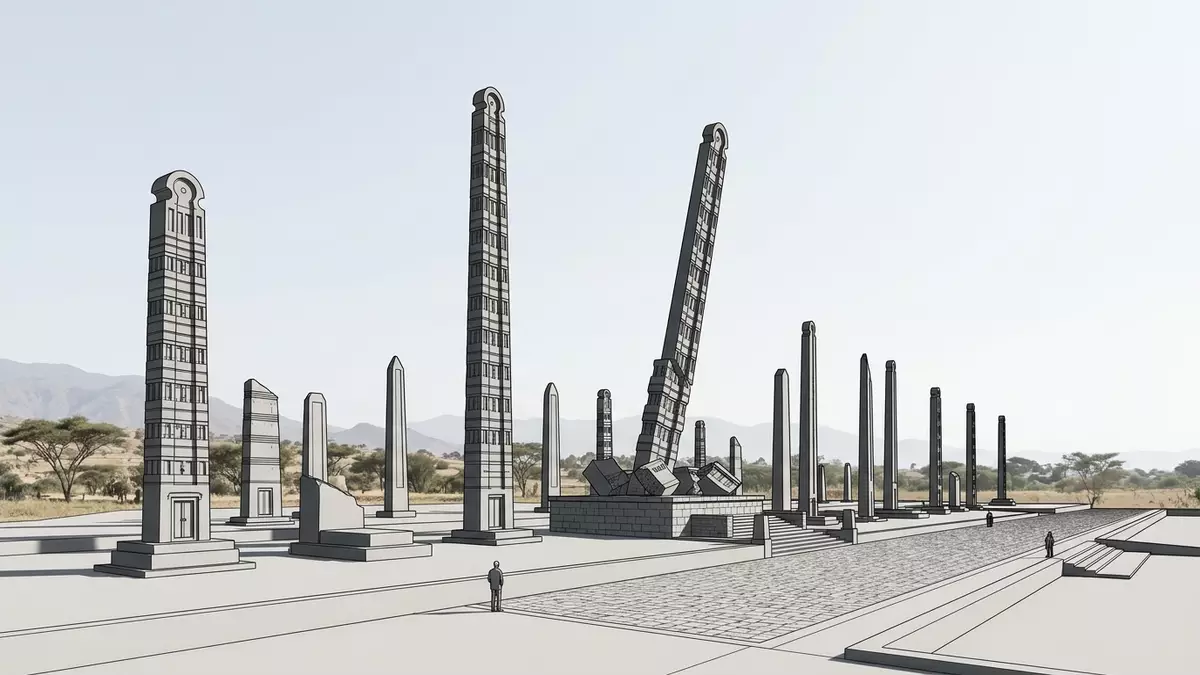
Axum Stelae are monumental stone towers standing in and around the town of Aksum in northern Ethiopia, where the great royal grave markers of the Aksumite kingdom still rise above the highland landscape. Carved from single blocks of stone and set above tombs, they form one of the most distinctive surviving ensembles of late antique Ethiopia, with key examples dating to the third and fourth centuries AD.
Granite towers of the Aksumite kingdom
Aksum lies on a high plateau in the Tigray region of northern Ethiopia, and its major monuments include fields of stelae, known in English as Axum Stelae.Aksum stands on a high plateau These towers are single blocks of granite, quarried, dressed and carved so that their surfaces resemble multi-storey buildings, with storeys stacked above a marked doorway and framed by rows of windows.single blocks of granite
The stelae belong to the architectural legacy of the Kingdom of Aksum, dated by historians and UNESCO to between the first and eighth centuries AD.Kingdom of Aksum Many of the stone towers in the main fields date between the third and fourth centuries AD, a period when Aksum was a major power between the Eastern Roman Empire and Persia.stelae survive dating between the 3rd and 4th centuries AD The site of Aksum, including its stelae fields and associated tombs and palaces, was inscribed on the UNESCO World Heritage List in 1980 for its outstanding testimony to this civilisation.UNESCO World Heritage List in 1980
Northern Stelae Park and the great monuments
The most accessible concentration of Axum Stelae lies in the Northern Stelae Park, also known as the Northern Stelae Field, close to the centre of Aksum.Northern Stelae Field Here more than one hundred stone markers of various sizes stand in an archaeological field, many made of smooth grey granite and aligned above burial structures below.contains 176 stelae The park forms part of a wider royal and elite cemetery landscape that also includes the Gudit Stelae Field and central areas around major churches.
Among the Axum Stelae, three great monuments dominate descriptions of the site. The largest, known as the Great Stele, would measure about 33 m (108 ft) in length if upright, but it lies fallen and broken in the field.Great Stele measuring 33 metres The second is the Obelisk of Axum, a 24 m (79 ft) phonolite stele whose carved faces are divided into storeys above a doorway, and whose weight is around 160 tonnes.Obelisk of Axum Nearby stands King Ezana’s Stele, about 21 m (69 ft) tall above ground, originally carved from a single piece of granite and associated with a fourth-century ruler of Aksum.Stele is 21m in height above ground
Burial landscape and carved detail
The Axum Stelae stand above built tomb complexes, and their function as grave markers for royal and elite burials is clear from the chambers beneath them.great stelae are grave markers The size and finish of each tower reflect the status of the person buried below, ranging from rough smaller markers in the surrounding fields to the elaborately carved great stelae near the heart of the cemetery.elaborately carved megalithic royal grave markers
On the surfaces, Axum Stelae show typical Aksumite design. False doors and windows are picked out in relief, and the arrangement of panels evokes multi-storey palaces rather than simple markers, linking the monuments to the architecture of the kingdom’s elite buildings.decorated with false doors and windows In some cases, low platforms or altars near the bases carry grooves cut into the stone, which are associated by archaeologists with the management of sacrificial offerings at the graves.altars at the base with grooves
Visiting Axum Stelae: what travellers from Western Europe should know
- Axum Stelae stand in and around the Northern Stelae Park on the northern side of Aksum in Ethiopia’s Tigray region, reached by road connections from other towns in northern Ethiopia.
- The archaeological fields contain uneven ground, stone surfaces and burial pits, so walking involves exposed rock and short climbs across low mounds.
- Aksum lies on a high plateau in northern Ethiopia at an elevation of over 2,000 m (about 6,560 ft), so the air is thinner than in many Western European cities.
- The official language is Amharic and the currency is the Ethiopian birr.
- Entry requirements depend on your nationality; UK travellers can check the FCDO travel advice at gov.uk/foreign-travel-advice, Irish travellers the Department of Foreign Affairs at ireland.ie.
Searching for Axum Stelae on social platforms
These links open searches for Axum Stelae on each platform.Frequently asked questions about Axum Stelae
Where are Axum Stelae located?
Axum Stelae stand within and around the Northern Stelae Park in the town of Aksum in Ethiopia’s Tigray region, on a high plateau in the country’s north.
What should travellers expect when visiting the site?
Travellers encounter fields of carved granite towers above ancient tombs, with uneven stone surfaces, low mounds and exposed rock forming part of the walk through the cemetery landscape.
What makes Axum Stelae distinctive among ancient monuments?
The Axum Stelae are distinctive for their height, single-block construction and detailed carving that mimics multi-storey palaces, combined with their role as royal grave markers of the Aksumite kingdom.


