
Atomium turns an iron crystal into Brussels architecture
Published on 09/23/2026 at 15:55 | Editorial responsibility: Rafael Müller, Editor-in-Chief AD HOC NEWS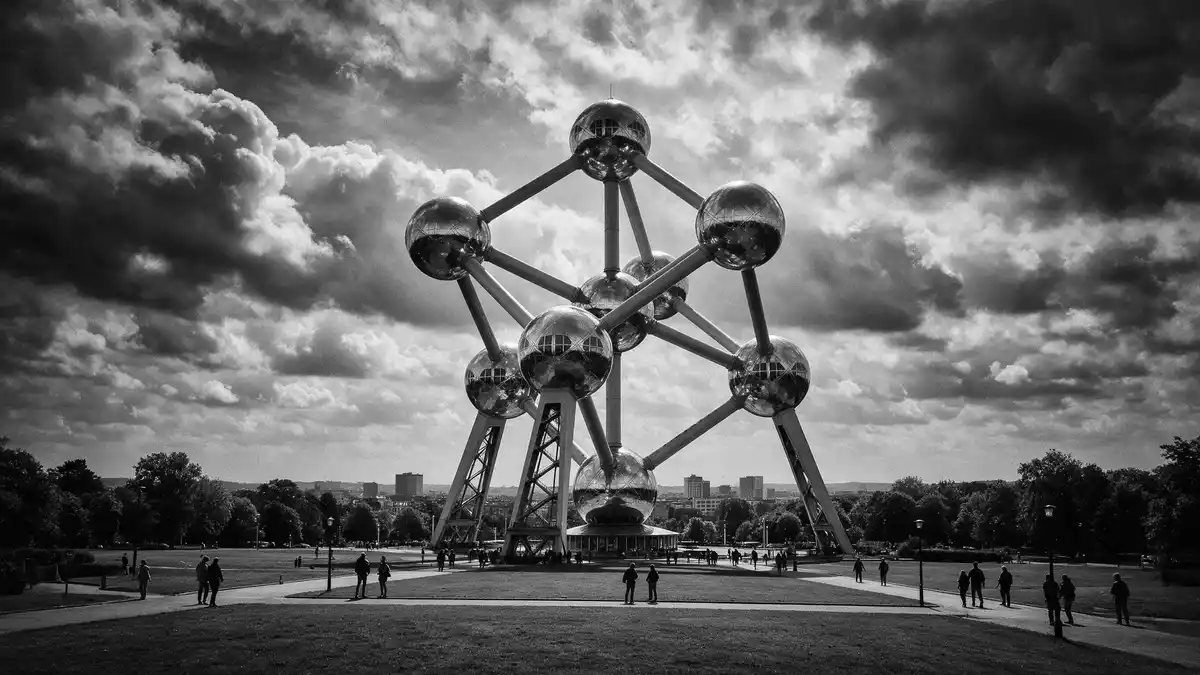
Atomium rises above northern Brussels as a large geometric model of an iron crystal. Completed in 1958 for the Brussels World’s Fair, it turns a scientific structure into architecture through linked spheres, metal tubes and elevated passageways.
Atomium and the geometry of an iron crystal
The building represents the conventional unit cell of an iron crystal, enlarged on an extraordinary architectural scale. Its nine spheres are connected by tubes, forming a three-dimensional composition that resembles a diagram translated into steel.
Each sphere has a diameter of 18 metres (59 ft), while the complete structure reaches 102 metres (335 ft). The dimensions give the model a physical presence across the Heysel Plateau, where the building occupies the northern part of the City of Brussels. Atomium’s recorded dimensions include its height, sphere diameter and connecting tubes.
André Waterkeyn and Expo 58
Engineer André Waterkeyn created the concept, with architects André and Jean Polak responsible for the architectural design. Construction began in 1956 and the Atomium was completed in 1958 for Expo 58, the Brussels World’s Fair.
The fair placed science, engineering and industrial design at the centre of its public setting. Atomium served as the exhibition’s flagship building and emblem, giving the event a permanent visual landmark in Brussels. The building’s Expo 58 history remains part of its identity.
Inside the spheres and tubes
Atomium sits between sculpture and architecture. Its stainless-steel-clad spheres contain exhibition areas, while tubes connect the elevated sections and carry circulation routes through the composition.
The upper parts provide views across Brussels, and the interior combines galleries, escalators, stairs and structural passages. The building’s material and geometry remain visible throughout, joining practical spaces to the form of the crystal model. Atomium’s architectural description records its designers, date and position on the Heysel Plateau.
Visiting Atomium: what travellers from Western Europe should know
- Atomium is at Place de l’Atomium in Laeken, northern Brussels. Brussels public transport serves the Heysel area, with the site connected to the city’s metro network.
- The building combines elevated spheres, tubes, stairs, escalators and exhibition rooms. A visit involves moving through a vertical architectural structure rather than a ground-level museum.
- The surrounding Heysel district contains Brussels landmarks and public spaces associated with the World’s Fair site.
- The official languages are Dutch, French and German, and the currency is the euro.
Searching for Atomium on social platforms
These links open searches for Atomium on each platform.
Frequently asked questions about Atomium
Where is Atomium?
Atomium is at Place de l’Atomium in Laeken, in the northern part of Brussels. It stands on the Heysel Plateau, the area associated with Expo 58.
What can visitors expect inside?
Visitors move through spheres and connecting tubes containing exhibition spaces, stairs, escalators and viewing areas. The route presents the building as both an architectural landmark and a scientific model.
What makes Atomium distinctive?
Its nine stainless-steel-clad spheres represent an iron-crystal unit cell enlarged to architectural scale. The combination of scientific geometry, industrial material and elevated circulation defines the building’s appearance.


