
At-Turaif and the mudbrick citadel of Diriyah
Published on 09/23/2026 at 06:55 | Editorial responsibility: Rafael Müller, Editor-in-Chief AD HOC NEWS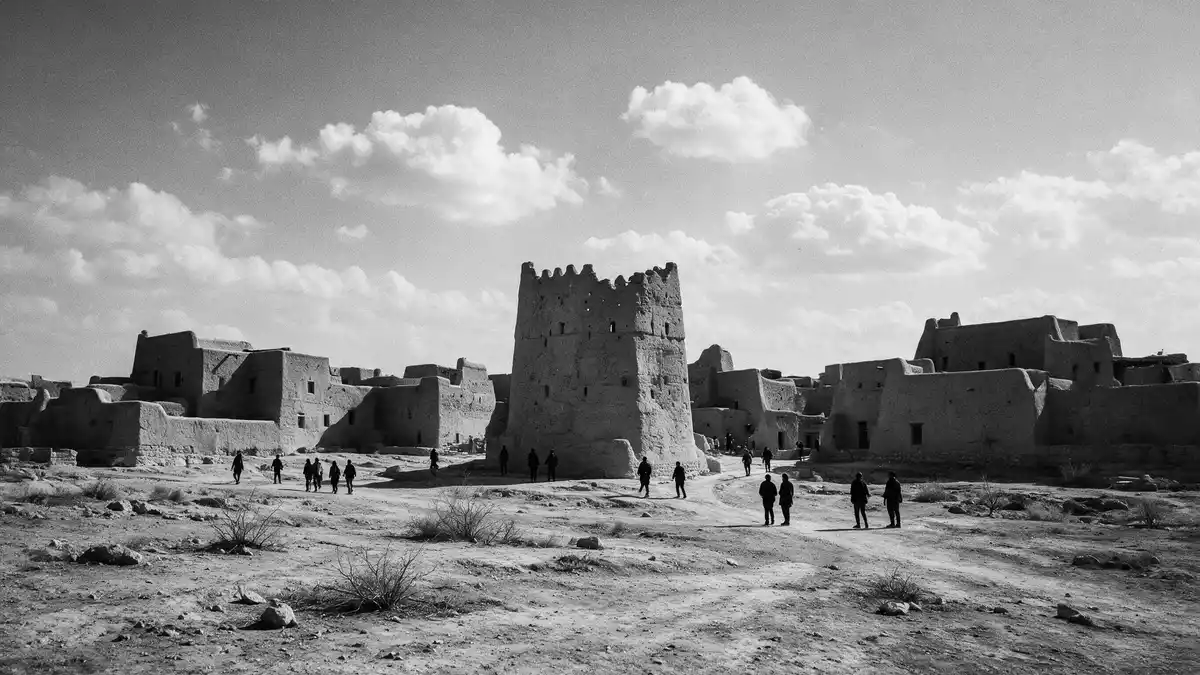
At-Turaif is a mudbrick citadel above Wadi Hanifah in Diriyah, where palaces, lanes and defensive structures form an urban landscape. Founded in the fifteenth century, it became the first capital of the Saudi Dynasty and the centre of the First Saudi State.
At-Turaif above the Diriyah oasis
At-Turaif occupies a low limestone plateau at the edge of the Diriyah oasis, north-west of Riyadh. The elevated district looks across Wadi Hanifah, a valley whose cultivated areas form the geographical setting for the historic settlement.
The site is an urban ensemble rather than an isolated monument. Its remains include palaces, mosques, residential quarters, defensive towers and narrow routes between buildings. The district extends across roughly 29 hectares and retains the outline of a fortified settlement within an oasis.
Najdi architecture in earth and geometry
At-Turaif is built in the Najdi architectural tradition of central Arabia. Mudbrick walls, adobe construction, plaster surfaces and timber elements create the material character of the citadel, while geometric decoration appears across surviving architectural details.
The buildings include major palatial complexes associated with the House of Saud. Salwa Palace is among the named structures in the district, alongside Saad bin Saud Palace, mosques, guesthouses and other remains that reveal the range of an urban capital.
The architecture combines solid earthen walls with flat-roofed forms and carefully arranged openings. The colour of the mudbrick belongs to the landscape around Wadi Hanifah, while the decorative patterns distinguish entrances, façades and interior spaces.
The Najdi architectural tradition is central to At-Turaif’s identity. It records a building culture specific to the central Arabian Peninsula, with adobe used across large palace complexes and geometric decoration applied to the built fabric.
From Saudi capital to heritage district
At-Turaif’s historical importance belongs to the eighteenth and early nineteenth centuries, when Diriyah became a political and religious centre. The citadel was connected with the House of Saud and with the spread of the Salafiyya reform movement in Arabia.
The First Saudi State was founded in 1727, with Diriyah as its capital. The period from 1727 to 1818 gave At-Turaif its place in the political history of the Arabian Peninsula, while the district’s palaces and urban layout preserve the setting of that state.
In 2010, At-Turaif was inscribed as a UNESCO World Heritage Site. The designation recognises its architectural form, its desert settlement pattern and its connection with a major phase in the history of central Arabia.
The World Heritage inscription covers an urban and architectural monument on the limestone plateau. Its value lies in the relationship between the surviving buildings, the road network, the oasis and the historical role of Diriyah.
At-Turaif is therefore read through several layers at once: a citadel, a palace district, an example of Najdi construction and the historic centre of a Saudi state. The mudbrick walls provide the visible thread linking those layers.
Visiting At-Turaif: what travellers from Western Europe should know
- At-Turaif lies in Diriyah, north-west of Riyadh, above Wadi Hanifah and beside the Diriyah oasis. Riyadh is the principal urban reference point for the district.
- The site occupies a limestone plateau with elevated ground, earthen ruins and routes between palaces, mosques and defensive structures. Walking involves uneven historic surfaces and changes in level.
- The surrounding landscape includes Wadi Hanifah and the cultivated Diriyah oasis. The relationship between plateau, valley and mudbrick buildings is part of the site’s physical character.
- The official language is Arabic and the currency is the Saudi riyal.
- Entry requirements depend on your nationality; UK travellers can check the FCDO travel advice at gov.uk/foreign-travel-advice, Irish travellers the Department of Foreign Affairs at ireland.ie.
Searching for At-Turaif on social platforms
These links open searches for At-Turaif on each platform.
Frequently asked questions about At-Turaif
Where is At-Turaif?
At-Turaif is in Diriyah, north-west of Riyadh, on a limestone plateau above Wadi Hanifah and the Diriyah oasis.
What can visitors see at At-Turaif?
The district contains mudbrick palaces, mosques, defensive towers, residential remains and narrow urban routes within a historic citadel.
What makes At-Turaif distinctive?
At-Turaif combines Najdi mudbrick architecture with the remains of the first Saudi capital and a UNESCO World Heritage inscription from 2010.


