
Art Nouveau district Riga and its quiet streets of facades
Published on 09/03/2026 at 11:55 | Editorial responsibility: Rafael Müller, Editor-in-Chief AD HOC NEWS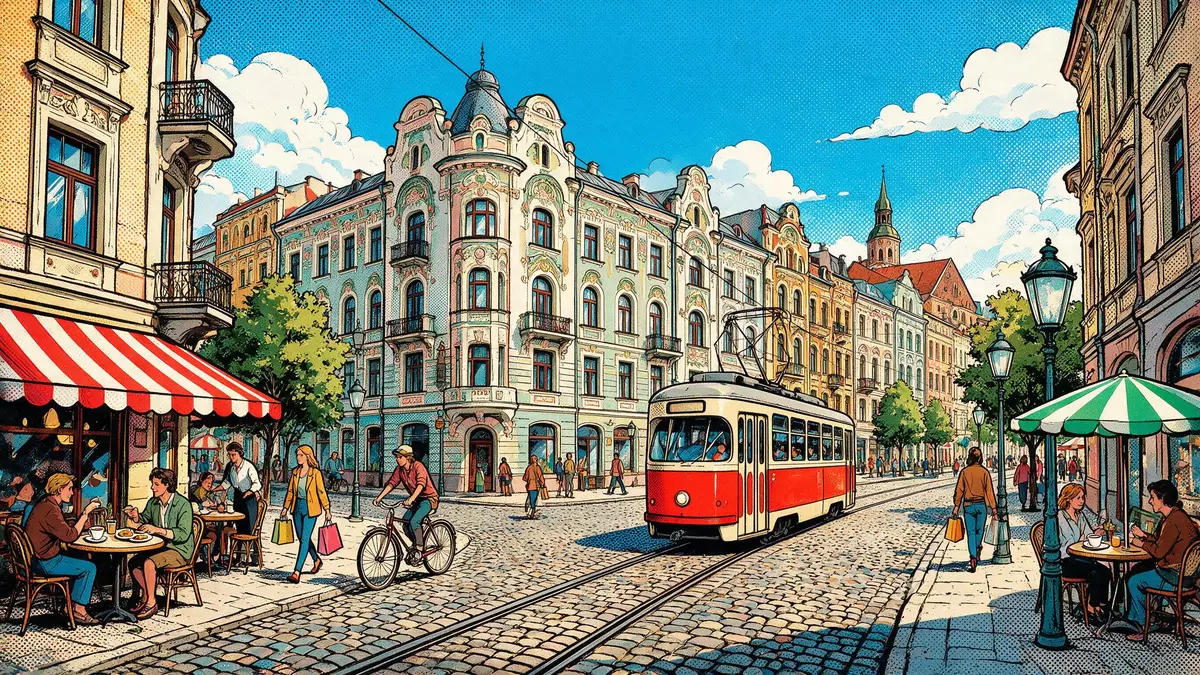
Art Nouveau district Riga is a stretch of central Riga where early 20th-century facades line residential streets in the city’s Quiet Centre. The area belongs to the Historic Centre of Riga, a UNESCO World Heritage site, and its best-known buildings date from the period around 1901 to 1908.Historic Centre of Riga
Alberta iela and the district’s decorative frontage
Alberta iela is the street most closely associated with the district. It carries a dense sequence of apartment houses with sculpted faces, floral ornament, balconies and varied wall surfaces, and several façades are linked to Konstant?ns P?kš?ns and Mikhail Eisenstein.Alberta iela
The district’s architecture ranges across Eclectic Art Nouveau and National Romantic forms. These streets also include a different layer of Riga identity: the work of builders and architects who turned a residential quarter into a compact open-air gallery of ornament and structure.Mikhail Eisenstein
A quarter shaped by early twentieth-century Riga
The district sits within the wider urban fabric that helped Riga gain a reputation for Art Nouveau architecture. UNESCO’s description of the Historic Centre of Riga refers to the quantity and quality of this building stock, and the city’s turn-of-the-century expansion left a strong concentration in the central streets north of the Old Town.quantity and quality
Konstant?ns P?kš?ns is one of the key names in this setting. His former residence at Alberta iela 12 later became the Riga Art Nouveau Museum, and the house adds an interior dimension to a district otherwise read mainly through its façades.Konstant?ns P?kš?ns
Reading the streets on foot
The district is a place of streets rather than a fenced monument. Alberta iela and nearby Elizabetes iela, Strelnieku iela and Antonijas iela form the core of the walk, with repeated frontage, varied ornament and repeated transitions between apartment buildings and smaller side streets.Quiet Centre streets
The place also shows how Riga’s Art Nouveau survives as part of lived-in urban fabric. Residential blocks, museum space and public streets sit close together, and the district remains legible through materials, decoration and the names attached to individual houses.public streets
Visiting Art Nouveau district Riga: what travellers from Western Europe should know
- The district lies in central Riga, north of the Old Town, in the Quiet Centre. Alberta iela, Elizabetes iela and nearby streets make up the core walking area.
- The main terrain is level city pavement, with short street blocks and residential blocks close together. Alberta iela is a street, not a closed compound.
- Riga’s official language is Latvian and the currency is the euro.
- Entry requirements depend on your nationality; UK travellers can check the FCDO travel advice at gov.uk/foreign-travel-advice, Irish travellers the Department of Foreign Affairs at ireland.ie.
- The district links façades by Konstant?ns P?kš?ns, Mikhail Eisenstein and Eižens Laube into a compact architectural route.
Searching for Art Nouveau district Riga on social platforms
These links open searches for Art Nouveau district Riga on each platform.
Frequently asked questions about Art Nouveau district Riga
Where is Art Nouveau district Riga?
It lies in central Riga, mainly in the Quiet Centre north of the Old Town. Alberta iela is the best-known street in the area.
What does a visit involve?
The district is read by walking its streets and looking at façades, balconies and ornament. Alberta iela 12 adds a museum interior to the exterior sequence.
What makes it distinctive?
The defining feature is the concentration of Art Nouveau buildings within the Historic Centre of Riga. The names Konstant?ns P?kš?ns and Mikhail Eisenstein recur across the district’s best-known houses.


