
Art Institute of Chicago and its Beaux-Arts gateway to world art
Published on 09/15/2026 at 12:26 | Editorial responsibility: Rafael Müller, Editor-in-Chief AD HOC NEWS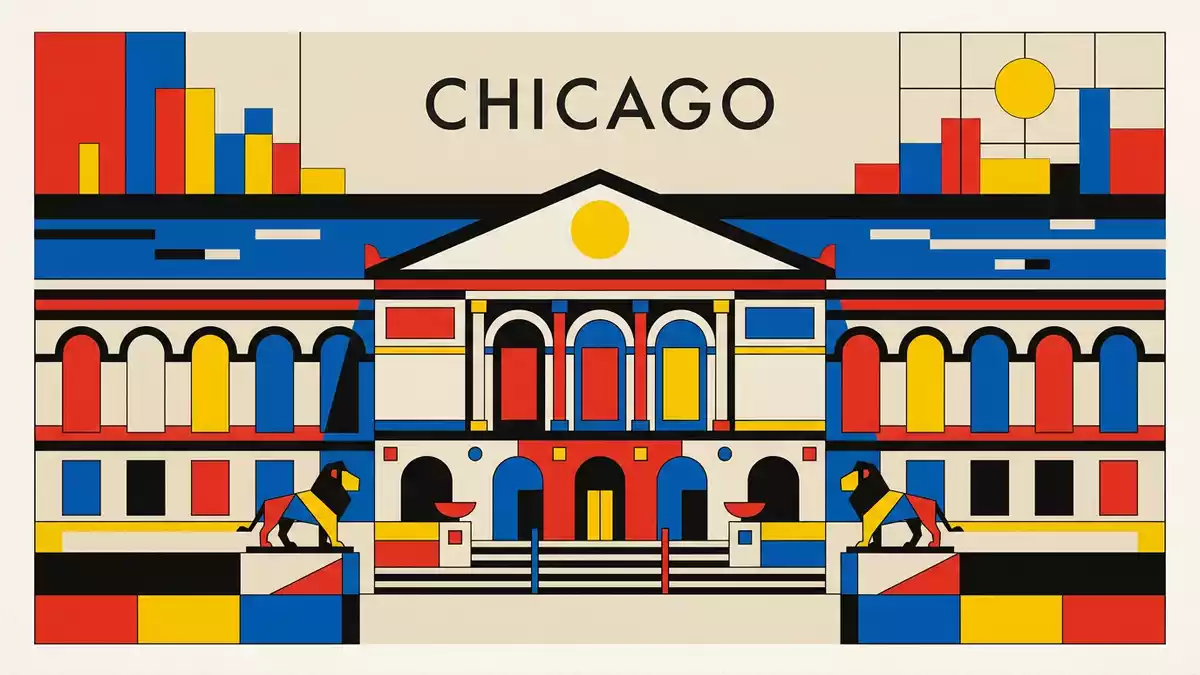
The Art Institute of Chicago is a major art museum on South Michigan Avenue in Chicago, bringing an encyclopaedic collection of world art into a grand Beaux-Arts building watched over by two bronze lions. Founded in 1879 as both a museum and a school for the fine arts, it took its present name in the early 1880s and has occupied its Grant Park home since the 1890s.
A Beaux-Arts façade facing Grant Park
The main building of the Art Institute of Chicago stands along 111 South Michigan Avenue, aligned with the open lawns of Grant Park and forming part of the cultural edge of downtown Chicago.111 South Michigan Avenue The structure was designed in the Beaux-Arts tradition by the Boston architecture firm Shepley, Rutan & Coolidge as part of the era shaped by the World’s Columbian Exposition.Shepley, Rutan & Coolidge Its masonry walls are clad in limestone, giving the museum a pale, solid presence along the avenue.
The central entrance is framed by a two-storey portico, flanked by symmetrical wings that extend along the street front.symmetrical wings Corinthian columns rise along the façade, supporting a triangular pediment decorated with classical ornament that draws on ancient Greek precedents. Friezes modelled on the Parthenon run along parts of the elevation, and statues of goddesses stand at the edges of the main front, tying the building visually to the classical world whose art is represented inside. On the pavement below, two bronze lions by sculptor Edward Kemeys guard the steps, their differing stances becoming informal mascots of the museum.bronze lions by Edward Kemeys
From academy to encyclopaedic museum
The institution behind the Art Institute of Chicago grew out of Chicago’s nineteenth-century artistic ambitions. Its predecessor, the Chicago Academy of Design, was founded in 1866; the organisation was reestablished as the Chicago Academy of Fine Arts in 1879 and took the name Art Institute of Chicago in 1882.Chicago Academy of Fine Arts in 1879 In that same year it was founded as both a museum and a school, binding public exhibition and formal art education into one institution.founded as both a museum and school
The museum moved into its present Michigan Avenue building in 1893, during the period when Chicago’s centre was being reshaped after the Great Fire of 1871.moved into its present building in 1893 Over the decades the original Beaux-Arts structure has been expanded by additional buildings and wings, creating a complex that spreads over around one million square feet of floor space.one million square feet of space The Art Institute continues to operate alongside the School of the Art Institute of Chicago, its long-standing sister institution, and its institutional archives contain records dating back to the 1879 founding.Institutional Archives
Collections from Impressionism to contemporary design
Inside the limestone shell, the Art Institute of Chicago holds a permanent collection of nearly 300,000 works of art drawn from many cultures and periods.nearly 300,000 works of art The museum’s holdings range from Chinese bronzes and ancient Mediterranean objects to contemporary design, textiles and installation art.fields ranging from Chinese bronzes to contemporary design European, American and Asian painting and sculpture are represented alongside decorative arts, photography and arms and armour.
The Art Institute is especially associated with nineteenth-century French painting and early twentieth-century works. Its galleries include major Impressionist and Post-Impressionist canvases by artists such as Claude Monet, Georges Seurat and Pierre-Auguste Renoir.Impressionist and Post-Impressionist art American art is strongly represented, including large-scale works such as Georgia O’Keeffe’s “Sky Above Clouds IV”, which spans roughly 24 by 8 feet and ranks among the museum’s largest paintings.Sky Above Clouds IV Other sections cover African and pre-Columbian American art, ancient objects and the 68 Thorne miniature rooms, each meticulously assembled to evoke a particular architectural period and interior style.Thorne miniature rooms
Visiting Art Institute of Chicago: what travellers from Western Europe should know
- The Art Institute of Chicago stands on South Michigan Avenue on the edge of Grant Park, within walking distance of many downtown Chicago hotels and offices.
- The main entrance is reached by a broad flight of exterior steps, with further internal staircases linking galleries, so a visit involves movement between levels.
- The museum lies in Chicago in the United States; the official language is English and the currency is the US dollar.
- Entry requirements depend on your nationality; UK travellers can check the FCDO travel advice at gov.uk/foreign-travel-advice, Irish travellers the Department of Foreign Affairs at ireland.ie.
Searching for Art Institute of Chicago on social platforms
These links open searches for Art Institute of Chicago on each platform.
Frequently asked questions about Art Institute of Chicago
Where is the Art Institute of Chicago located?
The Art Institute of Chicago stands at 111 South Michigan Avenue in Chicago, bordering Grant Park near the city’s central business district.
What can visitors expect on a visit to the museum?
Visitors encounter extensive galleries covering European, American, Asian, African and ancient art, with strong collections of Impressionist painting, American works and decorative arts.
What makes the Art Institute of Chicago distinctive among museums?
It combines a large encyclopaedic collection of nearly 300,000 works with a historic Beaux-Arts building, notable Impressionist holdings and a long-standing partnership with its art school.


