
Arenes de Nimes and the Roman ellipse at the centre of Nimes
Published on 09/23/2026 at 16:59 | Editorial responsibility: Rafael Müller, Editor-in-Chief AD HOC NEWS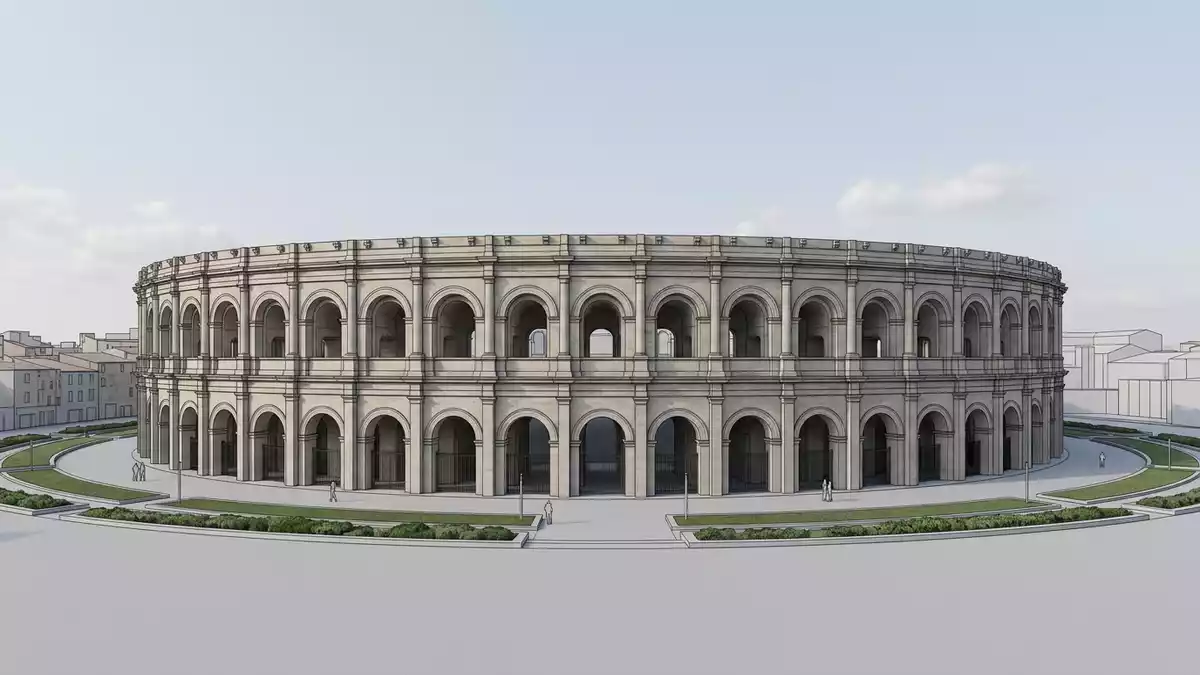
Arenes de Nimes is a Roman amphitheatre whose long stone ellipse remains embedded in the centre of Nimes. Built at the end of the first century AD, it rises through two levels of arcades above an arena that has carried several uses across nearly two thousand years.
The stone ellipse of Nemausus
The amphitheatre measures 133 metres long and 101 metres wide. Its outer wall reaches 21 metres, with two storeys of arcades and an attic above them. The façade is divided into 60 bays, creating a repeated rhythm around the entire oval perimeter.
The building belongs to Roman Nemausus, the ancient city whose name survives in Nimes. Limestone from the nearby Barutel and Roquemaillère quarries formed its walls. The stone courses were assembled without mortar, and the surviving shell retains the strong horizontal bands and curved profile of Roman amphitheatre architecture. The 133-metre Roman amphitheatre remains a defining monument of the city.
From Roman spectacle to fortified settlement
In its Roman phase, Arenes de Nimes hosted gladiatorial contests and hunts involving wild animals. Spectators occupied stepped terraces arranged around the arena, with galleries and stairways connecting the external entrances to the seating.
From the sixth century, the amphitheatre became a fortress. Its arcades were blocked, and the interior became a fortified settlement. Medieval residents included the viscounts of Nimes and the Knights of the Arenas. Houses, workshops and storage buildings occupied the enclosure until the early nineteenth century.
That layered history explains the difference between the monument’s original civic role and its later domestic and military uses. The Roman form remained legible beneath those changes, including the enclosing wall, the curving terraces and the network of passages beneath the seating.
A Roman building with a living performance space
During the nineteenth century, the private buildings inside the amphitheatre were removed and the arena was cleared. Restoration returned the monument to a public performance setting, while preserving the Roman fabric that defines its appearance.
Arenes de Nimes accommodates concerts, cultural performances, sporting events and bullfighting. The arena floor remains enclosed by the same rising stone structure that once held Roman spectators. The building therefore presents two visible identities together: an archaeological monument and an active venue.
The Musée de la Romanité describes the amphitheatre as 133 metres long, 101 metres wide and 21 metres high. It also records the survival of the upper storey, a feature that gives the external elevation its unusually complete profile. The Roman arena’s dimensions make its scale readable from the surrounding streets.
The date belongs to the end of the first century AD, close to the period when the Colosseum was established in Rome. A coin associated with the building dates from 88–89 AD, while scientific analysis places construction before 130 AD. The construction date of the amphitheatre belongs to the transition between the first and second centuries.
Visiting Arenes de Nimes: what travellers from Western Europe should know
- Arenes de Nimes stands at Place des Arènes in central Nimes. The city is connected by rail, and the amphitheatre lies within the historic urban area.
- The visit includes stepped seating, vaulted galleries and stairways inside a large Roman structure. Uneven stone surfaces and changes in level are part of the monument.
- Nimes lies in southern France, where French is the official language and the euro is the national currency.
- The nearby Musée de la Romanité presents further Roman material and stands close to the amphitheatre.
Searching for Arenes de Nimes on social platforms
These links open searches for Arenes de Nimes on each platform.
Frequently asked questions about Arenes de Nimes
Where is Arenes de Nimes?
Arenes de Nimes is in central Nimes, southern France, at Place des Arènes. It occupies a prominent position within the historic city.
What can visitors expect inside?
Visitors encounter Roman terraces, arcades, vaulted galleries and stairways around the arena floor. The building combines archaeological fabric with a venue for public performances.
What makes the amphitheatre distinctive?
Its complete elliptical shell, two arcaded levels and surviving upper storey define the monument. Its history also includes Roman spectacles, a medieval fortress and later cultural use.


