
Arena di Verona, the Roman amphitheatre that still stages grand evenings
Published on 08/31/2026 at 22:15 | Editorial responsibility: Rafael Müller, Editor-in-Chief AD HOC NEWS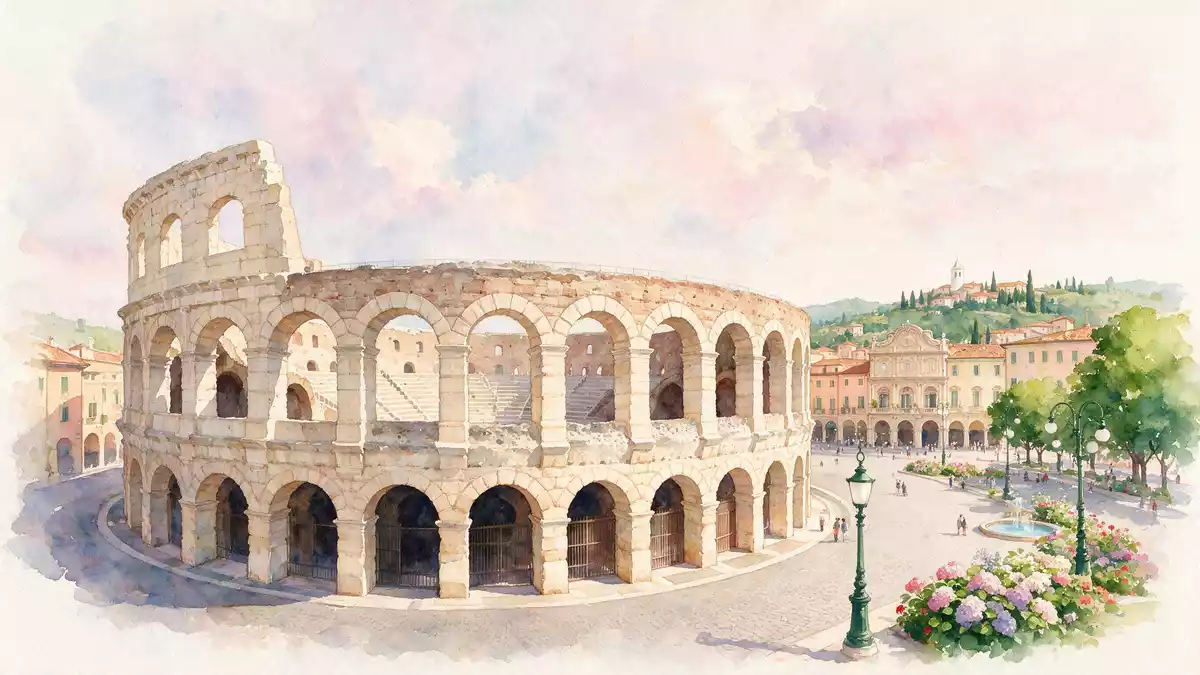
Arena di Verona is a Roman amphitheatre in the centre of Verona, where first?century stone terraces continue to frame large-scale performances in a single monumental space. Built in the first century AD, it gives Verona an ancient structure that still functions as a venue rather than a ruin, linking Roman spectacle to modern opera seasons.
An ancient amphitheatre in the fabric of Verona
Arena di Verona stands on Piazza Bra, the broad urban square that forms a central open space in Verona’s historic area.Piazza Bra location The building is a Roman amphitheatre completed in the first century AD, during the period when Verona was a colony of the Roman Empire.Roman amphitheatre completed around AD 30 It was originally raised just outside the Roman city walls and was later enclosed within the expanded urban defences as Verona grew.outside Roman walls then brought inside
The plan of the amphitheatre is elongated, with major and minor axes measuring roughly 152 m and 123 m (498 ft and 404 ft).dimensions of the amphitheatre This footprint makes Arena di Verona one of the largest surviving Roman amphitheatres in Italy, on a scale comparable with the Colosseum in Rome and the former amphitheatre at Capua.ranking among largest surviving amphitheatres The inner seating area rises above the central performance floor in continuous tiers, forming a vast bowl of masonry that once accommodated tens of thousands of spectators.
From gladiatorial combats to opera under the open sky
When Arena di Verona was built in the first century AD, its central area was used for public spectacles including gladiatorial contests and staged hunts, reflecting common Roman entertainment of that era.gladiatorial contests in the amphitheatre The terraced seating and encircling corridors were designed to handle large crowds by separating access routes and levels, allowing spectators to reach their places without crossing the central space. In Roman times, sources describe capacities around 30,000 spectators, matching the breadth of the stone terraces.
Centuries later, Arena di Verona took on a new role as a performance venue for opera and other staged events, using the same stone seating for audiences and a constructed stage within the arena.use as opera and theatre venue Rather than being converted into a museum-only site, the amphitheatre serves as an active setting for large productions, with lighting rigs, stage structures and acoustic equipment installed against the backdrop of Roman masonry. Spectators watch performances from the tiers that ring the arena, with some seated on historic stone steps and others on modern seating structures set within the original geometry.
Stone, colour and surviving structure
The masonry of Arena di Verona is built largely from local limestone, including pink and white stone quarried from the hills around Verona.pink and white limestone This combination creates subtle bands of colour along the arcades and terraces, giving the structure a two-tone appearance that changes with the light. The amphitheatre originally had an outer ring of high arcades encircling the whole building, of which a section remains standing, showing the original exterior elevation.
The main body of the amphitheatre rises to around 25 m (82 ft), with surviving parts of the outer ring reaching greater heights.height of main body and outer arches Inside, corridors run behind the seating, with staircases connecting different levels and passageways leading out to Piazza Bra. The central arena floor is now partly occupied by a stage and equipment when productions are mounted, while the remaining area gives views of the full curve of the terraces and the stonework above them.
Visiting Arena di Verona: what travellers from Western Europe should know
- Arena di Verona stands on Piazza Bra in central Verona, a short walk north from the main railway station Verona Porta Nuova along Corso Porta Nuova.
- The amphitheatre’s interior is arranged in rising terraces reached by stone staircases; visiting the upper levels involves climbing several flights of steps on historic masonry.
- Verona lies in the Veneto region of northern Italy; the official language is Italian and the currency is the euro.
Searching for Arena di Verona on social platforms
These links open searches for Arena di Verona on each platform.Frequently asked questions about Arena di Verona
Where is Arena di Verona located within Verona?
Arena di Verona stands on Piazza Bra in the historic centre of Verona, close to the city’s main streets and within walking distance of Verona Porta Nuova station.
What can visitors expect when entering the amphitheatre?
Visitors enter from Piazza Bra and move through stone corridors and staircases into the interior, where terraces rise around the central arena and views reach across the amphitheatre.
What distinguishes Arena di Verona from many other ancient sites?
It is a first?century Roman amphitheatre built from local limestone that retains its seating terraces and continues to host large-scale performances inside the historic structure.


