
Arena di Verona, a Roman amphitheatre that still performs
Published on 09/10/2026 at 06:35 | Editorial responsibility: Rafael Müller, Editor-in-Chief AD HOC NEWS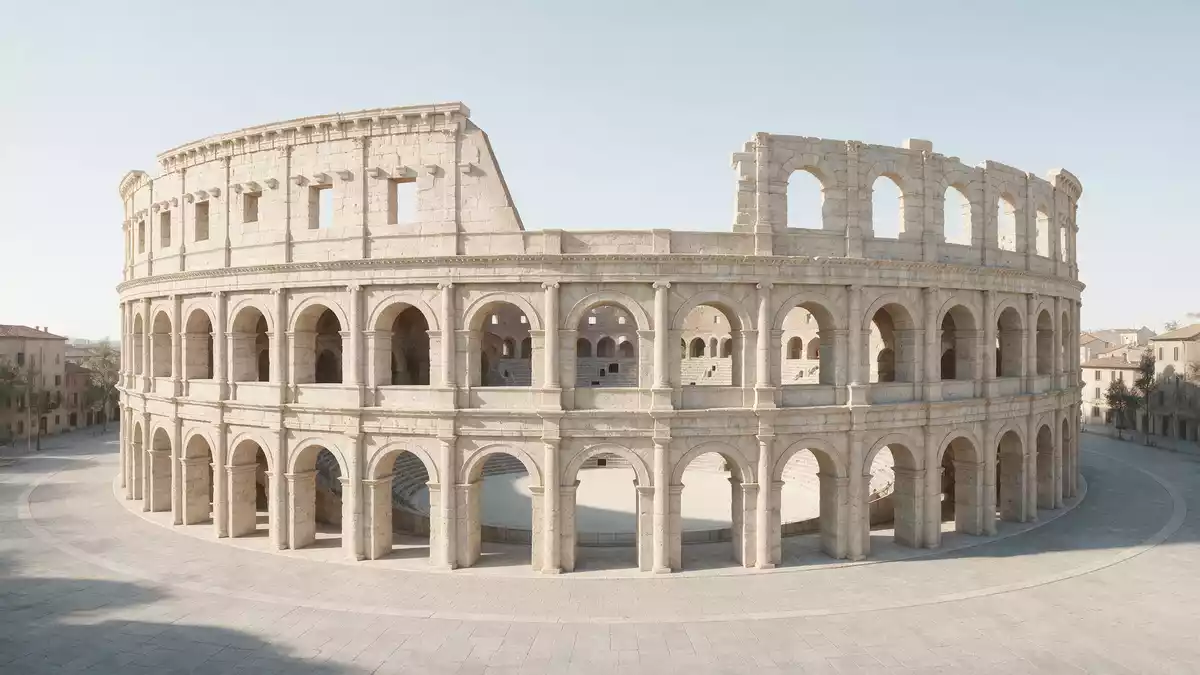
Arena di Verona is a Roman amphitheatre in the centre of Verona whose vast stone terraces still serve as a performance venue after nearly two millennia of use. Built in the first century AD and long associated with the early imperial period, it anchors Piazza Bra and brings Roman architecture directly into the everyday life of the city.
A Roman amphitheatre shaped for spectacle
Arena di Verona belongs to the family of large Roman amphitheatres that once staged gladiatorial contests and other public spectacles across the empire.Verona Arena as a Roman amphitheatre It stands in Verona, in northern Italy, and was completed during the first century AD, with many studies placing its construction around AD 30.completed around AD 30 The building follows an elongated oval plan, formed by concentric rings of masonry that rise in tiers around a central arena floor.
The outer dimensions run to roughly 152 m (499 ft) along the major axis and about 123 m (404 ft) along the minor axis, giving the structure a broad footprint within the urban fabric.major and minor axes Inside, the central performance space measures around 75 m by 44 m, framed by ranks of stone seating that climb in regular steps towards the top of the cavea.dimensions of the arena floor That capacity has been estimated at about 30,000 spectators in Roman times, placing Arena di Verona among the largest surviving amphitheatres of the ancient world.original capacity around 30,000
Stone, structure and the surviving ellipse
The amphitheatre is built largely from local limestone, including pink and white stone from the hills around Verona, giving the masonry a characteristic two-tone appearance.pink-and-white limestone of Valpolicella The surviving exterior presents a sequence of arches and pilasters arranged along the oval, while the interior reveals the practical organisation of Roman seating, divided into sectors reached by staircases and access corridors. Much of the original outer ring, once a higher envelope around the amphitheatre, was lost through earthquakes and later reuse of stone, but a fragment known as the “ala” still stands as a reminder of the building’s former height.remnant of the outer ring
The arena floor, once covered in sand for gladiatorial games, lies open at the centre, encircled by the lowest rows of seating. Above them, further terraces rise in bands that follow the curve of the plan and form a continuous circuit around the performance space.stone terraces and central arena Radial passages and stairways connect the different levels, illustrating how Roman engineers moved large crowds to their places. The masonry shows both ashlar blocks and areas where later repairs have introduced different stone, recording centuries of maintenance as the city worked to preserve the amphitheatre.
From gladiators to grand performances
In Roman times Arena di Verona hosted gladiatorial combats and other spectacles that drew inhabitants of the city and visitors from the surrounding region.venue for gladiatorial combats After the end of gladiatorial games, the amphitheatre’s structure adapted to different uses, including tournaments and gatherings in the medieval period, while parts of the building were incorporated into fortifications during moments of conflict.later uses in medieval and early modern periods Systematic restoration campaigns from the sixteenth century onward stabilised the stonework and reasserted the arena as a monument within Verona.
Since the early twentieth century Arena di Verona has been closely associated with open-air opera performances, which take place on a stage set up on the arena floor with the ancient seating forming a vast auditorium.use as an opera venue since 1913 Large-scale productions use the breadth of the space, building sets that stand against the backdrop of Roman masonry. Concerts and other events have also taken place here, demonstrating how the original form of the amphitheatre accommodates different kinds of performance while retaining its identity as an ancient structure.
Visiting Arena di Verona: what travellers from Western Europe should know
- Arena di Verona stands on Piazza Bra in central Verona, a short walk from Verona Porta Nuova railway station along streets that lead towards the historic core.
- The amphitheatre interior is reached by stone stairways and passages, and visits within the seating area involve ascending and descending stepped terraces without handrails along every section.
- The monument lies within the flat basin of Verona by the Adige river, so approaching it from most directions in the city involves level pavements rather than steep climbs.
- The official language is Italian and the currency is the euro.
Searching for Arena di Verona on social platforms
These links open searches for Arena di Verona on each platform.
Frequently asked questions about Arena di Verona
Where is Arena di Verona located within Verona?
Arena di Verona stands on Piazza Bra in the historic centre, close to Verona’s main streets and within walking distance of Verona Porta Nuova station.Arena di Verona on Piazza Bra
What can visitors expect during a visit to Arena di Verona?
Visitors encounter a large Roman stone amphitheatre with a central arena floor, extensive tiers of seating and stairways that give access to different levels of the cavea.
What makes Arena di Verona distinctive among ancient venues?
Arena di Verona combines the scale of a first-century Roman amphitheatre with an enduring role as a working performance venue, using its historic terraces for opera and other events.large amphitheatre still in use


