
Arena di Verona, a Roman amphitheatre that still performs
Published on 09/05/2026 at 16:40 | Editorial responsibility: Rafael Müller, Editor-in-Chief AD HOC NEWS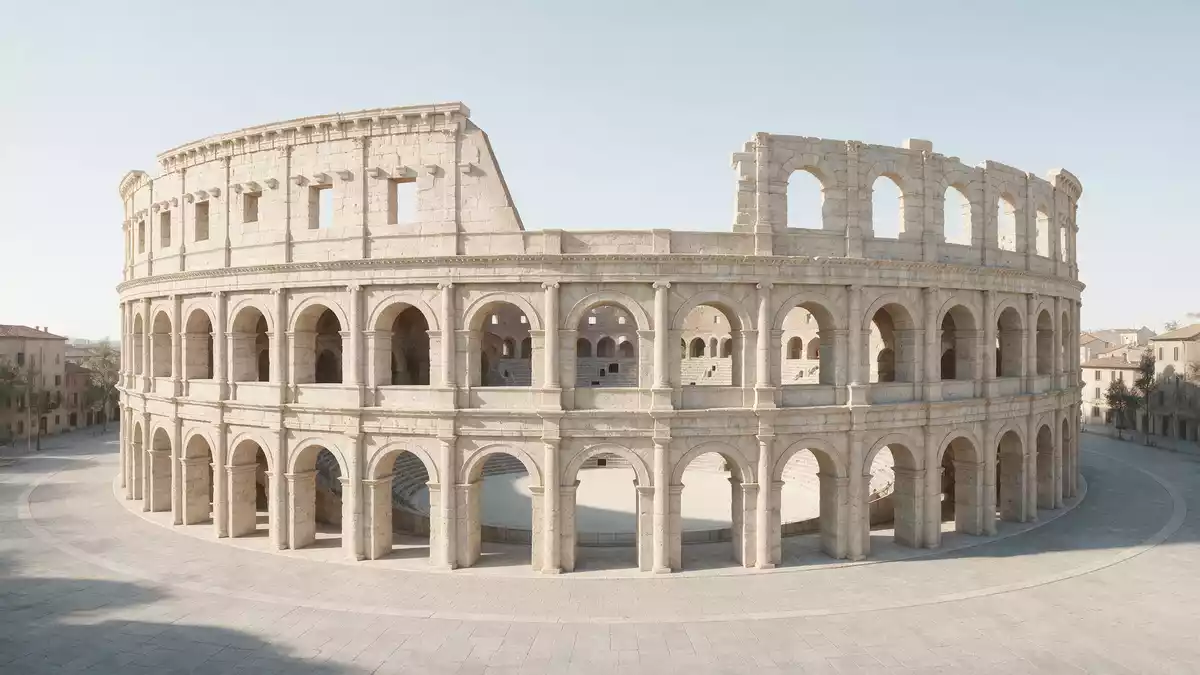
Arena di Verona is a Roman amphitheatre in the historic centre of Verona, its massive stone tiers still enclosing a vast performance space almost two millennia after construction.
A Roman monument woven into Verona’s fabric
The amphitheatre stands on Piazza Bra in Verona, a city in north-eastern Italy that grew along the Adige River and later became part of the Veneto region.Piazza Bra location The building is traditionally dated to the first century AD, with many sources placing its construction around 30 AD under the Roman Empire.first-century amphitheatre Its survival through changing eras has turned it into a central landmark, surrounded by later palazzi, cafés and civic buildings that frame its outer walls.
The plan of Arena di Verona follows the Roman amphitheatre type, with concentric rings of seating wrapped around an oval performance space. From the outside, the structure appears as a high envelope of masonry enclosing the cavea, the stepped seating area that once held tens of thousands of spectators.concentric rings of seating Much of the original outer ring was lost, but a fragment of the more external wall, known locally as the “ala”, still rises above the main body and signals the amphitheatre’s former scale.outer wall fragment
Stone, dimensions and internal layout
Arena di Verona is constructed largely from local stone, laid in massive blocks that form the arcade of arches, corridors and radial walls needed to support the seating tiers. The amphitheatre’s footprint is substantial: its major axis measures about 152.43 m (500 ft) and its minor axis about 123.23 m (404 ft), giving it a broad, elongated outline within the urban grid.major and minor axes The interior arena, the central area where spectacles took place, occupies a space of roughly 75 m by 44 m (246 ft by 144 ft), surrounded by rising steps of stone seating.arena measurements
The seating arrangement follows the Roman model of superposed tiers, with radial stairways and vaulted passages distributing spectators to different levels. Original capacity is generally given as around 30,000 people, a figure that underlines the ambition of the Roman builders and places Arena di Verona among the larger preserved amphitheatres in Italy.Roman seating capacity The surviving body of the amphitheatre reaches about 31 m (102 ft) in height at its highest points, and the curve of the cavea remains clearly legible despite the missing sections of the outer ring.overall height
From gladiatorial combats to opera performances
When Arena di Verona was built in the first century AD, it formed part of the Roman network of amphitheatres used for public spectacles. Historical descriptions indicate that the venue hosted gladiatorial combats and animal hunts, reflecting the entertainment culture of the Roman Empire.Roman spectacles The Latin term “arena” refers to the sand on the performance floor, laid to absorb blood during combat, and that origin survives in the modern Italian name Arena di Verona.Latin origin of arena
In later centuries, the amphitheatre’s function shifted from Roman games to different forms of public gathering and, eventually, to music and theatre. By the twentieth century, it had become firmly established as a venue for large-scale opera productions, taking advantage of the wide central floor and tiered seating to stage monumental performances. The same stone steps that once carried crowds to ancient spectacles now support an audience facing a modern stage set against the historic masonry.
Arena di Verona in the cityscape and for visitors
Within Verona, Arena di Verona serves as both monument and active venue, its stone shell forming a backdrop to everyday life on Piazza Bra. The structure’s presence defines one edge of the square, and its entrances open directly onto the paving, where visitors can see the arcades and upper tiers rising above street level. The building’s continued theatrical use links contemporary performances with the amphitheatre’s Roman origins, illustrating how a single structure can hold multiple cultural lives.
Visitors entering the amphitheatre encounter stone stairways and terraces that climb around the central performance area. The internal routes include vaulted corridors, steps and ramps, and the higher tiers give broad views across the arena and towards Verona’s roofs beyond the walls. The experience is shaped by the geometry of the cavea, the enclosing masonry and the contrast between open sky above and the stone fabric that frames the space.
Visiting Arena di Verona: what travellers from Western Europe should know
- Arena di Verona stands on Piazza Bra in Verona, Italy, within walking distance of the city’s historic streets and a short urban journey from Verona Porta Nuova railway station.
- The amphitheatre interior is reached by stone stairways and passages, with stepped seating rising above the central floor, so movement inside involves climbing and descending uneven steps.
- Verona lies in northern Italy’s Veneto region; the official language is Italian and the currency is the euro.
- Travellers arriving from elsewhere in Italy find that local buses link Verona Porta Nuova station with Piazza Bra, and taxis also serve the area around the amphitheatre.
Searching for Arena di Verona on social platforms
These links open searches for Arena di Verona on each platform.
Frequently asked questions about Arena di Verona
Where is Arena di Verona located?
Arena di Verona is a Roman amphitheatre on Piazza Bra in the historic centre of Verona, a city in the Veneto region of northern Italy.
What can visitors expect inside Arena di Verona?
Visitors find stone stairways, tiered seating and a wide central floor, with access routes leading through arches and corridors to different levels around the arena.
What makes Arena di Verona distinctive among Roman amphitheatres?
Arena di Verona combines a large Roman stone structure and a long history of spectacles with continued use as a performance venue in the middle of an active Italian city.


