
Arena di Verona, a Roman amphitheatre that still performs
Published on 08/21/2026 at 18:03 | Editorial responsibility: Rafael Müller, Editor-in-Chief AD HOC NEWS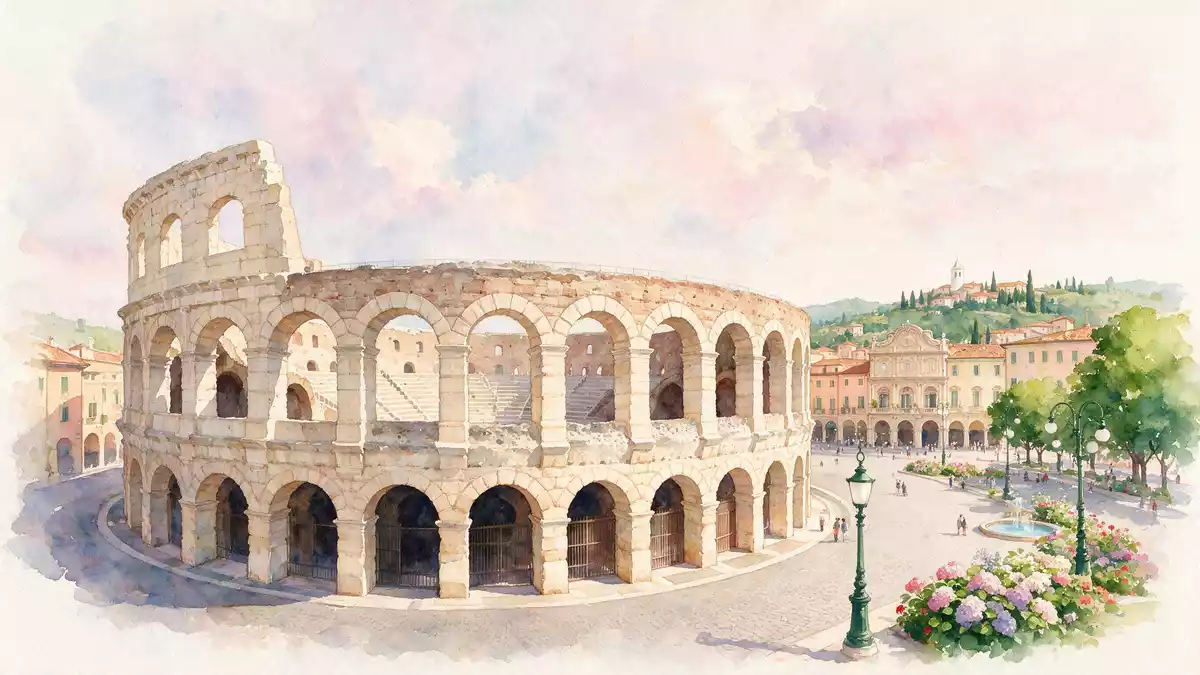
Arena di Verona is the Roman amphitheatre that defines central Verona, a monumental ellipse of stone where gladiatorial contests once played out and large-scale performances still fill the terraces. Built in the first century AD and long associated with the early Roman Empire, it anchors Piazza Bra and offers an unusually continuous link between ancient engineering and present-day use.
A Roman amphitheatre written into Verona’s fabric
Arena di Verona stands in the historic core of Verona, facing the broad expanse of Piazza Bra and surrounded by later palazzi and cafés that frame its stone arcades. The building is a Roman amphitheatre constructed in the first century AD, with many sources dating it around 30 AD during the imperial period, decades before the Colosseum in Rome was inaugurated.Roman amphitheatre The Italian national tourism portal places its construction in the reign of Emperor Claudius around 41–42 AD, reflecting scholarly debate over the exact year but confirming its first-century date.reign of Emperor Claudius
The amphitheatre was raised when Verona was a Roman colony on northern Italian trade routes, and its form still reads clearly as imperial infrastructure dedicated to spectacle.Roman colony context The original stonework used pale and pink limestone from the surrounding hills, creating a two-tone masonry that contrasts with the later brick and stucco of the city around it.pink-and-white limestone As Verona’s walls were extended under Emperor Gallienus in 265, the Arena was enclosed within the city fabric, a status it still holds as both monument and working venue.
Scale, stone and the geometry of spectacle
The form of Arena di Verona is elliptical, with a long axis of about 152 m (499 ft) and a shorter axis near 123 m (404 ft), dimensions that mark it among the larger surviving amphitheatres in Europe.152 m by 123 m plan Inside, the central performance space, the arena proper, measures roughly 75 m (246 ft) by 44 m (144 ft), encircled by sweeping stone terraces that rise in concentric rings.75 x 44 m arena The surviving outer walls reach around 24 m (79 ft) high in places, while studies of the original envelope suggest an initial height exceeding 30 m (98 ft), with an additional ring of arches that was largely lost to earthquake damage and stone reuse.
The seating, or cavea, was laid out in 45 tiers of steps designed to hold tens of thousands of spectators; modern assessments often give an original capacity close to 30,000, with around 20,000 seats now used for performances.45 seating tiers Britannica describes Verona Arena as the third-largest surviving amphitheatre in Europe, after the Colosseum and the site at ancient Capua near Naples, underscoring its role as a major provincial counterpart to Rome’s imperial venues.third-largest surviving amphitheatre Walking its perimeter, the regular rhythm of arches and the inclined planes of the terraces create a clear sense of how Roman engineers organised both circulation and sightlines inside a single vast masonry shell.
From gladiatorial contests to staged opera
In its earliest centuries, Arena di Verona hosted gladiatorial combats and other public spectacles, aligning with the Roman practice of using amphitheatres for displays that combined entertainment and civic ritual.gladiatorial combats As Christianity became established and gladiatorial games ceased, the amphitheatre’s use shifted rather than disappearing entirely; medieval chronicles record jousts, tournaments and other events that made use of the enclosed space and robust outer walls.medieval tournaments
The monument suffered damage through floods, earthquakes and periods of stone quarrying, including a major earthquake in 1117 that destroyed most of the outer ring of arches, leaving a fragment known locally as the “ala” as evidence of the original façade scale.earthquake of 1117 From the sixteenth century onwards, organised restoration campaigns sought to stabilise and repair the amphitheatre, keeping its terraces workable and its structure recognisable as an ancient monument.sixteenth-century restorations In 1913 the Arena began a new chapter as an open-air opera venue, a role it maintains with large productions staged on the central floor against the backdrop of Roman masonry.1913 opera performances
Visiting Arena di Verona: what travellers from Western Europe should know
- Arena di Verona stands on Piazza Bra in central Verona, with its main entrances facing the square and local streets connecting it to Verona Porta Nuova railway station.
- Inside the amphitheatre, access to the upper terraces involves climbing stone steps that are relatively high and can feel uneven compared with modern staircases.
- The structure rises to around 24 m (79 ft) at the surviving outer walls, so upper levels give elevated views over Verona’s roofs and across Piazza Bra.
- Verona is in Italy; the official language is Italian and the currency is the euro.
Searching for Arena di Verona on social platforms
These links open searches for Arena di Verona on each platform.
Frequently asked questions about Arena di Verona
Where is Arena di Verona located?
Arena di Verona stands on Piazza Bra in the historic centre of Verona, in northern Italy’s Veneto region.
What should visitors expect inside the amphitheatre?
Visitors encounter broad stone terraces surrounding a central floor, with access involving climbs on original steps and open views over the square and rooftops.
What makes Arena di Verona distinctive among Roman amphitheatres?
Its large elliptical plan, substantial capacity and long-running role as both ancient monument and working performance venue distinguish it within the Roman architectural legacy.


