
Arco de Santa Catalina frames Antigua Guatemala
Published on 09/22/2026 at 08:38 | Editorial responsibility: Rafael Müller, Editor-in-Chief AD HOC NEWS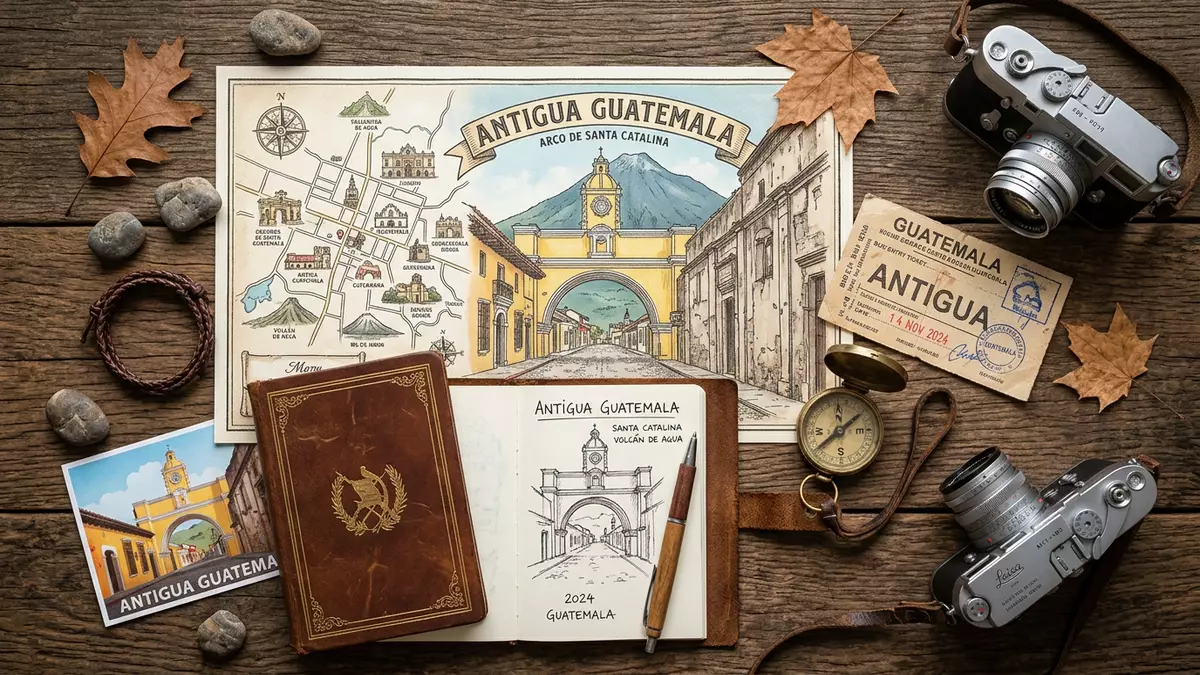
Arco de Santa Catalina crosses Calle del Arco in Antigua Guatemala as a covered passage above the street. Its yellow Baroque façade, small clock tower and volcanic setting form a compact view of the city’s colonial architecture.
A covered passage above Calle del Arco
The arch belonged to the Convent of Santa Catalina Virgen y Mártir, a religious complex associated with cloistered Dominican nuns. Its passage joined convent buildings on opposite sides of the street, keeping movement between them within the enclosed religious world.
Construction began in 1693, and the passage was completed in June 1694. The structure belongs to the Baroque architectural language of Spanish colonial Guatemala, with a broad arch opening, plastered walls and a strong horizontal presence above the road. the arch’s seventeenth-century history
Baroque masonry, yellow walls and a clock
Arco de Santa Catalina is recognised by its warm yellow-orange colouring, enclosed upper passage and small turret. A mechanical clock was added in the nineteenth century, giving the profile above the street an additional vertical element.
The visible building is therefore not limited to its seventeenth-century passage. The arch, tower and clock express different stages of Antigua Guatemala’s architectural history, while the surviving form remains closely connected with the former convent. the Baroque arch and clock
A street view shaped by colonial Antigua
Antigua Guatemala was founded in 1524 as Santiago de Guatemala and served as the capital of the Captaincy-General of Guatemala. The city stands at about 1,530 m above sea level in a region affected by earthquakes.
The earthquakes of 1773 damaged many buildings in the city, including religious complexes. Arco de Santa Catalina remained as a recognisable element of the historic centre, and Antigua Guatemala entered the UNESCO World Heritage List in 1979. Antigua Guatemala’s heritage status
Calle del Arco places the passage within the city’s historic street network. From the road, the arch can be read as architecture, former convent infrastructure and a framed urban vista at once. The distant volcanic slopes belong to the wider landscape of Antigua Guatemala, while the masonry and painted façade remain close at hand.
Visiting Arco de Santa Catalina: what travellers from Western Europe should know
- Arco de Santa Catalina stands on Calle del Arco in the historic centre of Antigua Guatemala, in the department of Sacatepéquez.
- The arch is reached on foot through Antigua Guatemala’s colonial street grid. Calle del Arco passes directly beneath the enclosed upper passage.
- Cobblestones form part of the surrounding streets, and the passage is viewed from the public road rather than approached as an open interior building.
- Nearby landmarks include La Merced, Parque Central and Tanque La Unión, all within Antigua Guatemala’s historic centre.
- The official language is Spanish and the currency is the Guatemalan quetzal.
- Entry requirements depend on your nationality; UK travellers can check the FCDO travel advice at gov.uk/foreign-travel-advice, Irish travellers the Department of Foreign Affairs at ireland.ie.
Searching for Arco de Santa Catalina on social platforms
These links open searches for Arco de Santa Catalina on each platform.
Frequently asked questions about Arco de Santa Catalina
Where is Arco de Santa Catalina?
Arco de Santa Catalina is on Calle del Arco in the historic centre of Antigua Guatemala, in Sacatepéquez, Guatemala.
What can visitors expect at the arch?
Visitors see a yellow Baroque passage spanning the street, with a small nineteenth-century clock tower above it. The surrounding approach runs across Antigua Guatemala’s cobbled colonial streets.
What makes Arco de Santa Catalina distinctive?
Its distinctive feature is the combination of an elevated convent passage, a painted Baroque façade, a clock tower and a view towards volcanic terrain.


