
Arches National Park’s sandstone arches and fins near Moab
Published on 09/16/2026 at 10:21 | Editorial responsibility: Rafael Müller, Editor-in-Chief AD HOC NEWS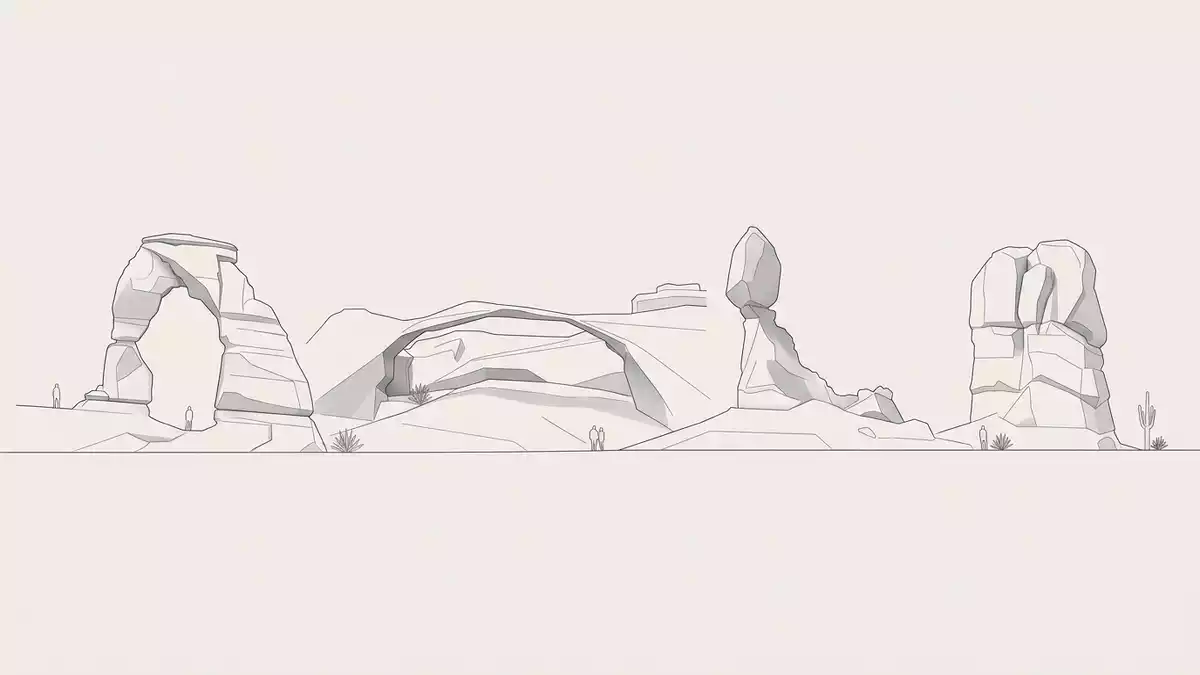
Arches National Park, on the Colorado Plateau north of Moab in Utah, is a landscape of sandstone walls, arches and slender fins concentrated within a compact desert basin. It is known for more than 2,000 natural sandstone arches and for named formations such as Delicate Arch, Landscape Arch and the Windows, all set among red rock valleys carved from Jurassic strata.
Sandstone, salt and the making of arches
The terrain of Arches National Park is built on thick layers of sedimentary rock that record environments from the Pennsylvanian through the Cretaceous, with the Navajo and Entrada Sandstones forming most of the visible cliffs and sculpted features.ten major sedimentary formations The park sits above subsurface salt deposits of the Paradox Formation, whose slow movement and dissolution warped the overlying rocks into anticlines and broad collapsed valleys such as Salt Valley and Cache Valley.Salt Valley and Cache Valley inside the park
Many arches and fins are carved from the Entrada Sandstone, deposited about 150 million years ago during the Jurassic Period from desert dunes that later lithified into thick, relatively soft beds.Entrada Sandstone was deposited about 150 million years ago Fracturing along parallel joints above salt-cored anticlines produced narrow rock walls, or fins, which erosion then thinned until openings developed, forming arches in units such as the Slick Rock Member of the Entrada and related formations.more than 2,000 sandstone arches chiseled from Entrada Sandstone
From monument to national park in the Utah desert
Arches National Park occupies an area of desert plateau and canyons north of Moab in eastern Utah, within Grand County, where valleys and rock ridges define a compact park boundary.Arches National Park near the town of Moab The site was first given federal protection as Arches National Monument on 12 April 1929, through a presidential proclamation signed by Herbert Hoover that reserved parts of Devil’s Garden and the Windows section as a monument.presidential proclamation signed by President Herbert Hoover on 12 April 1929
Later legislation enlarged the protected area and redesignated it as a national park on 12 November 1971, giving Arches National Park its present status as a unit of the United States National Park System encompassing tens of thousands of acres of sandstone landscape.established as a national monument in 1929 and designated a national park in 1971 Within this boundary, the park preserves arches, balanced rocks, spires and other rock forms as well as associated desert ecosystems adapted to the semi-arid climate.
Delicate Arch, Landscape Arch and other named formations
Visitors encounter Arches National Park through distinct districts of formations, each centred on prominent arches and rock features. Delicate Arch stands on a sandstone bench above slickrock slopes, a freestanding arch of Entrada Sandstone that has become a widely recognised symbol of Utah.Delicate Arch chiseled from blocks of Entrada Sandstone Other areas feature groupings of arches, including the Windows Section, where openings frame views across the desert and towards distant mesas.
In the north of the park, the Devils Garden area showcases arches eroded through long sandstone fins, including Landscape Arch, which spans a considerable distance across a slender rock band.Devils Garden is home to several arches including Landscape Arch Elsewhere, formations such as balanced rocks, narrow canyons and alcoves demonstrate the same combination of joint-controlled erosion and variable rock resistance that underlies the park’s concentration of arches.over two thousand natural sandstone arches preserved in the park
Visiting Arches National Park: what travellers from Western Europe should know
- Arches National Park lies north of Moab in eastern Utah; the main entrance road branches from U.S. Route 191, and Moab provides regional transport links.
- Much of the park is reached on foot along trails over uneven sandstone, with sections of slickrock, steps and short climbs on firm but exposed rock surfaces.
- The desert setting brings strong sun and low humidity, and exposed viewpoints often stand on high sandstone benches above surrounding valleys.
- Moab sits beside the Colorado River, and from Arches National Park there are broad views towards neighbouring canyon country and distant buttes.
- The official language is English and the currency is the United States dollar; entry requirements depend on your nationality, UK travellers can check the FCDO travel advice at gov.uk/foreign-travel-advice, Irish travellers the Department of Foreign Affairs at ireland.ie.
Searching for Arches National Park on social platforms
These links open searches for Arches National Park on each platform.
Frequently asked questions about Arches National Park
Where is Arches National Park located?
Arches National Park is in Grand County in eastern Utah, on the Colorado Plateau north of the town of Moab.
What should visitors expect on a visit?
A visit centres on driving through desert valleys and walking on sandstone trails among arches, fins, balanced rocks and broad views over canyons.
What makes Arches National Park distinctive?
The park combines Jurassic sandstone, salt-driven structures and thousands of natural arches in a relatively small area, giving it a dense concentration of sculpted rock forms.


