
Arches National Park’s sandstone arches above the Utah desert
Published on 09/05/2026 at 07:33 | Editorial responsibility: Rafael Müller, Editor-in-Chief AD HOC NEWS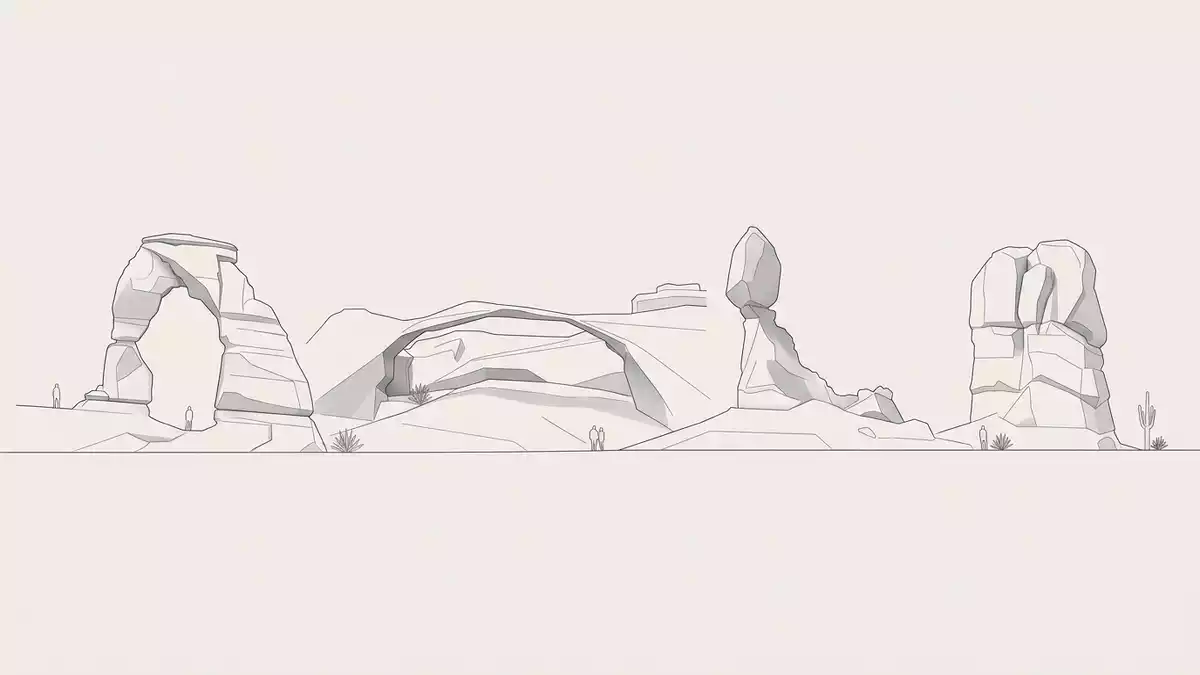
Arches National Park in eastern Utah, near the town of Moab, is a desert landscape where natural sandstone arches rise above bare rock and sparse vegetation in striking numbers. It preserves a concentration of arches that has become one of the defining geological scenes of the Colorado Plateau in the twentieth century, after its initial protection as a national monument in 1929 and redesignation as a national park in 1971.
Sandstone arches in a compact desert park
The defining feature of Arches National Park is the density of natural arches, openings in sandstone walls and fins that range from narrow slits to large spans. Within a relatively compact park area, more than 2,000 natural sandstone arches have been documented, a figure that reflects the way Arches collects this landform in one accessible place rather than scattering it across a wider region.More than 2,000 documented arches
These arches sit among sandstone fins, balanced rocks, pinnacles and eroded monoliths, all shaped from thick beds of reddish Entrada Sandstone and paler Navajo Sandstone. Both formations date from the Jurassic Period and record ancient deserts and shorelines in their cross-bedded layers, and the contrast in colour and layering between them is visible in many of the cliffs and slopes around Moab.Entrada and Navajo Sandstone
Delicate Arch and named formations
Among the many arches in the park, Delicate Arch has taken on a particular prominence as a freestanding arch in Entrada Sandstone on a bare slickrock ledge east of Moab. It stands around 16 m (52 ft) tall, with the curved opening beneath its span rising above a natural bowl in the sandstone.Delicate Arch in Entrada Sandstone While Delicate Arch is widely recognised, the park also includes arches such as the North and South Windows and formations in the Devils Garden area, where long sandstone fins carry multiple openings.
Many of these named arches form where different members of the Entrada Sandstone meet softer layers, for example at contacts between the Slick Rock Member and underlying units such as the Dewey Bridge Member. At these junctions, weathering can exploit contrasts in rock strength, carving alcoves that eventually break through as openings, and the result is strings of arches along cliff lines rather than isolated features.Contacts between sandstone members
Salt, fractures and the making of fins
The concentration of arches in Arches National Park arises from the combination of layered Jurassic sandstones and an underlying salt bed deposited in the Paradox Basin around 300 million years ago. As this buried salt moved and bulged, it warped the overlying strata into anticlines and created closely spaced fractures in the sandstone, particularly around features such as Salt Valley.Salt Valley and Paradox Formation When erosion removed softer rocks above, the fractured sandstones stood out as fins, sometimes tens of metres high.
Over thousands of years, water, temperature changes and gravity have gradually sculpted these fins into arches. Cracks widen, blocks fall away, and in places potholes near cliff edges deepen until they wear through the wall below, leaving an opening that can enlarge to a span exceeding 90 m (295 ft) in extreme cases.Weathering of Entrada Sandstone fins The park’s dry climate, thick brittle sandstones, soft interbeds and proximity to salt-cored anticlines together set the stage for this long, incremental process.
Visiting Arches National Park: what travellers from Western Europe should know
- Arches National Park lies north of Moab in eastern Utah, with paved roads leading from the town towards the park entrance and further routes branching to viewpoints and trailheads.
- Much of the park’s terrain consists of exposed sandstone, uneven slickrock and short cliffs; some viewpoint paths climb over rock and include stretches without shade.
- The Colorado River flows near Moab, and other protected areas such as Canyonlands National Park lie within driving reach, making Arches part of a wider desert landscape of canyons and mesas.
- The official language is English and the currency is the United States dollar.
- Entry requirements depend on your nationality; UK travellers can check the FCDO travel advice at gov.uk/foreign-travel-advice, Irish travellers the Department of Foreign Affairs at ireland.ie.
Searching for Arches National Park on social platforms
These links open searches for Arches National Park on each platform.
Frequently asked questions about Arches National Park
Where is Arches National Park located?
Arches National Park is in eastern Utah in the United States, just north of the small desert town of Moab on the Colorado Plateau.
What can visitors expect on a visit to Arches?
Visitors encounter a dry, high-desert environment of sandstone cliffs and fins, with roads and trails leading to viewpoints over natural arches and sculpted rock.
What makes Arches National Park distinctive?
Arches is distinctive for its concentration of more than 2,000 natural sandstone arches, many carved from Jurassic Entrada Sandstone above salt-influenced valleys.


