
Arches National Park and its sandstone arches near Moab
Published on 08/30/2026 at 13:03 | Editorial responsibility: Rafael Müller, Editor-in-Chief AD HOC NEWS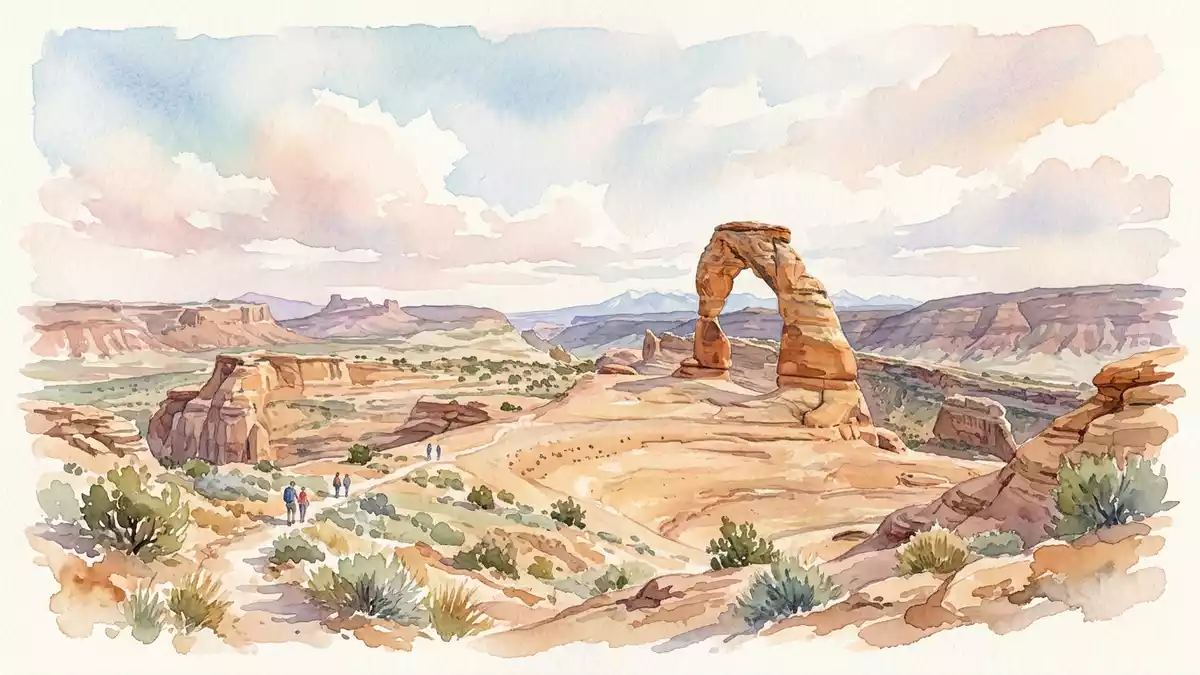
Arches National Park, just north of Moab in the high desert of eastern Utah, is defined by stone that has eroded into curves, spans and freestanding arches. Layered sandstones from the Jurassic period form cliffs, fins and pinnacles, and in many places those walls have opened into arches that frame the desert light.
A landscape built from ancient sand and salt
Arches National Park stands on the Colorado Plateau, where thick beds of sandstone rest above deep deposits of salt laid down in the Paradox Basin about 300 million years ago. These salt layers, known as the Paradox Formation, acted as a shifting foundation, slowly warping the overlying rock into domes and folds as the region rose.underground evaporite layer Beneath the plateau surface the salt bed reached great thicknesses, and as it moved it fractured the tougher sandstone above into sets of near-parallel cracks.
The park preserves more than 300 square kilometres of this plateau, where Mesozoic sandstones dominate the landscape.Mesozoic sedimentary rocks The Entrada Sandstone, deposited about 150 million years ago as desert dunes and beaches in the Jurassic period, is particularly important because most of the rock arches form within it.Entrada Sandstone formed 150 million years ago Above and below it sit other units such as the Carmel Formation and Navajo Sandstone, each weathering at a different rate and giving the park its banded cliffs and contrasting colours.
More than 2,000 natural arches in one park
The defining feature of Arches National Park is the density of natural rock arches carved into the sandstone. Over 2,000 documented arches of sandstone span the park, ranging from narrow openings in thin walls to grand spans that stretch for more than 90 metres (295 ft).over 2,000 documented archesdensest concentration of natural stone arches This concentration of arches within one protected area is one of the main reasons the park was first protected as a national monument in 1929 and redesignated as a national park in 1971.changed from monument to national park in 1971
Among these features, Delicate Arch has become the most recognisable single span. It rises about 16 m (52 ft) above a slickrock bowl and stands free of any cliff, its entire curve carved from Entrada Sandstone.Delicate Arch 16 m tall Elsewhere in the park, arches appear as openings in long sandstone fins, as paired “windows” in a single wall or as thin spans high above the desert floor. The result is a landscape where solid rock repeatedly breaks into gaps and frames, so that views are continually caught through natural stone gateways.
How rock fins turn into arches
The geology of Arches National Park is visible in the way rock layers step back from the canyons, crack and narrow into fins, then finally break through. Massive beds of Entrada Sandstone are jointed by faulting and by the subsurface movement of salt, which divides the rock into slabs with vertical fractures.massive brittle sandstones jointed by faulting Erosion along these fractures isolates thin walls of rock, particularly in areas such as Devils Garden where closely spaced parallel fractures are common.fins in Devils Garden area
Once fins stand free, water exploits every weakness in the sandstone. Rain seeps into the porous rock and reaches boundaries between units, especially where the Entrada Sandstone overlies denser beds such as the Carmel Formation, and cavities begin to form.drops of rainwater soak into porous Entrada sandstone Freeze–thaw cycles then widen cracks as ice expands, while loose grains fall away, deepening alcoves until openings cut completely through a fin. When a hole reaches a span of at least about one metre, geomorphologists count it as an arch, and in Arches National Park many such openings have enlarged into the graceful stone spans that give the park its name.definition of an arch opening
Visiting Arches National Park: what travellers from Western Europe should know
- Arches National Park lies north of Moab in eastern Utah, in the desert landscape of the Colorado Plateau in the United States.
- Most viewpoints and trailheads sit on a high desert plateau of bare sandstone and sandy soil, where exposed rock, limited shade and gradual slopes dominate the terrain.
- The official language is English and the currency is the United States dollar.
- Entry requirements depend on your nationality; UK travellers can check the FCDO travel advice at gov.uk/foreign-travel-advice, Irish travellers the Department of Foreign Affairs at ireland.ie.
Searching for Arches National Park on social platforms
These links open searches for Arches National Park on each platform.
Frequently asked questions about Arches National Park
Where is Arches National Park?
Arches National Park is in eastern Utah in the United States, just north of the town of Moab on the Colorado Plateau.
What should visitors expect on a visit?
Visitors encounter a desert plateau cut by canyons, with sandstone arches, fins and balanced rocks accessible from viewpoints and signed trails.
What makes Arches National Park distinctive?
Arches National Park is distinctive for its concentration of more than 2,000 natural sandstone arches formed in Jurassic Entrada Sandstone above deep salt deposits.


