
Archaia Olympia and the sanctuary valley of the ancient Games
Published on 09/07/2026 at 08:20 | Editorial responsibility: Rafael Müller, Editor-in-Chief AD HOC NEWS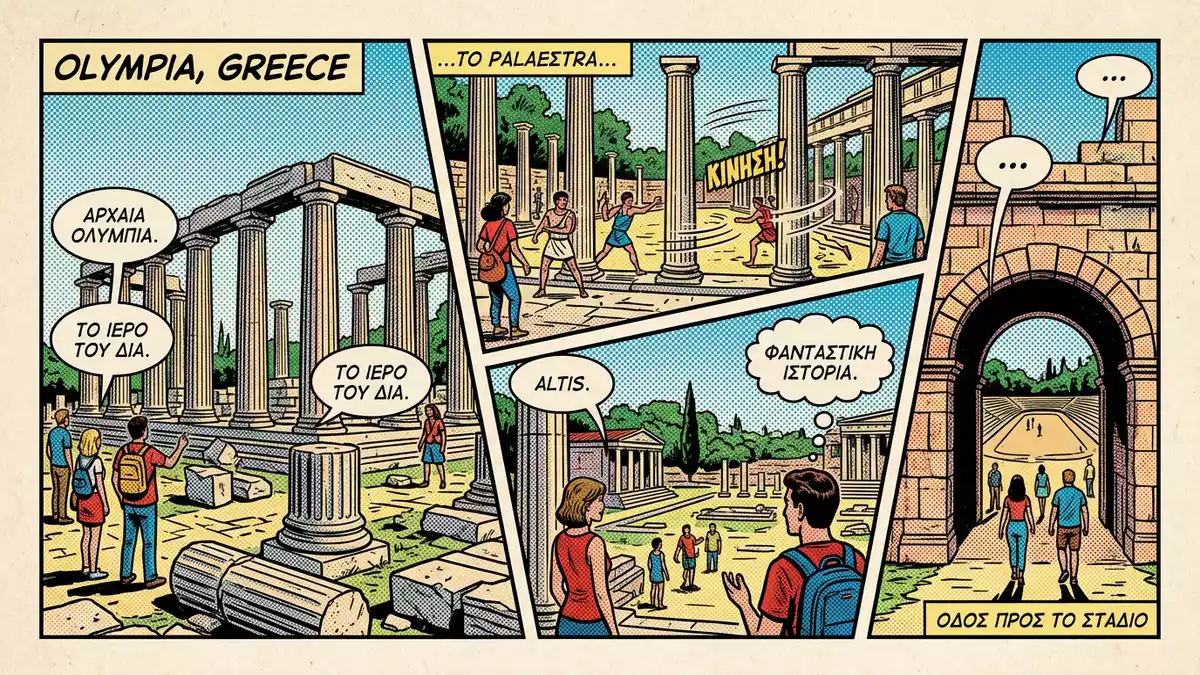
Archaia Olympia is the modern town in western Greece that shares its name with the ancient sanctuary and athletic grounds where the Olympic Games first took shape in the valley of the Alpheios and Kladeos rivers.Archaia Olympia lies in the regional unit of Elis on the Peloponnese peninsula, linking present-day life to an archaeological landscape that has been inscribed as the Archaeological Site of Olympia on the UNESCO World Heritage List since 1989.World Heritage status
The sanctuary of Zeus in a river valley
The ancient sanctuary at Archaia Olympia occupies a lowland valley framed by gentle hills, formed where the Alpheios and Kladeos rivers meet in the north-western Peloponnese.River valley setting In this landscape the area known as Altis, the sacred grove, gathered temples, altars and treasuries dedicated to the gods, especially Zeus and Hera, surrounded by trees and open ground that still gives a sense of enclosure between riverbanks and slopes.Altis sanctuary area
Human presence at the site is traced back to prehistoric times, with activity in the second millennium BC and cult practices that are associated with Zeus appearing between the tenth and eighth centuries BC.Early occupation Over the archaic and classical periods the sanctuary developed into a Panhellenic centre, drawing communities from across Greece to shared rituals and contests that linked religious devotion with athletic performance in the same valley floor.
Temples, training grounds and the ancient stadium
Within Altis the temple of Zeus stood as the principal cult building, joined by the temple of Hera, the Pelopion and a series of treasuries that lined the edge of the sacred area, each structure adding stone, columns and carved decoration to the grove’s outline.Temples of Zeus and Hera Outside the sanctuary core lay the gymnasium and palaestra, complexes of courts, colonnades and ancillary rooms where athletes prepared for competition and practised in the shadow of the religious buildings.
East of the Altis, a stadium was laid out with long, straight running tracks flanked by earth embankments for spectators, connected to the sanctuary by a vaulted entrance passage that linked the more enclosed grove with the open field beyond.Stadium at Ancient Olympia Here, beginning in 776 BC, the Olympic Games were held at regular four-year intervals in honour of Zeus, with a framework that included a sacred truce and a programme of races and other events that continued until the fourth century AD.Cycle of Olympic Games
From excavation to modern Archaia Olympia
Systematic excavation at Ancient Olympia began in the nineteenth century, when the French Archaeological Mission uncovered ruins in 1829, followed by extended campaigns under Greek and German archaeologists that brought the sanctuary, stadium and surrounding buildings progressively into view.Nineteenth-century excavations The modern town of Archaia Olympia grew beside the site, providing roads, services and places to stay, while the archaeological remains are organised as a protected zone that reflects layers from the prehistoric period through to late Roman times.Municipal description of the site
Near the sanctuary stands the Archaeological Museum of Olympia, which brings together statues, architectural fragments and smaller finds recovered on site, helping to connect the column bases and foundations in the open air with sculptural programmes and objects that once populated them.Archaeological Museum of Olympia In the wider area, institutions such as the International Olympic Academy use modern buildings within reach of the ruins to host events linked to the history and ideals of the Games, anchoring contemporary activity in the same landscape.
Visiting Archaia Olympia: what travellers from Western Europe should know
- Archaia Olympia lies in the regional unit of Elis in western Greece on the Peloponnese peninsula, reached by road connections from nearby towns such as Pyrgos and the port of Katakolon.
- The archaeological site stands in a river valley, and visiting involves walking on uneven ground between ruins, with paths that pass over low gradients and stone or packed-earth surfaces.
- The Alpheios and Kladeos rivers run close to the sanctuary area, so some viewpoints take in watercourses, wooded banks and the outlines of surrounding hills together with the remains of temples and the stadium.
- The official language is Greek and the currency is the euro.
Searching for Archaia Olympia on social platforms
These links open searches for Archaia Olympia on each platform.Frequently asked questions about Archaia Olympia
Where is Archaia Olympia?
Archaia Olympia is a town in the regional unit of Elis in western Greece, on the Peloponnese peninsula, beside the archaeological sanctuary and stadium of Ancient Olympia.
What can visitors expect on a visit to Archaia Olympia?
A visit brings walks among temple foundations, the outlines of training grounds and the earth banks of an ancient stadium, with nearby museum displays of sculpture and artefacts.
What makes Archaia Olympia distinctive among archaeological sites?
It combines a river-valley sanctuary dedicated to Zeus with the built setting of the earliest Olympic Games, and its remains and museum pieces reflect centuries of religious and athletic activity.


