
Archaia Agora: the open-air heart of ancient Athens
Published on 09/07/2026 at 20:50 | Editorial responsibility: Rafael Müller, Editor-in-Chief AD HOC NEWS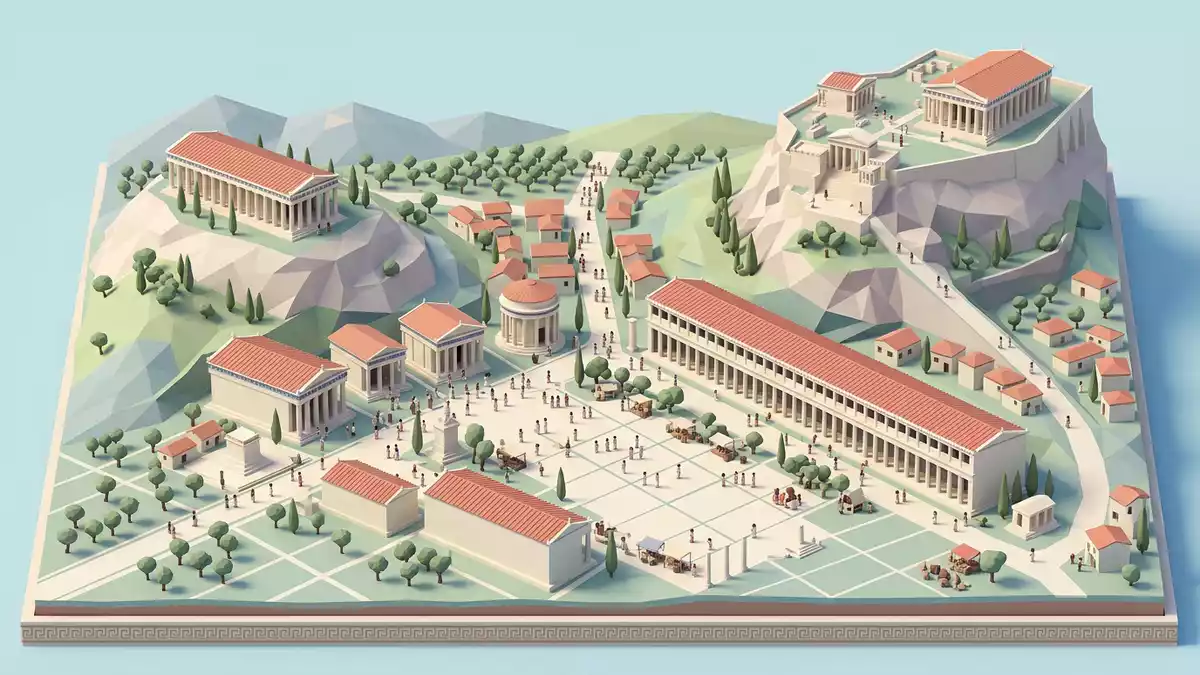
South of the modern district of Monastiraki and north-west of the Acropolis, Archaia Agora brings the ancient civic centre of Athen into the open air, where foundations, colonnades and temples still outline a classical city’s everyday stage.Ancient Agora of Athens
An open square where a city once gathered
Archaia Agora occupies a broad, irregular space that was laid out as Athens’ public square in the early sixth century BC in the time of Solon.early sixth century BC In classical antiquity this was the place where citizens met, magistrates worked and traders set out their stalls, a single area combining administrative, political, judicial, commercial, social and religious functions.focal point of public life
The ground had earlier served as a cemetery during the Late Bronze Age and Iron Age, before its gradual transformation into a civic space.used as a cemetery Once established, the Agora evolved over centuries, with building phases from the classical through the Hellenistic and Roman periods leaving a dense cluster of stoas, council buildings, altars and shrines that framed a large open centre.
Stoas, temples and the long view across the site
Walking into Archaia Agora today, the most striking enclosed structure is the Temple of Hephaestus, a well-preserved Doric temple overlooking the square from the north-west.Temple of Hephaestus Its colonnaded exterior crowns a low hill, giving long views across the former marketplace and towards the Acropolis beyond. Around the lower ground, the footprint of the square is picked out by foundations and scattered columns from stoas that once enclosed its edges.
On the north side stands the reconstructed Stoa of Attalos, a long, two-storey colonnaded building originally dating to the second century BC.Stoa of Attalos Its modern restoration gives a clear impression of how covered porticoes offered shade and shelter along the Agora’s perimeter, with a sequence of columns fronting enclosed rooms. Elsewhere, remains of the Bouleuterion, the council house, and other civic structures sit close to one another, underlining how dense the public architecture once was within this relatively compact area.civic buildings and square
Layers of history beneath a modern city
The story of Archaia Agora is written not only in isolated monuments but in the succession of building and destruction that shaped the whole site. Major damage came with the Persian sack of Athens in 480–479 BC, followed by Roman and later invasions that burned and toppled many structures.Persian and later destructions Each wave of rebuilding added new stoas, temples and civic buildings, so that by the Roman period the Agora combined Greek and Roman elements within one complex ground plan.Roman-period layout
After late antique invasions and gradual abandonment, the area reverted to a residential quarter, with later houses and churches overlaying the classical remains.Byzantine and later habitation Systematic archaeological excavations began in 1931 under the American School of Classical Studies at Athens, clearing modern buildings to reveal the ancient ground again.excavations in 1931 The result is a landscape where low walls, column drums and restored colonnades sit within a park-like setting, giving a sense of the Agora’s scale and its position between the Acropolis and the surrounding hills.
Visiting Archaia Agora: what travellers from Western Europe should know
- Archaia Agora lies north-west of the Acropolis in Athen, close to the neighbourhood of Monastiraki and reached on foot from Monastiraki metro station.
- The archaeological site covers uneven ground with earth paths, stone paving and low slopes, and exploring its temples and stoas involves walking over outdoor terrain.
- The official language is Greek and the currency is the euro.
Searching for Archaia Agora on social platforms
These links open searches for Archaia Agora on each platform.
Frequently asked questions about Archaia Agora
Where is Archaia Agora located in Athen?
Archaia Agora occupies the ancient civic centre north-west of the Acropolis, near the modern Monastiraki district and its metro station.
What can visitors expect when exploring Archaia Agora?
Visitors walk through an open archaeological landscape with the Temple of Hephaestus, the reconstructed Stoa of Attalos and low ruins marking former civic and commercial buildings.
What makes Archaia Agora distinctive among ancient sites?
Archaia Agora combines an open square, surrounding stoas and civic buildings on one continuous ground, preserving the layout of Athens’ classical public life within a single site.


