
Arashiyama Chikurin, the bamboo corridor of western Kyoto
Published on 09/19/2026 at 06:08 | Editorial responsibility: Rafael Müller, Editor-in-Chief AD HOC NEWS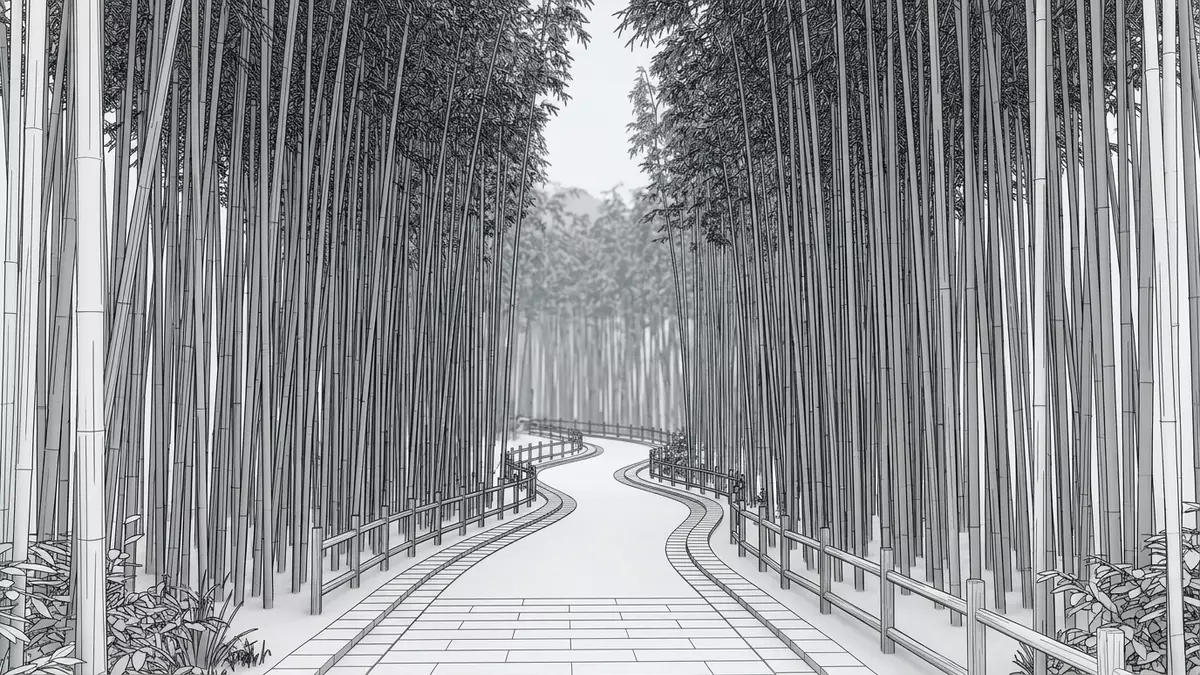
Arashiyama Chikurin is the Japanese name for the bamboo forest that lines a paved walking route in Kyoto’s Arashiyama district on the western side of the city. In this corridor the city’s rail lines, temple precincts and rising foothills meet in a single narrow band of ground, with the walking path threading directly through the bamboo between them.
A straight path through towering bamboo
The place most visitors know as the Arashiyama Bamboo Grove is a straight pedestrian route cut through dense stands of bamboo on Kyoto’s western edge. Described locally as Chikurin-no-Michi, or “bamboo grove path”, it forms a corridor of green stalks reaching high above a paved surface, creating a continuous outdoor passage framed by trunks and foliage.The bamboo grove path runs between the north gate of Tenryu-ji and the grounds of the villa Okochi Sanso, linking temple and garden districts within Arashiyama.
The bamboo itself belongs to the Sagano Forest, a wider natural bamboo area in Arashiyama that has become one of Kyoto’s most photographed landscapes.This Sagano bamboo forest spreads across the hillside above the district, with the public path occupying a strip at its lower edge. Bamboo trunks cluster close on either side of the paving, with cross-bracing and simple fencing keeping the stems back from the route itself.
Temples, shrines and hills alongside the grove
Arashiyama Chikurin sits within the Sagano and Arashiyama area of Ukyo Ward, a district where temple grounds and residential streets share space with wooded hills. One side of the grove borders Tenryu-ji, a major Zen temple founded in the fourteenth century and recognised as a UNESCO World Heritage Site as part of the “Historic Monuments of Ancient Kyoto”.The Bamboo Grove Path connects directly with Tenryu-ji’s entrance area, making the temple an obvious landmark beside the bamboo.
Along the route, visitors pass smaller sites such as Nonomiya Shrine, a Shinto shrine associated with literary references from “The Tale of Genji”.Nonomiya Shrine sits immediately beside the path within the grove, its buildings appearing at the edge of the bamboo stands. At the upper end lies Okochi Sanso, the former villa of film actor Denjiro Okochi, whose garden terraces face towards the wooded slopes above Arashiyama. Beyond the grove itself the wider district includes the Katsura River, the Togetsukyo Bridge and hillside enclosures such as Iwatayama Monkey Park, all within walking reach of the bamboo corridor.
Arashiyama Chikurin and the city around it
The bamboo grove is closely tied to Kyoto’s transport grid, with railway lines and stations forming clear anchors for orientation. The JR Sagano Line, part of the Sanin Main Line, runs west from Kyoto Station to Saga-Arashiyama Station in Ukyo Ward, from which the grove is reached on foot.Arashiyama Bamboo Grove lies roughly north of the station, on ground between the railway and the temple zone. A second line, the Randen tram operated by Keifuku Railway, terminates at Arashiyama Station near the Katsura River, giving another rail access point within walking distance of the grove.
Within Kyoto’s administrative layout, Arashiyama Chikurin belongs to Ukyo Ward on the western outskirts of the city.The bamboo grove occupies a strip at the base of the “Storm Mountains”, the low hills that rise immediately behind the district. The paved path itself functions as a public walkway, used both by sightseers and by people crossing between residential streets and the temple precincts. Electric lighting, simple railings and occasional side alleys connect the grove with neighbouring lanes, while the bamboo canopy remains the defining feature overhead.
Visiting Arashiyama Chikurin: what travellers from Western Europe should know
- Arashiyama Chikurin lies in Kyoto’s Arashiyama and Sagano district in Ukyo Ward on the western outskirts of the city, reached on foot from JR Saga-Arashiyama Station on the Sagano Line and from the Randen Arashiyama tram terminus.
- The walking route through the bamboo follows a paved surface with gentle gradients, but many approaches involve ordinary city pavements and occasional narrow lanes between houses and temple walls.
- The Katsura River, the Togetsukyo Bridge and Tenryu-ji temple sit very close to the grove, so walking itineraries often combine the bamboo corridor with riverside views and temple gardens on the same day.
- The official language is Japanese and the currency is the yen.
- Entry requirements depend on your nationality; UK travellers can check the FCDO travel advice at gov.uk/foreign-travel-advice, Irish travellers the Department of Foreign Affairs at ireland.ie.
Searching for Arashiyama Chikurin on social platforms
These links open searches for Arashiyama Chikurin on each platform.
Frequently asked questions about Arashiyama Chikurin
Where is Arashiyama Chikurin located within Kyoto?
Arashiyama Chikurin is in the Arashiyama and Sagano district of Ukyo Ward on Kyoto’s western outskirts, between JR Saga-Arashiyama Station, Tenryu-ji temple and the Katsura River.
What should visitors expect when walking through the bamboo grove?
Expect a straight paved corridor enclosed by dense bamboo stands, with side paths leading towards temple gates, shrines and residential lanes that sit immediately beside the grove.
What makes Arashiyama Chikurin distinctive among Kyoto’s sights?
Its distinctive character lies in the way a public walking path, major Zen temple grounds, a historic shrine and rising hills share a single narrow strip of bamboo forest in the city’s west.


