
Arashiyama Chikurin and the bamboo corridors of western Kyoto
Published on 08/19/2026 at 16:57 | Editorial responsibility: Rafael Müller, Editor-in-Chief AD HOC NEWS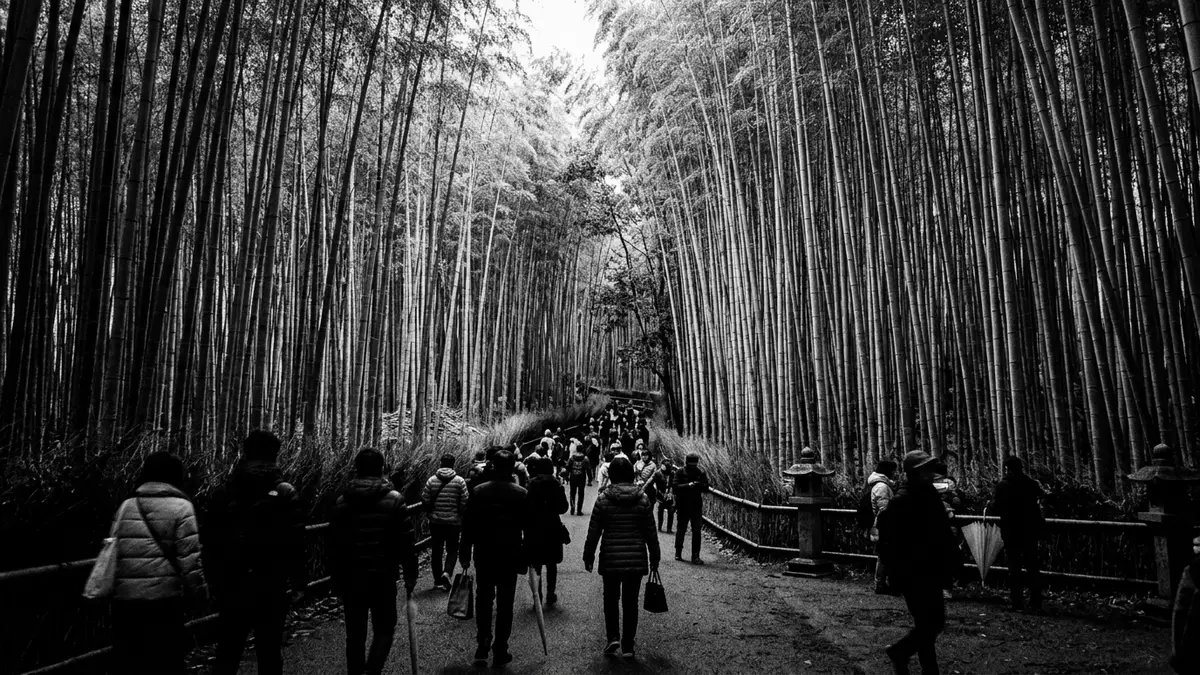
Arashiyama Chikurin is the Japanese name for the bamboo forest that lines paved walking routes through the Sagano and Arashiyama district on the western side of Kyoto in Japan. It is a natural grove of tall bamboo rather than a single built monument, with paths that link temple gates, village streets and hillside villas.
Bamboo paths between temple, shrine and villa
The best known part of Arashiyama Chikurin is a pedestrian route that runs between the north gate of Tenryu-ji temple and the hillside villa ?k?chi Sans?, following a gentle slope through dense bamboo on the western edge of Kyoto.runs from outside the north gate of Tenryu-ji to just below ?k?chi Sans? This route is widely known in Japanese as Chikurin no Komichi, literally the “Path of bamboo”.Chikurin-no-Komichi, or “Path of bamboo” A second signed route, often called the Bamboo Forest Trail, branches nearby in the Sagano area and winds through further stands of bamboo.
The grove lies in Kyoto’s Uky? ward, in a district where religious and residential sites sit among mixed woodland on the lower slopes of the mountains known as Arashiyama.Located in the Ukyo Ward on the western outskirts of Kyoto Entrances to Arashiyama Chikurin connect directly with the shopping street in Arashiyama, with the grounds of Tenryu-ji, and with paths near Nonomiya Shrine and other local sites.entrances accessible from the main shopping street, Nonomiya Shrine, or Tenryu-ji’s gardens This setting makes the bamboo corridors part of a wider walking landscape, rather than an isolated nature reserve.
Scale, layout and the character of the grove
Arashiyama Chikurin is characterised by long, straight sections of paved path bordered on both sides by dense stands of bamboo that rise far above head height. The main Chikurin no Komichi route is documented as being about 400 m (1,312 ft) long, forming a continuous corridor between temple and villa.a 400-meter-long pedestrian path Guides describing the Sagano Bamboo Grove give a combined figure of around 500 m (1,640 ft) for the linked routes, with the grove itself around 140 m (459 ft) wide.The combined length is about 500 meters, and the grove is about 140 meters wide
The bamboo in Arashiyama Chikurin is largely moso bamboo, a tall species whose straight green culms form vertical walls along the route.a natural forest of Moso bamboo Articles on the grove describe more than 10,000 plants within the area, creating a continuous canopy over the path.over 10,000 towering green stalks The two formal routes, Chikurin no Komichi and the Bamboo Forest Trail, thread through this planting, with short side paths, minor roads and access points leading to nearby houses and small guesthouses.
Sagano, Arashiyama and the cultural landscape around the grove
Arashiyama Chikurin sits within Sagano, a district on the western outskirts of Kyoto that has been associated with countryside retreats since Japan’s Heian period, when courtiers built villas there. Modern guides describe the area as lying about 7 km (4.3 mi) west of the city centre, anchored by the Togetsukyo Bridge over the Katsura River and by Tenryu-ji, a major Zen temple.Located about 7km west of downtown Kyoto, Arashiyama is one of Kyoto’s sightseeing districts The bamboo forest forms part of this cultural landscape, linking religious precincts, riverbank paths and hillside viewpoints.
The path through Arashiyama Chikurin connects several named sites that themselves date back centuries. Tenryu-ji, at the southern end of the main route, was founded in the fourteenth century and is recognised as a UNESCO World Heritage temple within the “Historic Monuments of Ancient Kyoto” grouping.close to Tenryu-ji temple At the northern end, ?k?chi Sans? is a villa built in the twentieth century by the actor ?k?chi Denjir?, with gardens that look across the forested slopes of Arashiyama.leads to the beautiful Okochi Sanso villa Nonomiya Shrine, a small Shinto shrine associated with imperial princesses, lies beside the path near its midpoint. Walking Arashiyama Chikurin therefore brings visitors past sites that reflect Kyoto’s long religious and cultural history as much as its landscape.
Visiting Arashiyama Chikurin: what travellers from Western Europe should know
- Arashiyama Chikurin lies in the Sagano and Arashiyama district on the western outskirts of Kyoto and is reached on foot from JR Saga-Arashiyama and Randen Arashiyama stations on local railway lines.
- The paths in the bamboo grove follow a gentle slope and include long stretches of paved walkway; some short connecting routes use narrow lanes and minor roads.
- The surrounding district includes riverbanks, small streets and temple grounds, so footwear suited to mixed surfaces is helpful for combining the grove with nearby walks.
- The official language is Japanese and the currency is the yen.
- Entry requirements depend on your nationality; UK travellers can check the FCDO travel advice at gov.uk/foreign-travel-advice, Irish travellers the Department of Foreign Affairs at ireland.ie.
Searching for Arashiyama Chikurin on social platforms
These links open searches for Arashiyama Chikurin on each platform.
Frequently asked questions about Arashiyama Chikurin
Where is Arashiyama Chikurin in Kyoto?
Arashiyama Chikurin is in the Sagano and Arashiyama district in Uky? ward, on the western outskirts of Kyoto, near Tenryu-ji temple and ?k?chi Sans? villa.
What can visitors expect when walking through the grove?
Visitors follow paved paths between tall moso bamboo, with long corridors linking temple grounds, a small shrine and a hillside villa in a mixed woodland setting.
What makes Arashiyama Chikurin distinctive among Kyoto’s sights?
It is a natural bamboo forest integrated into a historic district, where planted corridors and cultural sites form a single continuous walking route rather than separate attractions.


