
Apartheid Museum turns Johannesburg’s past into a physical journey
Published on 09/23/2026 at 19:19 | Editorial responsibility: Rafael Müller, Editor-in-Chief AD HOC NEWS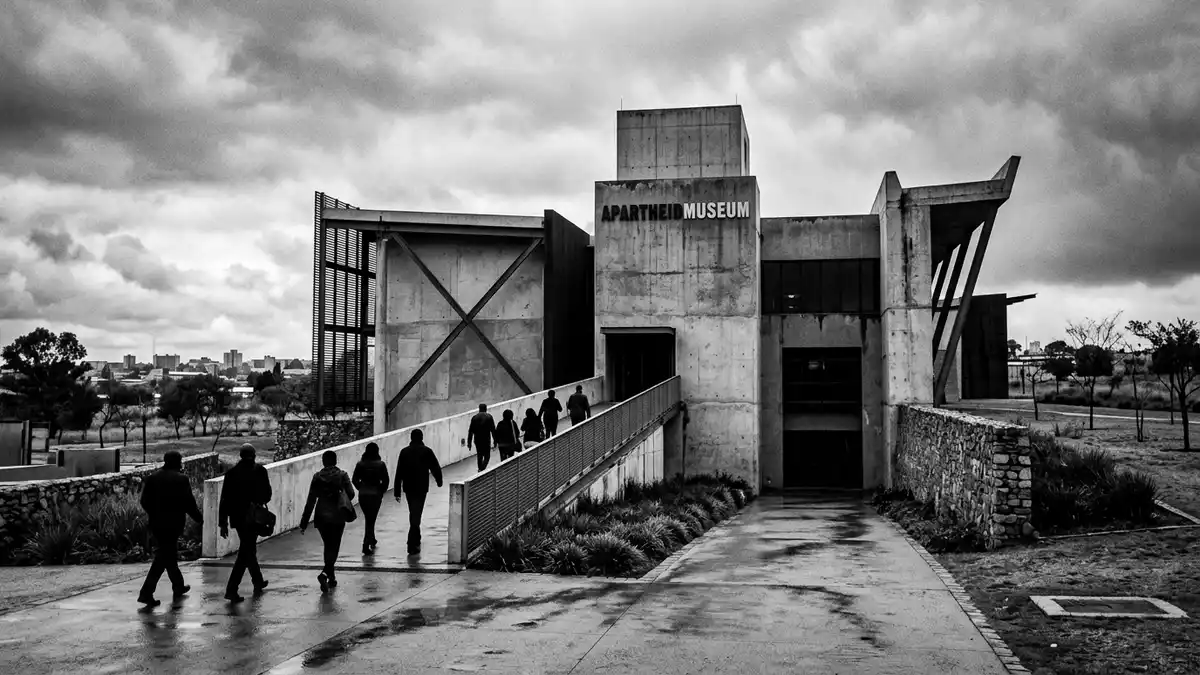
Apartheid Museum in Johannesburg presents South Africa’s twentieth-century history through a building of concrete, brick, stone and open landscape. The galleries trace the rise and fall of apartheid, while ramps, courtyards and exhibition rooms make the museum itself part of the encounter.
Apartheid Museum and the shape of memory
The museum opened in 2001 beside the Gold Reef City complex in southern Johannesburg. Its design came from an architectural consortium, and the building occupies a seven-hectare site with low forms, broad walls and landscaped spaces.
The complex sits in Ormonde, near Northern Parkway and Gold Reef Road. A largely horizontal arrangement extends across sloping ground, with circulation routes connecting exterior areas to galleries and other museum spaces. the museum’s architectural origins belong to the institution’s creation at the start of the twenty-first century.
South Africa’s twentieth century in photographs and objects
Apartheid Museum covers the political system that governed South Africa from 1948 until its dismantling in the early 1990s. The displays place laws, public policy and political milestones beside photographs, newspapers, film footage, documents and personal stories.
The subject is presented as lived history. Racial classification, restricted movement, segregated public life, forced removals, political resistance and state repression appear alongside the people who experienced them. The galleries connect national events with the ordinary spaces in which apartheid was enforced.
Nelson Mandela has a dedicated exhibition within the museum. It follows his roles as a political organiser, prisoner, negotiator and president, linking his life with the wider struggle against apartheid and the democratic transition. the Mandela exhibition forms one of the museum’s named interpretive sections.
From segregation to democracy
The historical sequence begins with the development of racial segregation and reaches the formal apartheid era introduced by the National Party after its 1948 election victory. Laws assigned racial categories, divided urban areas and restricted rights, movement and political participation.
The museum also follows resistance movements, imprisonment, protest and the negotiations that opened a route towards democratic government. The release of Nelson Mandela in 1990 and the first fully democratic elections in 1994 mark key points in the country’s political story.
Architecture and subject matter meet through the museum’s use of hard materials, changing levels and open areas. There is no separation between a neutral display room and a historical theme park. Instead, the building contains a sequence of galleries, surfaces, images and documents devoted to apartheid and its consequences.
The result is a place concerned with evidence as much as symbolism. Photographs record public events, objects give physical form to policy, and text panels establish the legal vocabulary of segregation. Personal accounts add individual experience to the political chronology.
Visiting Apartheid Museum: what travellers from Western Europe should know
- Apartheid Museum is in Ormonde, in southern Johannesburg, beside Gold Reef City at the corner of Northern Parkway and Gold Reef Road. The M1 freeway provides a road connection from the city.
- The site combines indoor galleries with landscaped outdoor areas, ramps, courtyards and changes in level. Comfortable footwear suits a visit involving movement across the complex.
- The museum’s subject is South African apartheid, and its displays use photographs, film, artefacts, documents and personal histories rather than a single type of collection.
- The official language is English and the currency is the South African rand.
- Entry requirements depend on your nationality; UK travellers can check the FCDO travel advice at gov.uk/foreign-travel-advice, Irish travellers the Department of Foreign Affairs at ireland.ie.
Searching for Apartheid Museum on social platforms
These links open searches for Apartheid Museum on each platform.Frequently asked questions about Apartheid Museum
Where is Apartheid Museum?
Apartheid Museum is in Ormonde, in southern Johannesburg, beside the Gold Reef City complex. Its address is associated with Northern Parkway and Gold Reef Road.
What can visitors expect inside?
The museum presents photographs, documents, film footage, artefacts, text panels and personal histories. Its galleries follow apartheid from segregation and racial classification through resistance and the democratic transition.
What makes Apartheid Museum distinctive?
The museum combines a purpose-built architectural complex with a detailed account of South Africa’s apartheid era. Concrete, brick, stone, landscaped spaces and documentary material share the same historical setting.


