
Aoraki / Mount Cook National Park, an alpine world above Mount Cook Village
Published on 09/12/2026 at 16:07 | Editorial responsibility: Rafael Müller, Editor-in-Chief AD HOC NEWS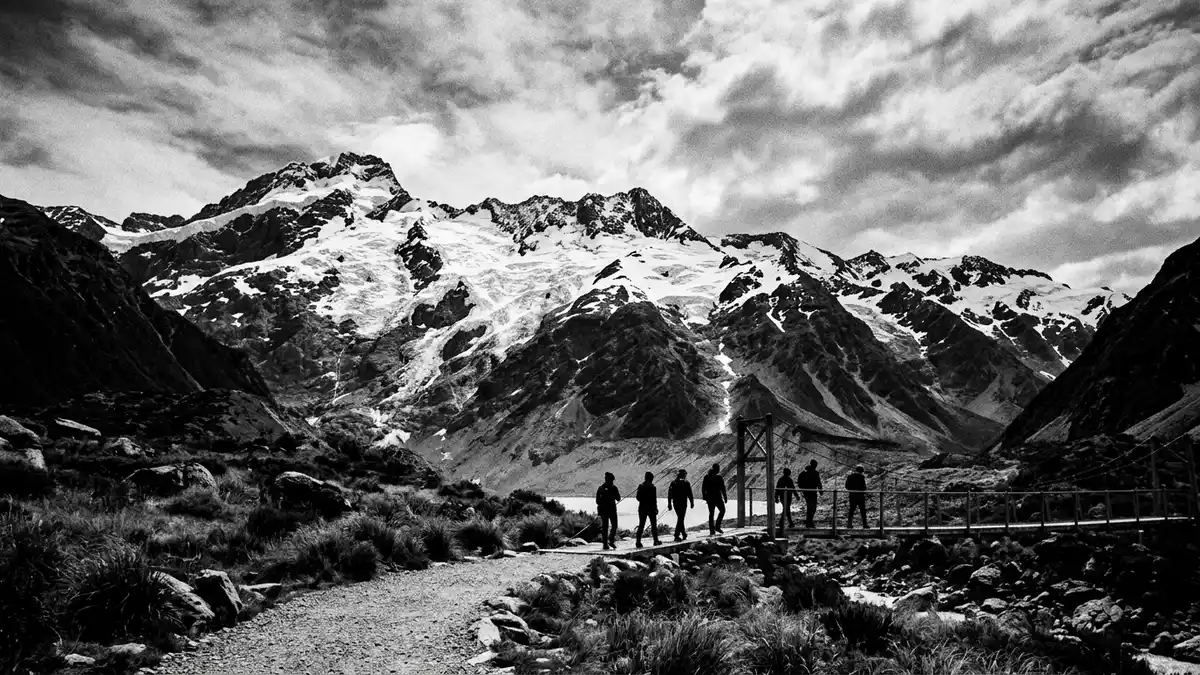
Aoraki / Mount Cook National Park in New Zealand’s Southern Alps is an alpine landscape where high peaks, long glaciers and steep valleys surround the small settlement of Mount Cook Village. The park was formally established in 1953 and takes its name from Aoraki / Mount Cook, the country’s highest mountain, which dominates the skyline above the central-west of the South Island.
Ice, rock and New Zealand’s highest mountain
Aoraki / Mount Cook National Park stretches along the eastern flank of the Southern Alps, in the Canterbury Region on the South Island of New Zealand, with its protected area recorded at about 707 km² (273 sq mi).recorded at about 707 km² Within this compact area, the park follows the crest of the range for several tens of kilometres, enclosing a dense concentration of ridges, cirques and glacier systems that form one of the country’s most dramatic mountain environments.concentration of ridges
At the centre stands Aoraki / Mount Cook itself, a permanently snow-clad summit rising to 3,724 m (12,218 ft) above sea level in a cluster of faces and buttresses that tower over surrounding valleys.rising to 3,724 m The wider park holds numerous peaks above 3,000 m (9,843 ft), forming a serrated skyline that frames the glaciers flowing down towards the Mackenzie Basin. In this high country the terrain is dominated by hard greywacke and other sedimentary rocks uplifted into sharp ridges, with permanent snow and ice occupying large tracts of the upper slopes.
Glacier country above a small alpine settlement
Aoraki / Mount Cook National Park is recognised as part of Te W?hipounamu – South West New Zealand, a World Heritage Area inscribed in 1990 for its outstanding natural values and concentration of alpine and glacial landscapes.World Heritage Area inscribed in 1990 Glaciers cover a substantial share of the park, with ice flowing in broad tongues such as the Tasman Glacier and Hooker Glacier on the flanks of Aoraki / Mount Cook.Tasman Glacier and Hooker Glacier These glacier systems carve deep troughs into the range and feed proglacial lakes where floating ice can be seen against bare rock walls.
Mount Cook Village, officially Aoraki / Mount Cook, sits inside the national park at the end of State Highway 80, on a flat valley floor framed by moraines and river channels.Mount Cook Village, officially Aoraki / Mount Cook Because the village lies within a protected area, the land is subject to conservation rules and property is not held in freehold, giving the settlement a compact, purpose-built character with accommodation and services concentrated in a small cluster of buildings. From the village, short approaches lead into glacial valleys where walking tracks, viewing areas and alpine routes bring the park’s terrain close at hand.
Landscape, light and Southern Alps weather
The park extends through an altitude range from valley floors to high summits, and the resulting shift in climate and vegetation is visible on almost any walk. Lower slopes carry alpine scrub and grasslands adapted to cold winters, while higher ground gives way to rock, snow and ice, with vegetation thinning out near the toe of the glaciers. Rivers such as the Hooker River and Tasman River run milky with suspended rock flour, a fine sediment ground from the bedrock by glacial movement.
Light and visibility are a substantial part of Aoraki / Mount Cook National Park’s appeal. The wider Mackenzie region is part of an International Dark Sky Reserve, and the clear air above the Southern Alps gives wide views along the main divide when conditions permit.International Dark Sky Reserve Weather can change quickly in this alpine environment, with cloud banks forming along the range and snowfall possible at higher elevations in many months of the year. Even in settled spells, the combination of sun on snowfields, shadowed faces and glacial lakes produces sharp contrasts that define the character of the landscape.
Visiting Aoraki / Mount Cook National Park: what travellers from Western Europe should know
- Aoraki / Mount Cook National Park lies in the Canterbury Region of New Zealand’s South Island, reached by State Highway 80 from the Mackenzie Basin towards Mount Cook Village.
- The terrain around Mount Cook Village includes valley-floor paths, river crossings and routes with sustained gradients; higher-level tracks and alpine routes encounter steep slopes, loose rock and snow.
- Mount Cook Village sits within Aoraki / Mount Cook National Park, so facilities and accommodation are concentrated in a compact settlement surrounded by protected land rather than a large town.
- The official language is English and the currency is the New Zealand dollar.
- Entry requirements depend on your nationality; UK travellers can check the FCDO travel advice at gov.uk/foreign-travel-advice, Irish travellers the Department of Foreign Affairs at ireland.ie.
Searching for Aoraki / Mount Cook National Park on social platforms
These links open searches for Aoraki / Mount Cook National Park on each platform.
Frequently asked questions about Aoraki / Mount Cook National Park
Where is Aoraki / Mount Cook National Park?
Aoraki / Mount Cook National Park is in the Canterbury Region on the central-west of New Zealand’s South Island, along the eastern side of the Southern Alps, with Mount Cook Village inside its boundaries.
What can visitors expect on a visit to the park?
Visitors encounter an alpine landscape of high peaks, extensive glaciers, steep-sided valleys and braided rivers, with walking tracks and alpine routes starting from Mount Cook Village and nearby trailheads.
What makes Aoraki / Mount Cook National Park distinctive among New Zealand’s parks?
The park contains New Zealand’s highest mountain, Aoraki / Mount Cook, a high concentration of peaks above 3,000 m and large glacier systems, all recognised within the Te W?hipounamu World Heritage Area.


