
Aoraki / Mount Cook and the high alpine world above Mount Cook Village
Published on 08/31/2026 at 11:38 | Editorial responsibility: Rafael Müller, Editor-in-Chief AD HOC NEWS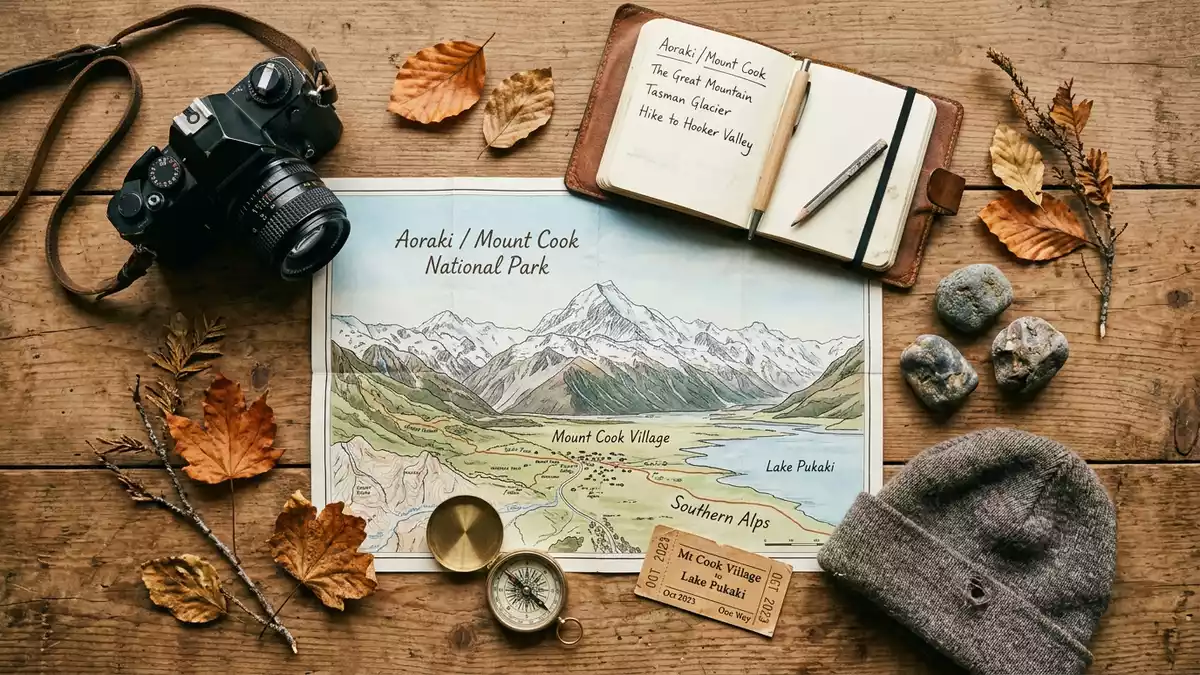
Aoraki / Mount Cook rises above Mount Cook Village as the highest mountain in New Zealand, forming a sharply sculpted summit within the Southern Alps of the South Island. The peak stands within Aoraki / Mount Cook National Park, an alpine protected area established in 1953 that later became part of the Te W?hipounamu – South West New Zealand World Heritage Area.
A high peak in a crowded alpine skyline
The mountain of Aoraki / Mount Cook anchors a concentration of summits where snow and ice cover the upper slopes all year. Its high point reaches over 3,700 m (around 12,000 ft), placing it above a ring of surrounding peaks that also climb beyond 3,000 m in elevation.The highest mountain in New Zealand rises along the main spine of the Southern Alps / K? Tiritiri o te Moana in the central-west of the South Island.
Aoraki / Mount Cook is closely linked with glaciers on both flanks, with Hooker Glacier lying to the west and Tasman Glacier to the east, carving valleys that lead down towards Mount Cook Village.Hooker Glacier and Tasman Glacier frame the mountain and feed the braided rivers of the wider Mackenzie Basin. Climbers have been drawn to these faces since the nineteenth century, with the first recorded ascent in 1894 marking Aoraki / Mount Cook as a benchmark for high alpine mountaineering in New Zealand.The first recorded ascent in 1894
Aoraki / Mount Cook National Park and Mount Cook Village
The broader setting for Aoraki / Mount Cook is Aoraki / Mount Cook National Park, a protected area of about 707 km² (273 sq mi) in the Canterbury Region.The national park in the Canterbury Region follows the crest of the Southern Alps for dozens of kilometres, sharing part of its western boundary with Westland Tai Poutini National Park. Glaciers cover a substantial share of the park’s surface, and the valleys cut by ice form corridors that stretch from the high snowfields down towards the grasslands of the Mackenzie Country.
Mount Cook Village stands as the nearest settlement to the mountain, lying within the national park and serving as a small base for travellers, walkers and climbers. It sits amid rivers, moraines and glacial lakes, with views towards the summit pyramid of Aoraki / Mount Cook and the nearby peaks. The park’s status as part of Te W?hipounamu – South West New Zealand means that the landscape around the village forms part of a wider World Heritage area recognised for its concentration of high mountains and extensive glaciers.Te W?hipounamu – South West New Zealand
Name, cultural background and alpine environment
The dual name Aoraki / Mount Cook reflects both M?ori and European strands in the mountain’s history. Aoraki, also written Aorangi, comes from the M?ori language and is associated with a meaning of “cloud piercer”, while the Mount Cook component commemorates the British navigator James Cook, whose name was attached to the peak in the nineteenth century.The M?ori name Aoraki and James Cook Together they name a summit that occupies a central place in South Island geography and in New Zealand’s high country culture.
The alpine environment around Aoraki / Mount Cook and Mount Cook Village is marked by permanent snowfields, exposed rock faces and ice that shapes both the high peaks and the lower valleys.A rugged land of ice and rock Nineteen peaks within the national park reach beyond 3,000 m, and glaciers occupy large terraces and basins, creating an intricate pattern of icefalls, crevasses and meltwater streams. At night, the skies above the village are notably dark, with the wider region forming part of an International Dark Sky Reserve, so the mountain often appears as a silhouette against a dense field of stars.
Visiting Aoraki / Mount Cook: what travellers from Western Europe should know
- Aoraki / Mount Cook and Mount Cook Village lie in the central-west of New Zealand’s South Island, within Aoraki / Mount Cook National Park in the Canterbury Region. The approach by road runs through the Mackenzie Basin past Lake Pukaki before reaching the village.
- The terrain around Mount Cook Village is high alpine, with steep slopes, long valley trails and sections of rocky ground and glacial moraine. Walks may include bridges over fast rivers and paths that cross uneven surfaces.
- In winter, snow reaches down into the valleys around Aoraki / Mount Cook and Mount Cook Village, and conditions on higher routes can involve ice and cold temperatures.
- The official language is English and the currency is the New Zealand dollar.
- Entry requirements depend on your nationality; UK travellers can check the FCDO travel advice at gov.uk/foreign-travel-advice, Irish travellers the Department of Foreign Affairs at ireland.ie.
Searching for Aoraki / Mount Cook on social platforms
These links open searches for Aoraki / Mount Cook on each platform.
Frequently asked questions about Aoraki / Mount Cook
Where is Aoraki / Mount Cook located in New Zealand?
Aoraki / Mount Cook stands in the Southern Alps of the South Island, within Aoraki / Mount Cook National Park in the Canterbury Region, near Mount Cook Village.
What kind of landscape surrounds Mount Cook Village?
Mount Cook Village sits in a high alpine valley with rivers, glacial lakes, moraines and steep-sided peaks, including Aoraki / Mount Cook and other summits above 3,000 m.
What makes Aoraki / Mount Cook distinctive compared with other New Zealand mountains?
Aoraki / Mount Cook is New Zealand’s highest peak and is closely flanked by major glaciers, giving it a combination of height, permanent snow and extensive surrounding ice fields.


