
Aoraki / Mount Cook and the high alpine world above Mount Cook Village
Published on 08/29/2026 at 16:22 | Editorial responsibility: Rafael Müller, Editor-in-Chief AD HOC NEWS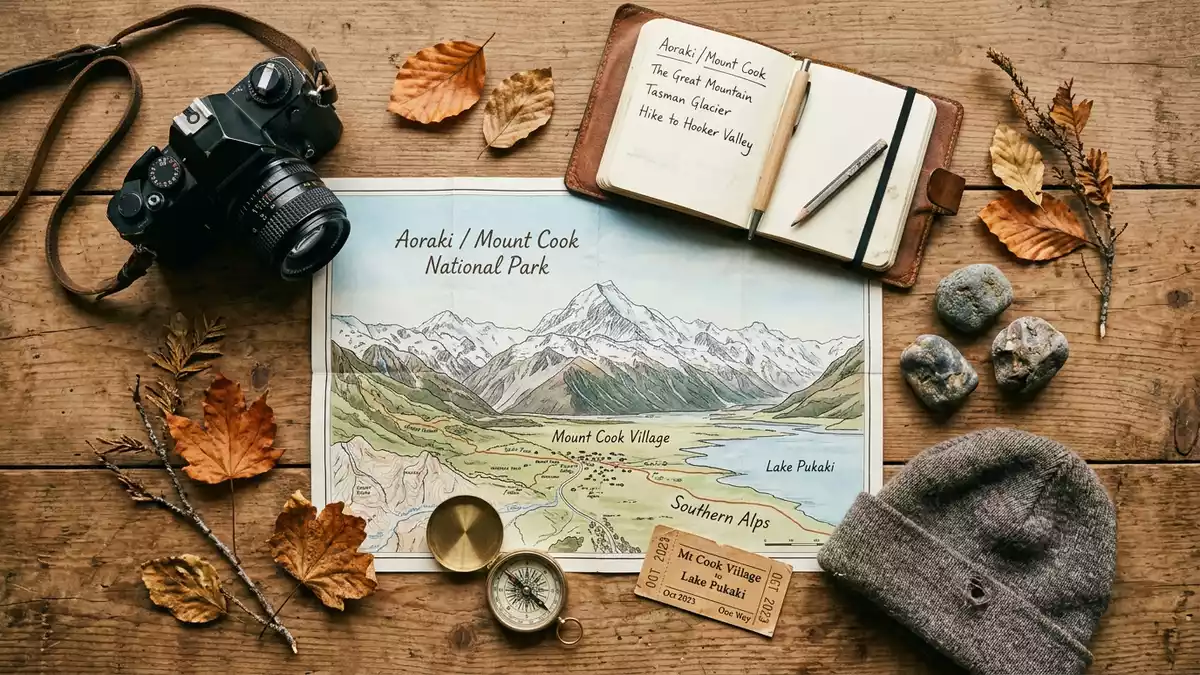
Aoraki / Mount Cook, above Mount Cook Village on the South Island of New Zealand, is the country’s highest mountain and the centrepiece of a striking alpine landscape shaped by ice, rock and steep relief.highest mountain in New Zealand
An alpine giant in the Southern Alps
Aoraki / Mount Cook rises within the Southern Alps / K? Tiritiri o te Moana, a mountain chain that runs along the spine of New Zealand’s South Island and carries a dense cluster of high summits.Southern Alps / K? Tiritiri o te Moana The peak stands at more than 3,700 m (over 12,100 ft), its upper slopes permanently clad in snow and ice, with steep faces dropping into glacial valleys on either side.3,724 m (12,218 ft)
The mountain has three principal summits arranged along a ridge, and it is flanked by major glaciers including the Hooker Glacier to the west and the Tasman Glacier to the east.three peaks on its summit ridge The M?ori name “Aoraki”, sometimes rendered “Aorangi”, is associated with the idea of a “cloud piercer”, and the mountain’s high, sharp profile often rises into bands of cloud along the range.M?ori name Aoraki
Aoraki / Mount Cook National Park and Mount Cook Village
The mountain sits inside Aoraki / Mount Cook National Park, a protected area in the Canterbury Region that was established in 1953 and shares its western boundary with Westland Tai Poutini National Park along the main divide of the Southern Alps.national park in the Canterbury Region The park covers about 707 km² (273 mi²), with more than a third of its surface under permanent snow and glacial ice, and includes a concentration of peaks above 3,000 m (9,843 ft).area and snow cover
Mount Cook Village, officially named Aoraki / Mount Cook, lies at the end of State Highway 80 inside the national park, a short distance south of the summit across the valley floor.village at the end of State Highway 80 It is a compact settlement of accommodation and services clustered beneath high walls of rock and ice, with views along the Hooker and Tasman valleys and access to walking tracks, alpine routes and guided excursions that radiate from the valley into the surrounding mountains.
Ice, rock and deep time in the Aoraki region
The wider Aoraki / Mount Cook region is marked by long valley glaciers, rugged ridges and moraines that record the advance and retreat of ice over geological time.glaciers and ridges The Tasman Glacier, among the largest in New Zealand, flows down the eastern side of the range, while other glaciers such as the Hooker, Godley and Murchison occupy hanging valleys and feed rivers that run towards the plains.Tasman, Godley and Murchison rivers
Rocks in the national park mainly date from the Permian to Triassic periods, roughly between 300 million and 200 million years ago, and have been folded, faulted and uplifted during successive phases of mountain building known collectively as the Kaikoura Orogeny.Permian to Triassic age rocks The park forms part of the broader Te Wahipounamu – South West New Zealand area, which has been recognised as a UNESCO World Heritage site for its outstanding natural landscapes, ecological processes and intact glacial landforms.Te Wahipounamu World Heritage area
Visiting Aoraki / Mount Cook: what travellers from Western Europe should know
- Aoraki / Mount Cook and Mount Cook Village lie in the central-west part of New Zealand’s South Island, reached by road along State Highway 80 from the shore of Lake Pukaki in the Mackenzie Basin.
- Walking routes around the village include valley tracks with formed paths and bridges, but higher terrain involves steep slopes, loose rock and snow, and access to the upper mountain is reserved for experienced climbers.
- In winter and early spring, snow can reach down to the valley floor and ice may affect tracks, while in summer the high alpine areas retain year-round snow and exposed rock.
- The official language is English and the currency is the New Zealand dollar.
- Entry requirements depend on your nationality; UK travellers can check the FCDO travel advice at gov.uk/foreign-travel-advice, Irish travellers the Department of Foreign Affairs at ireland.ie.
Searching for Aoraki / Mount Cook on social platforms
These links open searches for Aoraki / Mount Cook on each platform.
Frequently asked questions about Aoraki / Mount Cook
Where is Aoraki / Mount Cook in New Zealand?
Aoraki / Mount Cook stands in the Southern Alps on the South Island, within Aoraki / Mount Cook National Park in the Canterbury Region, above Mount Cook Village.
What should visitors expect on a visit to Aoraki / Mount Cook and Mount Cook Village?
Visitors encounter a high alpine environment with snow-capped peaks, valley glaciers, braided rivers and walking tracks ranging from short valley routes to more demanding alpine approaches.
What makes Aoraki / Mount Cook distinctive compared with other mountains?
The mountain combines the highest elevation in New Zealand with steep glaciated faces, a three-peaked summit ridge and a setting inside a national park that forms part of the Te Wahipounamu World Heritage area.


