
Aoraki / Mount Cook and the alpine world of Mount Cook Village
Published on 09/14/2026 at 15:21 | Editorial responsibility: Rafael Müller, Editor-in-Chief AD HOC NEWS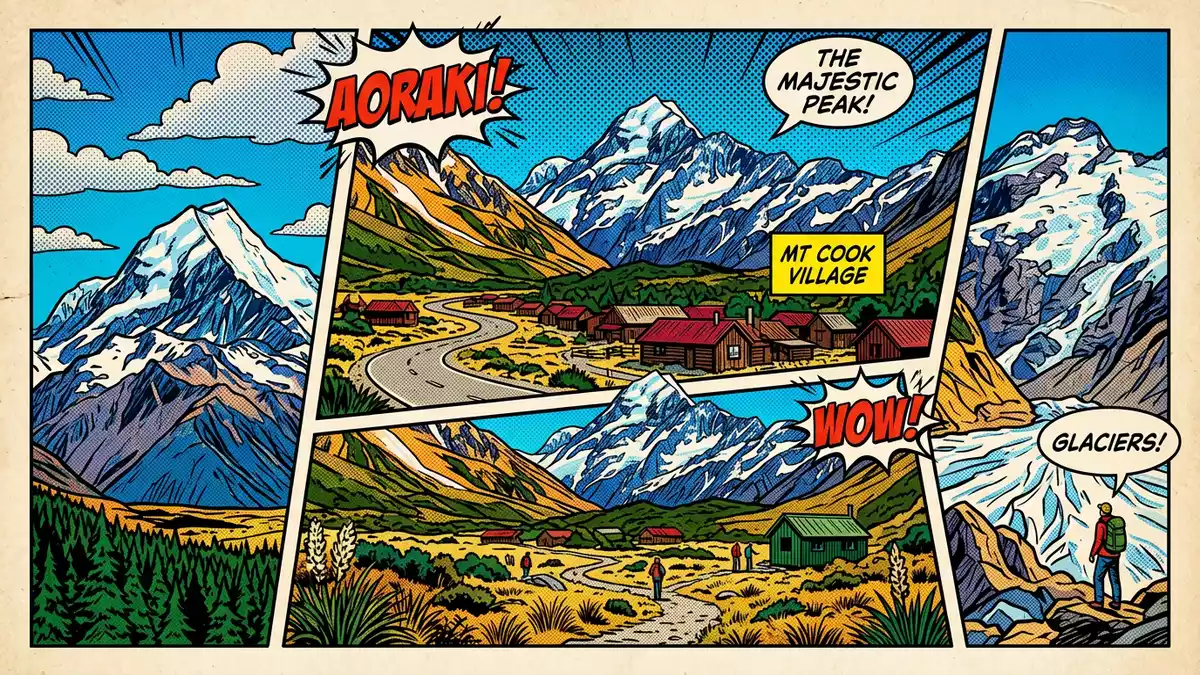
Aoraki / Mount Cook, rising above Mount Cook Village in New Zealand’s Southern Alps, is the country’s highest mountain and the focal point of a remarkably concentrated alpine landscape. The mountain stands within Aoraki / Mount Cook National Park, part of the broader Te W?hipounamu – South West New Zealand World Heritage Area, and anchors a setting where rock, ice and sky meet at close quarters.
The highest peak in New Zealand’s Southern Alps
Aoraki / Mount Cook stands in the central-west of New Zealand’s South Island, on the main crest of the Southern Alps / K? Tiritiri o te Moana that run the length of the island.Southern Alps location The peak is permanently snow-clad, rising above a cluster of high summits that form one of the most dramatic sections of the range. Aoraki / Mount Cook consists of several summits aligned along a narrow ridge, with the High Peak forming the mountain’s highest point.multiple summits on one ridge
The mountain’s elevation has been reported just over 3,720 m (around 12,200 ft), making it the highest point in New Zealand and the pinnacle of the national mountaineering scene.highest mountain in New Zealand Surrounding peaks also reach above 3,000 m (9,843 ft), creating a skyline of jagged rock and steep faces that fall away into glaciated valleys. The height and steepness of Aoraki / Mount Cook have made it a central training ground for climbers, and its profile is visible from long distances across the Mackenzie Basin, where the low foreground emphasises the scale of the mountain wall.
Aoraki / Mount Cook National Park: glaciers and high valleys
The wider landscape around Aoraki / Mount Cook is protected as Aoraki / Mount Cook National Park, established in 1953 in the Canterbury Region of the South Island.national park established in 1953 The park extends along the crest of the Southern Alps for several tens of kilometres, enclosing valleys carved by glaciers and flanked by high ridges. Its area is documented at more than 700 km² (270 sq mi), and within that footprint lie nineteen peaks over 3,000 m and a dense network of glaciers that cover a large share of the park’s surface.high peaks and extensive glaciers
Among these glaciers, the Tasman Glacier on the eastern side and the Hooker Glacier to the west of Aoraki / Mount Cook stand out for their length and their role in shaping the valleys.Hooker and Tasman glaciers The park forms part of Te W?hipounamu – South West New Zealand, a UNESCO World Heritage area recognised for its alpine landforms, glacial systems and relatively intact ecosystems.World Heritage designation Within this protected landscape, valleys such as the Hooker Valley lead towards the base of the high peaks, with walking tracks bringing visitors within sight of the mountain faces, the glacier fronts and the milky blue lakes that collect meltwater and glacial silt.
Mount Cook Village: a settlement at the end of the road
Mount Cook Village, officially also known as Aoraki / Mount Cook, sits within the national park at the end of State Highway 80.village at the end of State Highway 80 The road runs along the shore of Lake Pukaki and then into the valley, terminating close to the cluster of buildings that form the settlement. Statistics New Zealand describes Mount Cook Village as a rural settlement with a compact land area, and its permanent population has been recorded in the low hundreds, reflecting its role as a small base for visitors and staff rather than as a large town.rural settlement with small population
The village includes accommodation, visitor facilities and services linked to the national park, set against a backdrop of steep valley walls and high summits. From the settlement, short approaches lead towards trailheads such as the start of the Hooker Valley Track and other walks that explore moraine, river flats and viewpoints over the surrounding glaciers.accessible day walks in the park The proximity of Mount Cook Village to the main alpine valleys gives the area a distinctive character: everyday amenities stand within sight of icefalls and buttresses, and the transition from village street to mountain track is a short one.
Visiting Aoraki / Mount Cook: what travellers from Western Europe should know
- Aoraki / Mount Cook and Mount Cook Village lie in the central-western part of New Zealand’s South Island, at the end of State Highway 80 which branches from the road network near Lake Pukaki.
- The terrain around the village and within Aoraki / Mount Cook National Park is alpine, with steep valley sides, glaciated basins and walking tracks that can involve uneven ground and sustained gradients.
- Within sight of Aoraki / Mount Cook are major glaciers such as the Tasman Glacier and Hooker Glacier, reached by approaches that begin near Mount Cook Village and follow valley floors and moraines.
- The official language is English and the currency is the New Zealand dollar.
- Entry requirements depend on your nationality; UK travellers can check the FCDO travel advice at gov.uk/foreign-travel-advice, Irish travellers the Department of Foreign Affairs at ireland.ie.
Searching for Aoraki / Mount Cook on social platforms
These links open searches for Aoraki / Mount Cook on each platform.
Frequently asked questions about Aoraki / Mount Cook
Where is Aoraki / Mount Cook and Mount Cook Village located?
Aoraki / Mount Cook and Mount Cook Village are in Aoraki / Mount Cook National Park in the central-west of New Zealand’s South Island, within the Southern Alps.
What should visitors expect on a visit to Aoraki / Mount Cook?
Visitors encounter a high alpine landscape of steep peaks, extensive glaciers and glacial valleys, with walking tracks and viewpoints starting near Mount Cook Village.
What makes Aoraki / Mount Cook distinctive among mountain destinations?
Aoraki / Mount Cook combines the country’s highest summit with a dense concentration of 3,000 m peaks and glaciers in a relatively compact, protected national park setting.


