
Aoraki / Mount Cook above the glacier valleys of Mount Cook Village
Published on 09/07/2026 at 16:12 | Editorial responsibility: Rafael Müller, Editor-in-Chief AD HOC NEWS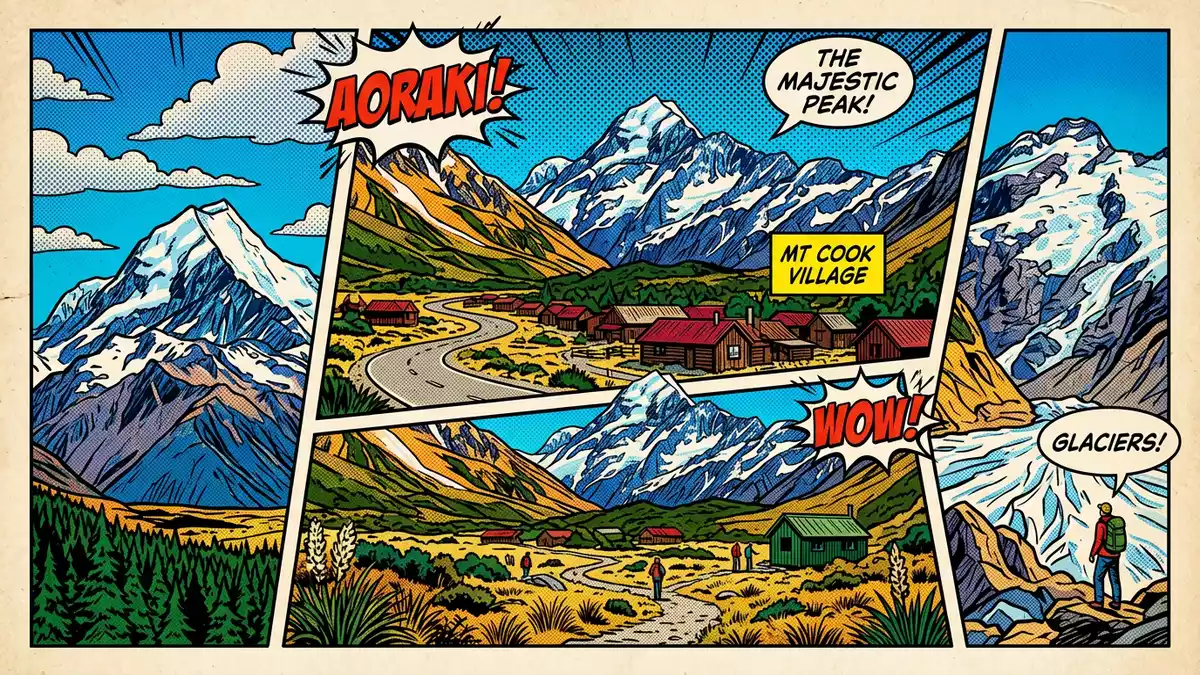
Aoraki / Mount Cook is New Zealand’s highest mountain, a permanently snow-clad summit rising above the alpine settlement of Mount Cook Village and the glacier valleys of the Southern Alps.
An alpine giant in the Southern Alps
The mountain known as Aoraki / Mount Cook stands in the central-west of New Zealand’s South Island, within the crest of the Southern Alps, K? Tiritiri o te Moana. Its summit reaches 3,724 m (12,218 ft), making it the highest point in the country and a dominant feature of the surrounding range.New Zealand’s highest mountain The peak forms part of a chain of ridges and faces that drop towards the Hooker valley on one side and towards the broad Tasman valley on the other.
Aoraki / Mount Cook is flanked by major valley glaciers, including Hooker Glacier to the west and Tasman Glacier to the east, which carve long troughs through the Southern Alps and feed milky glacial lakes on the valley floors.Hooker and Tasman glaciers The mountain itself has three named summits: from south to north, a lower peak, a middle peak and the high peak, creating a serrated skyline that is easily recognised from the valleys below.three main summits
Aoraki / Mount Cook National Park and Mount Cook Village
Aoraki / Mount Cook stands at the heart of Aoraki / Mount Cook National Park, a protected alpine area in the Canterbury Region that was established in 1953 and covers more than 700 km² (270 mi²).national park in Canterbury The park forms part of the wider Te W?hipounamu – South West New Zealand World Heritage Area, recognised for its combination of high peaks, extensive glaciers and glacially carved valleys.World Heritage area
Mount Cook Village, officially Aoraki / Mount Cook, lies within the national park on the floor of the Hooker valley, near the terminus of State Highway 80. The settlement is positioned south of the mountain’s summit and serves as a base for alpine guiding, walking and scenic excursions into the surrounding valleys and ridges.village within the park From the village, steep valley sides rise towards snowfields and hanging glaciers, with Aoraki / Mount Cook visible as a prominent peak at the head of the valley in clear weather.
Summits, glaciers and climbing history
Aoraki / Mount Cook has long been a focus for mountaineering on the South Island. The first recorded ascent of the high peak was made in 1894 by New Zealand climbers Tom Fyfe, George Graham and Jack Clarke, a milestone in the country’s alpine history.first ascent in 1894 Later generations of climbers, including Sir Edmund Hillary, used the mountain and its surrounding peaks to build experience for expeditions to higher ranges abroad.training ground for climbers
The wider park holds numerous peaks that exceed 3,000 m (9,843 ft), creating a skyline of jagged ridges and ice-covered faces that frame Aoraki / Mount Cook as the highest summit among them.peaks over 3,000 m Glaciers occupy a substantial portion of the park’s area, extending down-valley from the accumulation zones beneath the main crest and leaving moraines, outwash plains and glacial lakes that visitors can see from valley tracks and viewpoints.glaciers covering much of the park
Visiting Aoraki / Mount Cook: what travellers from Western Europe should know
- Aoraki / Mount Cook and Mount Cook Village lie in the central-west of New Zealand’s South Island in the Canterbury Region, reached by State Highway 80 from the shores of Lake Pukaki.
- The terrain around the village and in the national park is mountainous, with steep valley sides, alpine paths and sections of track that include sustained gradients and staircases.
- Glacial features such as moraines, lakes fed by meltwater and exposed rock are prominent near the main walking areas, and weather conditions in the high mountains can change rapidly.
- The official languages of the country are English and te reo M?ori, and the currency is the New Zealand dollar.
- Entry requirements depend on your nationality; UK travellers can check the FCDO travel advice at gov.uk/foreign-travel-advice, Irish travellers the Department of Foreign Affairs at ireland.ie.
Searching for Aoraki / Mount Cook on social platforms
These links open searches for Aoraki / Mount Cook on each platform.
Frequently asked questions about Aoraki / Mount Cook
Where is Aoraki / Mount Cook located?
Aoraki / Mount Cook stands in the Southern Alps of New Zealand’s South Island, within Aoraki / Mount Cook National Park in the Canterbury Region.
What can visitors expect when staying in Mount Cook Village?
Visitors staying in Mount Cook Village find a small alpine settlement surrounded by steep-sided valleys, glacier-fed lakes and tracks that lead towards views of Aoraki / Mount Cook.
What makes Aoraki / Mount Cook distinctive among New Zealand’s mountains?
It is the country’s highest peak, rising above a concentration of other three-thousand-metre summits and major valley glaciers within a protected national park and World Heritage landscape.


