
Antigua Guatemala and its grid of Baroque ruins
Published on 08/25/2026 at 20:23 | Editorial responsibility: Rafael Müller, Editor-in-Chief AD HOC NEWS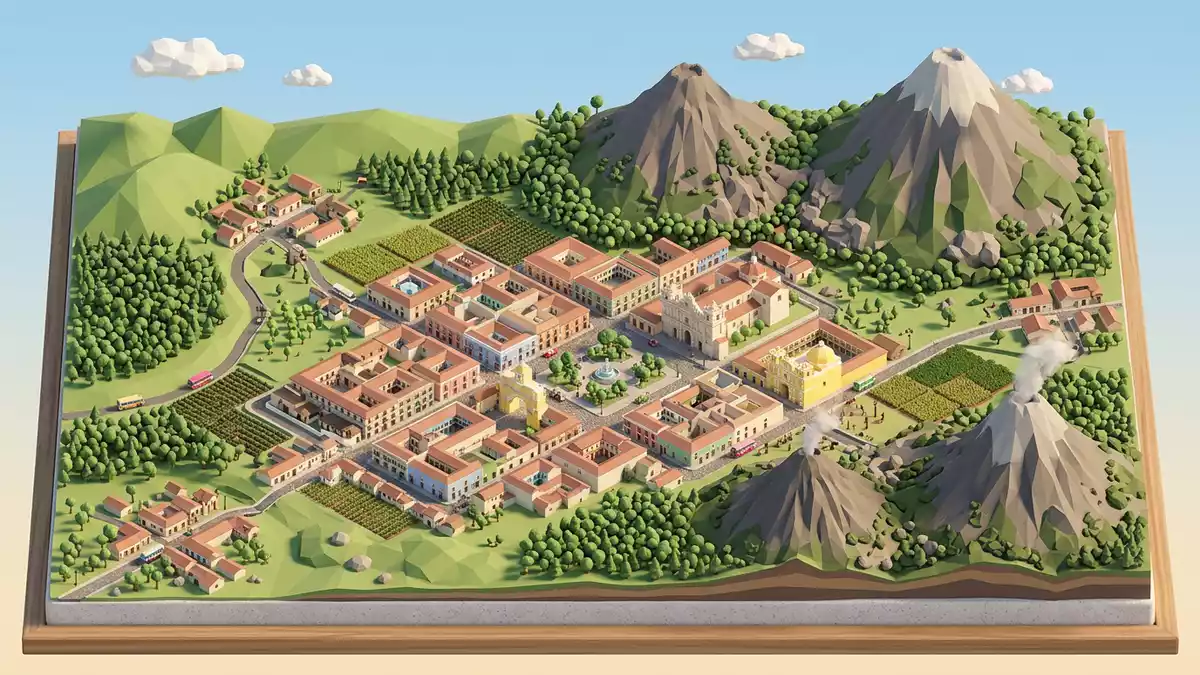
Antigua Guatemala is a colonial city in the Guatemalan highlands, built on a Renaissance-inspired grid and recognised by UNESCO in 1979. Its streets, plazas and ruined churches make the layout as legible as the stonework.
Antigua Guatemala’s grid of churches and ruins
The city was founded in 1543 as Santiago de Guatemala, and its historic core still follows the street grid dating from that year. UNESCO notes the Baroque monuments and church remains that define the townscape, together with the urban plan itself.1543 grid plan
Many of the surviving monuments belong to the seventeenth and eighteenth centuries, when the city served as the capital of the Captaincy-General of Guatemala. The architecture mixes civic buildings, monasteries and churches, and the ruined parts sit beside later repairs and intact façades.Captaincy-General capital
Barroco antigueño in stone and stucco
The local version of Baroque architecture is often called Barroco antigueño, and it appears in thick walls, low bell towers and elaborate stucco surfaces. UNESCO also describes the city as lying at about 1,500 m above sea level in an earthquake-prone region.1,500 m above sea level
That setting is part of the visible character of the place, from the weathered masonry to the broad plazas and arcades. The city’s monument list includes the Cathedral, Las Capuchinas, La Merced and other churches and convents that frame the centre.the Cathedral
Antigua Guatemala and the volcanic horizon
The skyline is dominated by Volcán de Agua, while the historic town sits in a basin-like valley of streets, plazas and low buildings. The contrast between the compact city plan and the high volcanic backdrop is one of the clearest visual features of the place.
Antigua Guatemala was largely damaged by the 1773 earthquake, and the surviving monuments remain part of its identity. The property was inscribed as a UNESCO World Heritage Site, and the city’s protected centre preserves a rare continuity between plan, ruins and living urban fabric.World Heritage Site
Visiting Antigua Guatemala: what travellers from Western Europe should know
- The city lies in Sacatepéquez, west of Guatemala City. It is reached by road from the capital and by the main routes across the central highlands.
- The historic centre is flat, with cobbled streets, plazas and many low buildings. Church ruins and convent compounds give several streets a broken, uneven edge.
- English is not an official language. The official language is Spanish and the currency is the Guatemalan quetzal.
- The city is backed by volcanic peaks, including Volcán de Agua. Their presence is visible from many streets and squares.
Searching for Antigua Guatemala on social platforms
These links open searches for Antigua Guatemala on each platform.
Frequently asked questions about Antigua Guatemala
Where is Antigua Guatemala?
It is in the central highlands of Guatemala, west of Guatemala City. The historic centre lies below the volcanic slopes of the region.
What can be expected on a visit?
The city offers a compact colonial centre with churches, ruins, arcades and plazas. Its streets are easy to read because the original grid remains visible.
What makes Antigua Guatemala distinctive?
Its distinction lies in the combination of a 1543 urban plan, Baroque ruins and a highland volcanic setting. UNESCO recognises it for that historic city fabric.


