
Antelope Canyon’s sculpted sandstone corridors near Page
Published on 08/28/2026 at 22:40 | Editorial responsibility: Rafael Müller, Editor-in-Chief AD HOC NEWS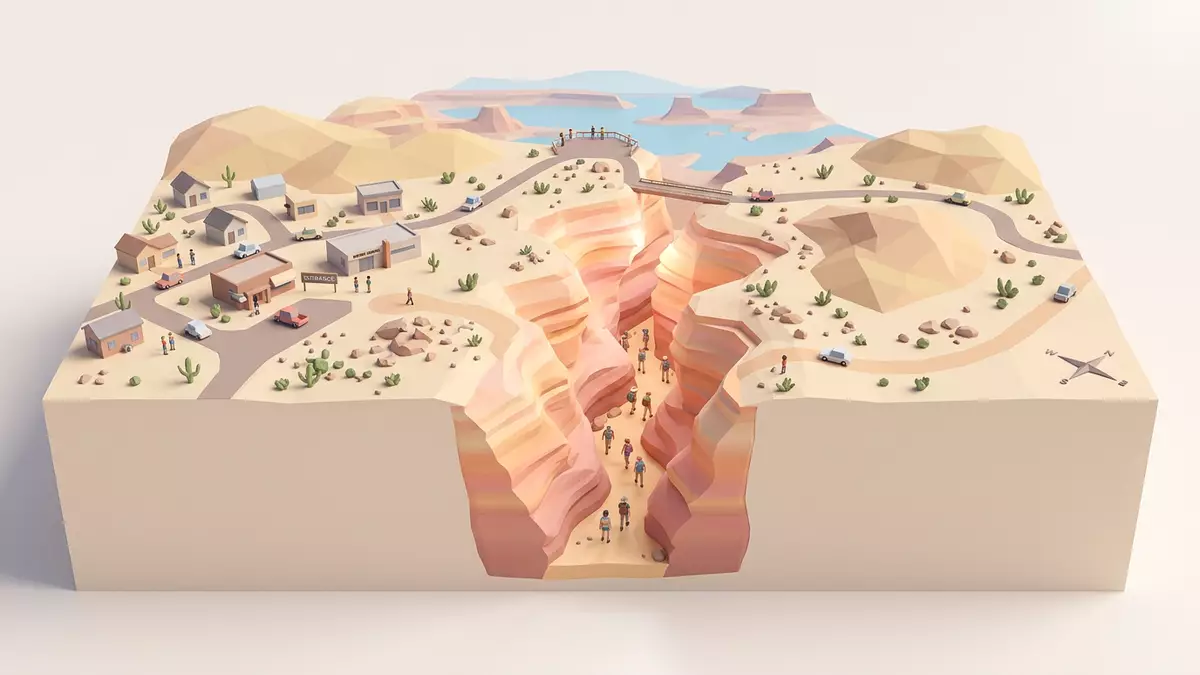
Antelope Canyon east of Page in northern Arizona is a narrow sandstone gorge where sculpted walls, carved over millions of years, turn desert rock into flowing forms of light and shadow. Set on Navajo Nation land, it is divided into distinct sections cut through Navajo Sandstone, a Jurassic-aged formation whose layered colours and textures define every turn of the canyon.
A Navajo Sandstone slot canyon in the high desert
Antelope Canyon is a slot canyon in the American Southwest, formed as rainwater drains through a basin above Page and cuts into Navajo Sandstone on the Navajo Nation reservation. The rock itself is part of a broad Jurassic-era sandstone unit that underlies much of the Colorado Plateau and is characterised by pale reds and oranges, visible in the canyon’s smooth surfaces.Navajo sandstone dominates the walls, preserving traces of ancient desert dunes in its sweeping lines and subtle cross-bedding.
Within this rock, Antelope Canyon descends to depths of around 37 m (120 ft), separating the canyon floor from the desert surface above.Eroded sandstone walls up to 120 feet high enclose passages that are significantly deeper than they are wide, a defining feature of slot canyons across the region. The sandstone is estimated to date from between 8 and 60 million years, while the canyon itself reflects countless cycles of flash flooding that have smoothed hard edges and carved undulating corridors.Age estimates for the sandstone place it within a long geological story of dune fields turned to rock.
Upper and Lower Antelope: two expressions of the same canyon
Antelope Canyon is best known through two main sections, Upper Antelope Canyon and Lower Antelope Canyon, which cut through the same sandstone on opposite sides of a wash. Upper Antelope, reached at ground level, is a relatively short but continuous corridor where visitors walk on flat sand beneath high walls and a narrow opening above.Descriptions of the upper section emphasise its compact length and the way light enters from above.
Lower Antelope Canyon lies across the highway towards Lake Powell and is reached by descending into the rock through stairs and ladders bolted to the canyon walls.Accounts of access to Upper and Lower Antelope describe the lower section as more physically demanding, with a route that twists through narrower spaces and changes level more frequently. Both sections share the same Navajo Sandstone geology and both display the characteristic “flowing” shapes carved by flash floods, yet the contrast between walking in at surface level and climbing through a more intricate path gives each its own character.Comparisons between upper and lower canyons underline how two nearby slot canyons can express the same rock in different ways.
Light, colour and Navajo names
The experience of Antelope Canyon is defined by how light filters into the narrow spaces, catching suspended dust and revealing the colours of the sandstone. In Upper Antelope Canyon, the opening far above the floor admits shafts of sunlight that reach down into the darker interior, creating distinct beams at certain positions and times of year.Descriptions of illuminated sandstone corridors mention the way red sandstone formations are dramatically lit from above, while the walls of Lower Antelope display striations and curves that catch more diffuse light from the wider top.
Navajo names reflect the relationship between water, rock and form. Upper Antelope Canyon is known as Tse’ bighanilini, translated as “the place where water runs through rocks”, and Lower Antelope Canyon as Hasdestwazi, often rendered as “spiral rock arches”.Navajo names and translations encapsulate in a few words the processes that sculpted the canyon and the shapes seen in its corridors. The walls themselves display layers of sediment and mineral deposits, creating bands of colour that range from pale beige to deep orange.Geological notes on striations and colours show how different layers in the sandstone respond to erosion.
Visiting Antelope Canyon: what travellers from Western Europe should know
- Antelope Canyon lies a short distance east of Page in northern Arizona, on Navajo Nation land near State Route 98; approaches start from the outskirts of Page.
- The canyon passages are narrow and uneven underfoot, and the Lower Antelope section involves climbing stairs and ladders fixed to sandstone walls.
- The surrounding landscape is high desert at elevations of around 1,200 m (about 4,000 ft), with exposed approaches across sandy washes and little natural shade.
- The official language is English and the currency is the United States dollar.
- Entry requirements depend on your nationality; UK travellers can check the FCDO travel advice at gov.uk/foreign-travel-advice, Irish travellers the Department of Foreign Affairs at ireland.ie.
Searching for Antelope Canyon on social platforms
These links open searches for Antelope Canyon on each platform.
Frequently asked questions about Antelope Canyon
Where is Antelope Canyon?
Antelope Canyon is in northern Arizona on Navajo Nation land east of Page, close to State Route 98 and not far from Lake Powell.
What should visitors expect inside the canyon?
Inside Antelope Canyon, visitors walk or climb through narrow sandstone corridors, with light filtering from above and walls rising tens of metres on either side.
What makes Antelope Canyon distinctive among desert landscapes?
Antelope Canyon stands out for its slot canyon form, its Navajo Sandstone walls up to about 37 m (120 ft) high, and its named upper and lower sections with contrasting layouts.


