
Anping Gubao in Tainan, Taiwan’s layered coastal fort
Published on 09/09/2026 at 21:13 | Editorial responsibility: Rafael Müller, Editor-in-Chief AD HOC NEWS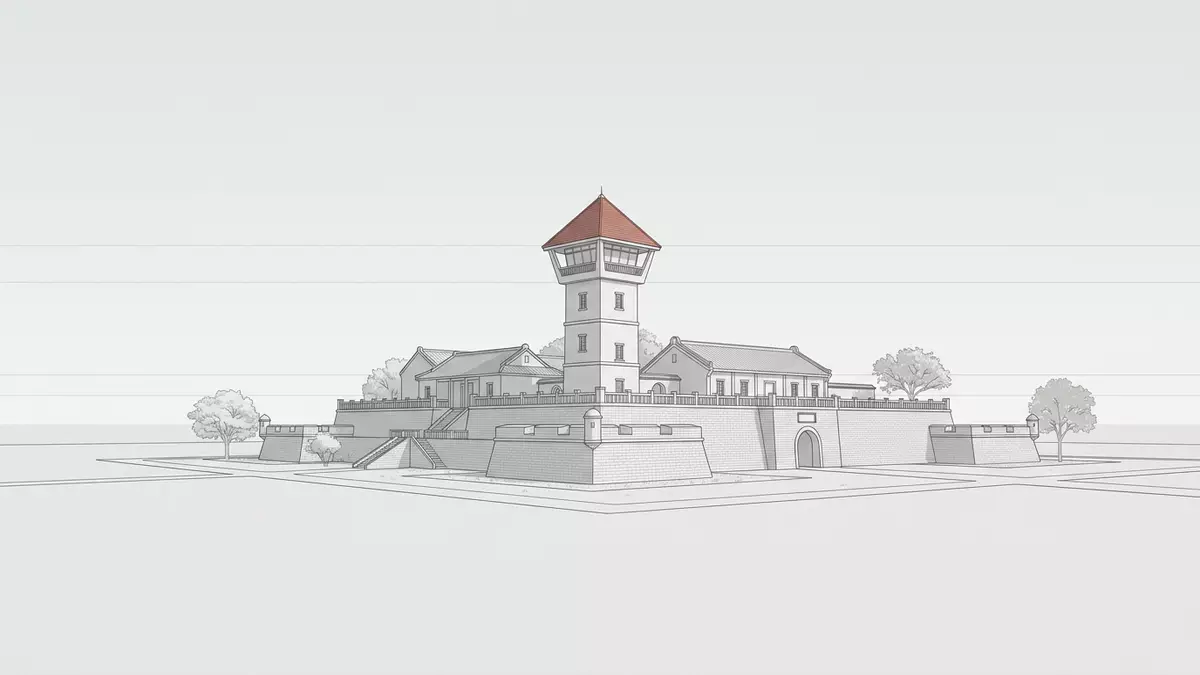
Anping Gubao in Tainan, Taiwan, is the present-day name for the former Dutch fortress known as Fort Zeelandia, a coastal stronghold whose layered fort remains now form a compact heritage site in Anping District. Built by the Dutch East India Company in the seventeenth century and later reshaped under Ming, Qing and Japanese administrations, the fort’s brick platforms and earth walls give a concentrated view of how this corner of Taiwan’s south-western coast has been contested and rebuilt across centuries.
Anping Gubao and the Dutch East India Company
The story of Anping Gubao begins in the early seventeenth century, when the Dutch East India Company established a base on Taiwan’s south-western shoreline to secure regional trade routes and a foothold in East Asia. In 1624 the company started building a fortress on the sandy peninsula at Anping, a structure recorded under its Dutch name Fort Zeelandia, and by 1634 the main fortification was completed as a brick-built stronghold facing the Taiwan Strait.
The Dutch laid out Fort Zeelandia as a walled compound raised above the surrounding ground, with ramparts and bastions enclosing administrative and storage buildings for the trading operation. Over this period Anping developed into a settlement tied closely to the fortress, as traders, soldiers and workers moved into the area around the stronghold.Anping Old Fort is described as a Dutch-built fortress and the Dutch presence in Tainan shaped local patterns of commerce and contact with indigenous communities along the coast.
Siege, changing rulers and surviving walls
In the 1660s Dutch control over Fort Zeelandia came under direct challenge from Zheng Chenggong, better known in Western sources as Koxinga, a Ming loyalist commanding naval forces from bases along the Chinese coast. In 1661 his forces laid siege to the fortress at Anping, surrounding the Dutch garrison with warships and troops and cutting the stronghold off from outside support.Accounts of the siege describe months of fighting before a Dutch surrender in 1662, after which Koxinga established his own regime based at Tainan.
Under Koxinga and the Kingdom of Tungning, the former Dutch fort took on a new identity as Anping Castle, with Chinese-style administrative buildings introduced around and on top of the older colonial foundations.Later Qing and Japanese periods saw further damage to the original Dutch structures, both through coastal erosion and the reuse of bricks for other projects. By the twentieth century, after Japanese rule and the arrival of the Republic of China authorities, only parts of the seventeenth-century fort walls remained, and these fragments were incorporated into a heritage-style fort layout with brick platforms and a tower overlooking the district.
A compact heritage fort above Anping’s streets
The Anping Gubao that visitors see now is a small fort park raised above surrounding streets, combining surviving sections of seventeenth-century wall with later brickwork terraces, stairways and commemorative structures. The Chinese name “Anping Gubao” literally means “Anping Old Fort”, and the site’s designation reflects its role as a longstanding landmark within the historic district.Municipal heritage listings recognise Anping’s fort sites as historic assets, and the complex stands among narrow streets where older shop houses and colonial-era merchant residences recall the area’s trading past.
Within the grounds, visitors encounter layered materials that speak to different periods of construction and repair. Lower walls and rampart lines follow the outline of the Dutch-era fortification, while upper platforms carry later red-brick structures, including a square tower that gives views across Anping District and towards the harbour. Courtyards hold plaques and small monuments describing the site’s role under successive regimes, and mature trees edge the walkways and steps connecting the various levels. Around the fort park, Anping’s streets retain their historic pattern, with alleys and commercial frontages forming what is widely known as Anping’s old streets, an urban setting that makes the fort feel closely tied to everyday neighbourhood life.Descriptions of Anping Gubao Ancient Street refer to these as some of Taiwan’s oldest streets, and the proximity between the fort and these lanes reinforces the sense of continuity between commerce and defence.
Visiting Anping Gubao: what travellers from Western Europe should know
- Anping Gubao stands in Anping District on the western side of Tainan, on Taiwan’s south-western coast. It is reached by city buses and urban roads from central Tainan, with the fort entrance on Guosheng Road.
- The fort occupies a raised platform above nearby streets, with stairways and steps linking its different levels. Moving between terraces involves walking up and down these stairs rather than using lifts.
- The surrounding area includes Anping’s historic streets lined with traditional shop houses and merchant buildings, so a visit to the fort can easily be combined with exploring the immediate neighbourhood on foot.
- The official language is Chinese and the currency is the New Taiwan dollar.
- Entry requirements depend on your nationality; UK travellers can check the FCDO travel advice at gov.uk/foreign-travel-advice, Irish travellers the Department of Foreign Affairs at ireland.ie.
Searching for Anping Gubao on social platforms
These links open searches for Anping Gubao on each platform.
Frequently asked questions about Anping Gubao
Where is Anping Gubao in Tainan?
Anping Gubao stands in Anping District on the western side of Tainan, close to the city’s harbour areas on Taiwan’s south-western coast and accessed from Guosheng Road.
What can visitors expect at Anping Gubao?
Visitors encounter a compact fort park with layered brick and earth walls, elevated terraces, stairways, a tower structure and small monuments, all set above adjoining historic streets.
What makes Anping Gubao distinctive among Taiwan’s historic sites?
Anping Gubao combines Dutch seventeenth-century fort foundations with later Chinese and Japanese-era structures, giving a rare concentration of colonial and local influences within a single coastal fort complex.


